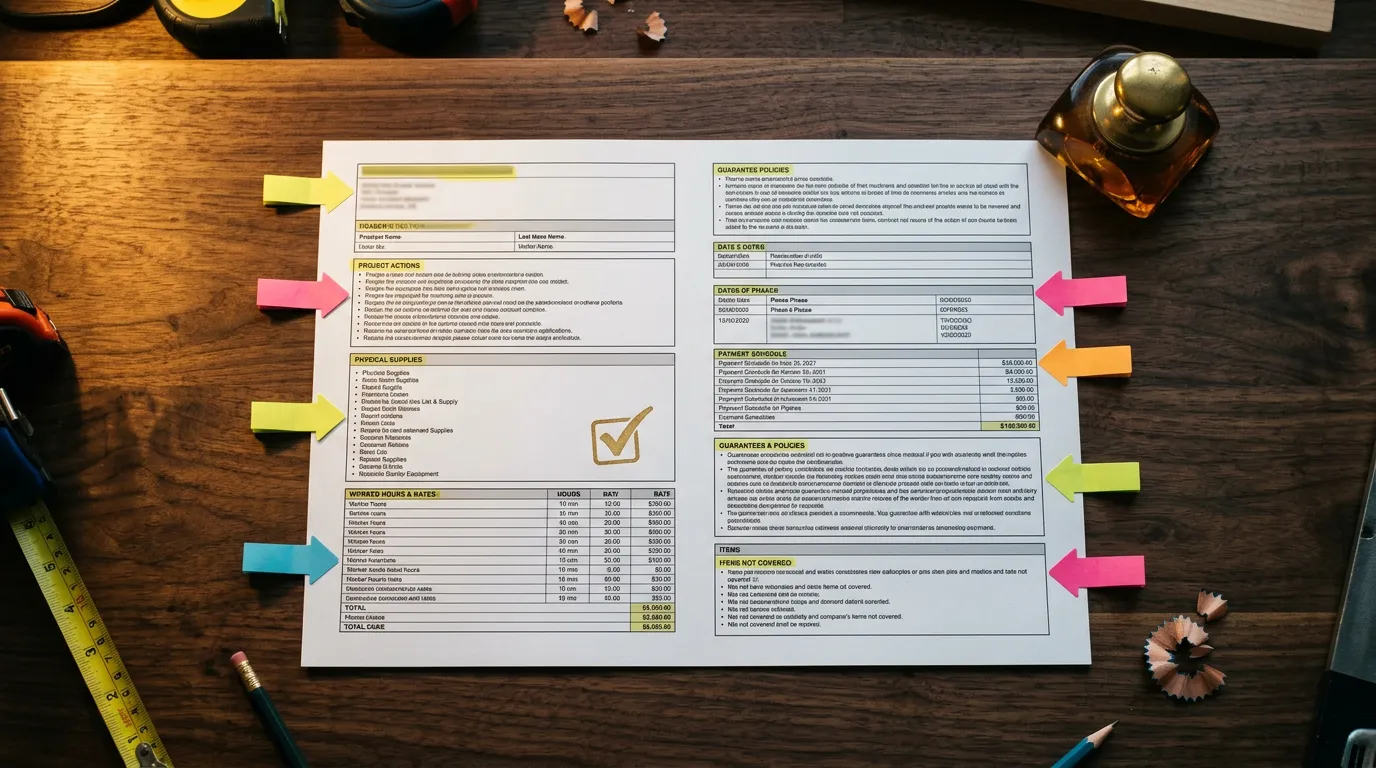
What Should a Builder's Quote Include? The Full Checklist
Got a builder's quote but not sure if it covers everything? Here's the 15-point checklist, plus the items most builders deliberately leave out.
You've got a quote back from a builder. It's a PDF, maybe a page or two, with a number at the bottom. Looks official enough. But is it actually any good?
In short: A builder's quote should include a detailed scope of works, itemised labour and material costs, start and completion dates, a payment schedule, VAT breakdown, insurance details, and a clear list of exclusions. If any of these are missing, ask before you accept.
A surprising number of builder quotes are missing key details. Not because most builders are trying to hide anything, but because there's no standard format. Understanding the difference between a quote and an estimate is the first step to knowing what you should expect. Some builders write two pages. Others write twenty. The problem is knowing what should be there so you can spot what isn't.
For a downloadable checklist you can use while reviewing, see our Red Flags in Builder Quotes resource. Here's the full list.
The 12 things every quote should have
1. The builder's details
Name, address, phone number, email. If they're a limited company, the company registration number. If they're a sole trader, their full name.
This sounds obvious. But we've seen quotes that are literally just a price list on a blank sheet. No letterhead, no contact details, nothing. If a builder can't put their name to it, that's a problem.
2. Your details and the project address
The quote should say who it's for and where the work is happening. If you're getting quotes for a rental property, make sure the address on the quote matches the site - not your home address.
3. A proper description of the work
This is the big one. The scope of works should describe every task the builder will carry out. Not "build extension" - that tells you nothing. More like:
- Excavate and pour strip foundations to building control spec
- Build blockwork walls to DPC, cavity insulation, facing brick outer leaf
- Install steel beam (RSJ) to structural engineer's design
- Flat roof with EPDM membrane and 150mm insulation
The more detail, the better. Vague scope is the number one cause of disputes. Our complete guide to what should be in a builder's quote covers every element in depth.
4. Materials and spec
What are they actually using? "Supply and fit kitchen" could mean IKEA or Howdens or Wren or bespoke joinery. The quote should tell you.
At minimum, expect:
- Type of bricks or blocks
- Window and door brands or at least quality level
- Insulation type and thickness
- Roof covering material
- Flooring type
If the quote says "materials as discussed" - get it in writing properly. Verbal agreements aren't worth the paper they're not printed on. Watch out for provisional sums too - allowances for items that haven't been fully specified yet. They're legitimate, but you need to understand what they mean for your final cost.
5. A cost breakdown
A single lump sum is legal. But it's not helpful. If the total is £65,000, you want to know how that splits across trades:
| Trade | Rough % of total |
|---|---|
| Groundworks & foundations | 15–20% |
| Masonry & structural | 20–25% |
| Roofing | 8–12% |
| Electrics | 5–8% |
| Plumbing & heating | 8–12% |
| Plastering & joinery | 8–12% |
| Kitchen/bathroom fit-out | 15–25% |
| Decoration | 3–5% |
| Prelims (scaffolding, skips, etc.) | 8–12% |
A breakdown helps you compare quotes properly. It also means you can challenge specific lines rather than arguing about the whole number. Our guide on whether your quote is too high includes per-trade benchmarks you can check against.
6. VAT status
Is the total inclusive or exclusive of VAT? If the builder is VAT-registered (turnover above £90,000), they must charge 20% VAT. That's an extra £13,000 on a £65,000 job. Our guide to VAT on building work explains the rates, exemptions, and how to check whether your builder should be charging it.
Some smaller builders aren't VAT-registered. That's fine - it's not a red flag. But you need to know either way so you can compare quotes on the same basis.
7. What's NOT included
This section matters more than most people think. Common exclusions:
- Building control fees - usually £500–£1,000
- Party wall surveyor - £700–£1,500 per neighbour
- Structural engineer's design - £500–£1,200
- Architect's drawings - £1,500–£4,000
- Utility diversions (moving gas/water mains)
- Decoration and final finishes
- Landscaping and garden reinstatement
- Temporary accommodation if needed
A quote with no exclusions section isn't necessarily better. It might just mean the builder hasn't thought about it - and if items are missing, you may face surprise price increases mid-project.
8. A payment schedule
Never pay everything upfront. A reasonable schedule looks something like:
- 10–15% deposit on signing
- 25% at foundations complete
- 25% at roof watertight
- 25% at second fix complete
- 10–15% on practical completion
Our guide to stage payments and retention explains the standard structures, how retention works, and why tying payments to milestones protects you.
Be cautious if more than 25% is due before any work starts. And avoid schedules tied to calendar dates rather than milestones - you want to pay for progress, not time.
9. Start date and how long it'll take
"We'll start in a few weeks" isn't good enough. The quote should give you:
- A proposed start date (or at least a window)
- An estimated duration
- Any assumptions (e.g. "assumes planning approval received by April")
Builders are busy. Start dates slip. But having it in writing gives you something to hold them to.
10. A validity period
Quotes should say how long the price holds. Thirty days is common. Ninety days is generous. A validity period tells you how long you have to make your mind up. It is not the thing that fixes the price.
Accepting the quote is what fixes the price. Section 50(1) of the Consumer Rights Act 2015 treats anything the builder said or wrote to you about the service as a term of the contract, where you took it into account in deciding to go ahead, and section 50(2)(b) makes a later change to it effective only where you and the builder have expressly agreed it. So once you have accepted, the quoted figure is a contract term rather than an indication, and it does not move on the builder's say-so alone.
Before you accept is where the date earns its keep. Material costs move: timber, steel, and copper have all swung 10–20% in recent years. A quote with no validity period leaves you guessing how long the figure is meant to hold, so ask for one in writing.
11. Warranty or defects period
Most builders offer a 12-month defects liability period. This means they'll come back and fix anything that goes wrong in the first year - cracking plaster, sticking doors, minor snags.
Some offer longer. Some don't mention it at all. If it's not in the quote, ask.
12. Terms and conditions
Not the most exciting reading. But the T&Cs should cover:
- How changes to the work are handled (variations)
- What happens if either side wants to cancel
- How disputes are resolved
- Insurance arrangements
If there are no terms at all, you're relying on goodwill. That works until it doesn't.
What most quotes are missing
We've analysed a lot of quotes through MyBuildAlly. The most commonly missing items are:
- Exclusions - about half of quotes don't list them at all
- Materials spec - "fit bathroom" with no mention of what bathroom
- Prelims - scaffolding, skips, and site costs often vanish
- Payment terms - just a total with no schedule
- Validity date - the quote has no expiry
None of these mean the builder is trying to overcharge you. Most builders are tradespeople, not contract administrators. They quote the way they've always quoted. But the gaps create risk for you. Once you know what's included, decide whether to go fixed price or day rate. Use our Budget Planner to map out both quoted and unquoted costs side by side.
A quick way to check yours
Go through the 12 points above with your quote open. Tick off what's there. Anything missing? Ask the builder to add it before you sign.
Or if you'd rather save the effort - upload your quote to MyBuildAlly and our AI will flag the gaps for you in under a minute. It checks scope coverage, pricing against regional benchmarks, and highlights anything that looks off.
Once the work is underway, knowing how to inspect the finished work gives you the confidence to hold your builder to the standard they quoted for.
Either way, a few minutes checking now can save you thousands later.
Was this useful?