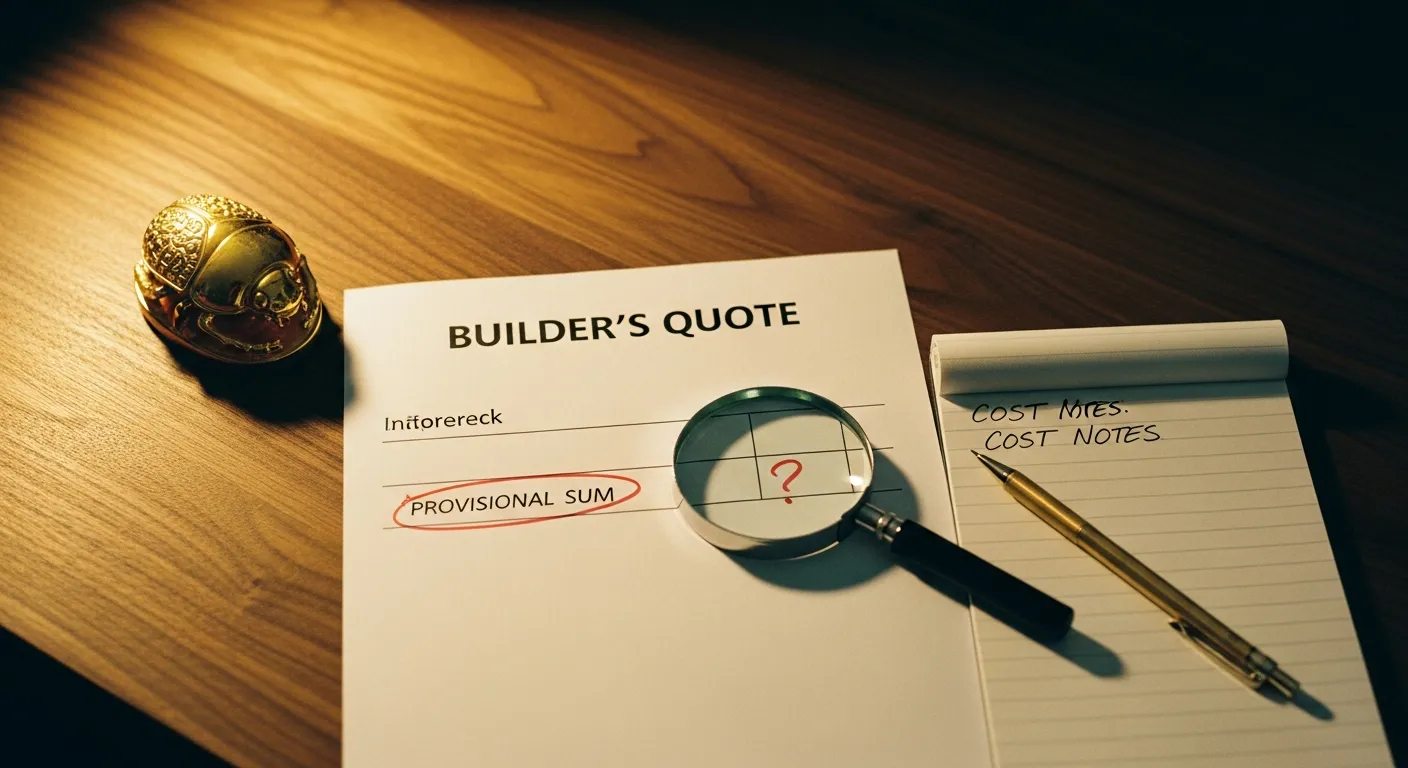
What Is a Provisional Sum? Why It Matters in Your Builder's Quote
A provisional sum is an estimated allowance for work that can't be priced exactly. Here's what homeowners need to know and how to avoid cost surprises.
You're reading through a builder's quote and everything looks clear - until you hit a line that says "Provisional Sum: £3,500 for drainage." No breakdown. No detail. Just a number and a vague description.
In short: A provisional sum is an estimated allowance in a builder's quote for work that can't be priced exactly yet. It's not a fixed price - the actual cost could be higher or lower. Every provisional sum in your quote is a potential cost overrun, so you need to understand what they are and how to manage them.
What does it mean? Should you be worried? And why is half your quote made up of them?
What is a provisional sum?
A provisional sum (sometimes shortened to "PS" or "prov sum") is an estimated amount of money included in a builder's quote to cover work that can't be priced accurately at the time of quoting. The builder knows the work will need doing, but the exact cost won't be clear until they get on site and see what they're dealing with.
Think of it as an educated guess, built into the contract price.
The term comes from formal construction contracts. JCT (Joint Contracts Tribunal) contracts, widely used on larger projects in England and Wales, provide for provisional sums, and equivalent Scottish forms are published by the Scottish Building Contract Committee. The split into defined and undefined provisional sums comes from the RICS New Rules of Measurement (NRM2), the measurement rules that contract documents refer to, rather than from the JCT conditions themselves. Most small domestic jobs are not on a JCT contract at all, but the same distinction is worth applying to any quote. We'll come back to it shortly.
The important thing to understand is this: a provisional sum is not a fixed price. When the work is actually carried out, the builder will charge you the real cost - which might be more than the provisional sum, or less. Either way, you pay the actual amount, not the estimate.
Common examples of provisional sums
Some work genuinely can't be priced until you open up a wall, dig a trench, or get a specialist on site. Here are the most common provisional sums you'll see in residential quotes:
Drainage connections - Connecting to the main sewer often involves unknowns: the depth of the existing drain, the route it takes, whether there are obstructions. Your builder can estimate, but they won't know the real cost until they dig.
Groundworks and foundations - Ground conditions vary hugely, even within the same street. One plot might need standard strip foundations at 1m deep. The next might hit clay, rock, or an old well and need piled foundations at three times the cost. See our guide on minimum foundation depths in the UK for what's typical.
Structural alterations - Removing a load-bearing wall sounds straightforward, but the size and specification of the steel beam often can't be confirmed until the structural engineer has done final calculations. The provisional sum covers the beam, its padstones, and the installation.
Specialist finishes - If you haven't chosen your kitchen, bathroom suite, or floor tiles yet, the builder might include a provisional sum as an allowance. "PS: £5,000 for kitchen supply" means they've budgeted five grand - if you choose a kitchen that costs £7,000, you pay the difference.
Asbestos removal - Common in pre-2000 properties. The builder suspects there might be asbestos in the artex ceilings or floor tiles but won't know until a survey is done. Work on textured coatings such as artex, and on asbestos floor tiles and mastic, is non-licensed work under the Control of Asbestos Regulations 2012, so it does not need a licensed contractor. Higher risk materials such as sprayed coatings, pipe lagging and asbestos insulating board do need one, and cost considerably more to remove. The provisional sum covers whichever applies once the survey confirms what is there.
Service diversions - Moving a gas main, water supply, or electricity cable that's in the way of the build. Utility companies set their own prices and timelines, so the builder can only estimate.
Defined vs undefined provisional sums
This distinction matters more than most homeowners realise.
A defined provisional sum is one where the builder has described the work in enough detail that you can assess the time and cost implications. They know what the work is - they just can't pin down the exact price. For example: "Provisional sum of £2,500 for connecting new foul drainage to the existing manhole at a depth of approximately 1.2m, including breaking out and making good."
An undefined provisional sum is vaguer. The builder knows some work will be needed but can't describe it precisely. For example: "Provisional sum of £3,000 for unforeseen groundworks." There's no description of what this actually covers.
From your perspective, defined provisional sums are far better. You can see what the money is for, get a second opinion on the amount, and hold the builder accountable if the actual cost is wildly different. Undefined provisional sums are essentially blank cheques.
If your quote has undefined provisional sums, push the builder to define them. Ask: "What specifically does this cover? What would make it cost more? What would make it cost less?"
Provisional sum vs prime cost sum
You might also see "PC Sum" or "Prime Cost Sum" in a quote. These are different from provisional sums, though they're often confused.
A provisional sum covers both the work and the materials. It's an allowance for a complete piece of work where the cost is uncertain.
A prime cost sum covers only the supply cost of a specific item - usually something you'll choose later. A PC sum of £3,000 for bathroom sanitaryware means the builder has budgeted £3,000 for the taps, basin, toilet, and shower. The labour to install them is priced separately in the main quote.
The key difference: with a prime cost sum, you control the spend by choosing the product. With a provisional sum, the cost is driven by site conditions or specialist pricing that you can't directly influence.
| Provisional sum | Prime cost sum | |
|---|---|---|
| Covers | Labour and materials | Materials/supply only |
| Who controls the cost | Largely the builder/site conditions | You (by choosing the product) |
| Common for | Drainage, groundworks, structural work | Kitchens, bathrooms, tiles, fixtures |
| Can you shop around? | Usually not - it's specialist or site-dependent | Yes - that's the point |
How many provisional sums is too many?
A well-prepared quote should have as few provisional sums as possible. Every provisional sum is a gap in the builder's knowledge - and a gap in your budget certainty.
For a typical house extension, you might reasonably see one or two provisional sums: one for drainage and one for a kitchen allowance if you haven't chosen it yet. That's normal.
If the quote has four, five, or more provisional sums, ask yourself why. Has the builder actually surveyed the site? Have they spoken to a structural engineer? Have they checked the existing drainage? A quote loaded with provisional sums often means the builder hasn't done enough homework before pricing. That's a red flag - and it's one of the signs your builder may be overcharging.
Compare it with other quotes you've received for the same work. If one builder has priced drainage as a fixed item and another has left it as a provisional sum, the first builder has done more investigation. That tells you something about their approach.
For a deeper look at what should and shouldn't be in a quote, see our post on what a builder's quote should include.
What to ask your builder about provisional sums
Before you accept a quote with provisional sums, ask these questions:
"What specifically does this provisional sum cover?" - Get a description of the work, not just a number. If the builder can't explain what the money is for, that's a problem.
"What could make the actual cost higher than the provisional sum?" - You want to understand the risk. If the drainage provisional sum is £3,000, what scenario would push it to £5,000? And how likely is that?
"What could make it lower?" - Good builders will tell you the upside too. "If the drain is at the depth we expect, it'll come in under the provisional sum and you'll pay less."
"Can we firm this up before work starts?" - Sometimes a trial hole, a CCTV drain survey, or a specialist visit can turn a provisional sum into a fixed price. It might cost a few hundred pounds upfront, but it removes a much larger uncertainty from your budget.
"How will you handle the difference?" - If the actual cost is lower than the provisional sum, do you get a credit? (You should.) If it's higher, when will they tell you? You want a commitment that they'll flag any overspend before it happens, not present it as a surprise on the final invoice.
Real-world scenario: how provisional sums play out
You're building a single-storey rear extension. The quote is £85,000, including two provisional sums:
- PS: £4,000 for foul drainage connection
- PS: £5,000 for kitchen supply and fit
When the builder digs the drainage trench, they find the existing drain is deeper than expected and runs under a neighbour's patio. The actual drainage cost comes in at £6,200 - that's £2,200 over the provisional sum.
Meanwhile, you've chosen a kitchen that costs £4,200 instead of the £5,000 allowance. That's £800 under.
Your final account adjustment: +£2,200 – £800 = +£1,400 on top of the quoted price. The final bill is £86,400.
This is how it's supposed to work. The adjustments are transparent, you can see exactly where the money went, and the rest of the quote stays fixed. The trouble starts when builders use vague provisional sums to low-ball a quote and then hit you with large adjustments later. That's why scrutinising provisional sums upfront matters so much.
How to protect yourself
-
Minimise provisional sums - Before accepting a quote, ask whether each provisional sum can be firmed up. A £200 drain survey now could save a £3,000 surprise later.
-
Get defined descriptions - Don't accept a line that just says "provisional sum - groundworks." Insist on a description of what's included and what's excluded.
-
Set a cap - Ask the builder to agree that if a provisional sum looks like it'll exceed the estimate by more than 15-20%, they'll notify you before proceeding. Get this in the contract.
-
Compare across quotes - If one builder has priced something as a provisional sum and another has given a fixed price, ask why. The one with the fixed price may have done a more thorough survey. Our guide on how to read a builder's quote can help you compare effectively.
-
Keep a running total - Track provisional sum adjustments as the project progresses. Don't wait for the final invoice to discover the damage. The hidden costs of renovations guide covers other surprises to watch for.
-
Check your contract - If you're using a JCT contract, the rules for provisional sums are clearly defined. Make sure both you and the builder are following them.
Quick reference
For a broader overview of construction terms including provisional sums, prime cost sums, retention, and snagging, see our construction glossary.
Got a quote with provisional sums you're not sure about? Upload it to MyBuildAlly and we'll break down exactly what each line means - including whether those provisional sums look reasonable for your project.
Sources
- JCT (Joint Contracts Tribunal) - Standard form construction contracts, which provide for provisional and prime cost sums
- RICS New Rules of Measurement (NRM2) - The measurement rules that set out defined and undefined provisional sums
- RICS (Royal Institution of Chartered Surveyors) - Professional guidance on quantity surveying and cost management
- Control of Asbestos Regulations 2012, regulation 2 - Definition of licensable work with asbestos
- HSE asbestos essentials - Task sheets for non-licensed work, including textured coatings and floor tiles
- Consumer Rights Act 2015 - Your rights when paying for services, including building work
- GOV.UK - Building regulations approval - When building work requires formal approval
Was this useful?