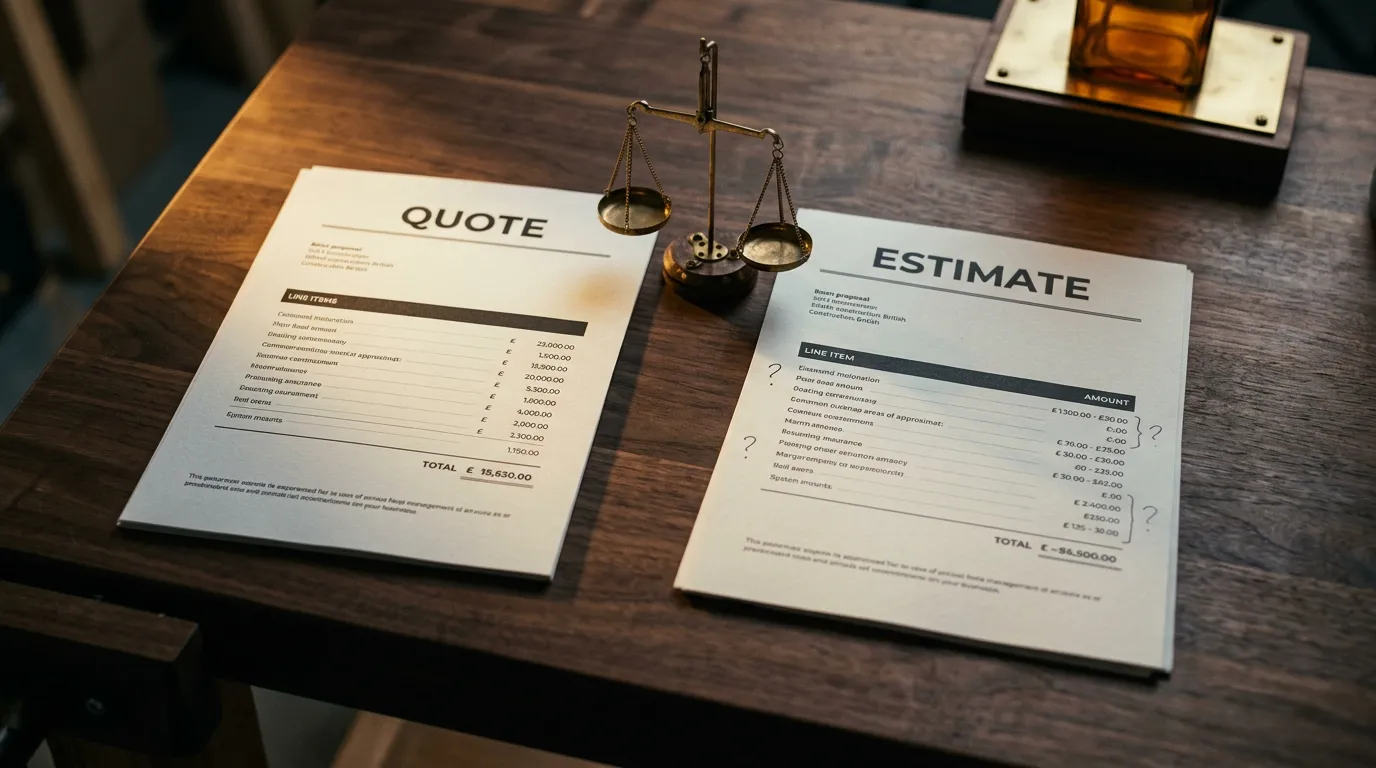
Builder's Quote vs Estimate - What's the Difference?
Quotes and estimates aren't the same thing. One is legally binding, the other isn't. Here's what that means for your building project - and your wallet.
Your builder says he'll "send over a quote." What arrives is a one-page PDF titled "Estimate." You sign it and agree to the price. Three months later, the builder says it's going to cost £8,000 more.
In short: A quote is a fixed price and is legally binding once accepted. An estimate is a rough guide and can change. Always insist on a written quote for any significant building work.
Can he do that?
The answer depends on whether you received a quote or an estimate. Most people use the words interchangeably. Legally, they mean very different things.
What a quote actually is
A quote - sometimes called a quotation or a fixed-price quote - is a firm price for a defined piece of work.
Once you accept it, the builder is committed to that price. They can't increase it later because materials went up or the job took longer than expected. The risk sits with them.
For a quote to hold up, it needs to be specific. It should describe the work, list the materials, state the price, and have a validity period. A quote that says "build extension - approximately £60,000" isn't really a quote. It's an estimate dressed up as one. See our guide on what a builder's quote should include for the full checklist.
Key features of a proper quote:
- Fixed total price
- Detailed scope of works
- Material specifications
- Validity period (usually 30–90 days)
- Builder bears the risk of cost increases
The price can only change if you change the scope. If you ask for underfloor heating that wasn't in the original spec, that's a legitimate variation. If the builder underestimated how much concrete he'd need - that's his problem, not yours.
What an estimate actually is
An estimate is a rough guide. It's the builder's best guess based on what they know at the time. It's not a firm commitment.
Estimates are normal in construction, especially early on. If you ask a builder to "ballpark" a project before you've got drawings, they'll give you an estimate. It's useful for budgeting, but it's not something you can hold them to.
Key features of an estimate:
- Approximate price (often shown as a range)
- Less detailed scope
- Price can change as more information becomes available
- Builder does not bear the risk of cost increases
- Often labelled "estimate" or "budget estimate"
An estimate of £55,000–£65,000 that ends up at £63,000 is perfectly normal. An estimate of £55,000 that ends up at £85,000 is a problem - but you'd struggle to enforce the original figure in court.
How far can an estimate drift?
There's no legal limit, but there is an expectation of reasonableness. A 10–15% overrun on an estimate is generally accepted. It's called a "reasonable estimate" for a reason - the builder should have been roughly right.
If an estimate doubles, something has gone wrong. Either the builder didn't understand the project when they priced it, or the scope has genuinely changed beyond recognition. Either way, you should have been told before the costs were incurred.
The Consumer Rights Act 2015 says services must be provided at a "reasonable price" if no price is fixed. So even with an estimate, there are limits - they're just harder to enforce than a fixed quote.
Side-by-side comparison
| Quote | Estimate | |
|---|---|---|
| Price certainty | Fixed - the number is the number | Approximate - expect it to move |
| Legal status | Binding once accepted by both parties | Not binding - it's a guide |
| Detail level | Specific scope, materials, and costs | Broader description, less detail |
| When it's used | Builder has visited, measured, and designed | Early stages, before full specification |
| Can the price change? | Only if you change the scope | Yes - as the project develops |
| Your protection | Strong - builder carries the cost risk | Weak - you carry most of the risk |
What about a tender?
You might hear the word "tender" if your project is larger - typically £100,000+.
A tender is a formal, competitive bidding process. You (or your architect) send a detailed specification to several builders. They each submit a price for the same scope of work. You compare and choose.
Tenders are standard on commercial projects. For residential work, they're mainly used on bigger extensions, new builds, or whole-house renovations where an architect is managing the project.
The key difference from a regular quote: tenders are priced against a common specification, so the comparison is fairer. With normal quotes, each builder might be quoting for slightly different things.
If your project is under £80,000 or so, you probably don't need a formal tender. Getting three detailed quotes and comparing them properly will do the job.
What to do if a builder tries to change a quoted price
It happens. Builder quotes £48,000. You accept. Halfway through the build, they say materials have gone up and they need another £5,000.
Here's the thing: if it was a genuine fixed-price quote and you haven't changed the scope, the builder has no right to increase the price. The quote is a contract.
Your options:
1. Check the original document
Is it actually a quote or an estimate? What does the header say? Does the body use language like "fixed price" or "we estimate"? The wording matters.
2. Check for a price variation clause
Some builders include a clause allowing price adjustments for material cost increases. If it's in the document you signed, they're within their rights. This is why reading the terms matters.
3. Check if you changed the scope
Did you ask for something different - an extra socket, a different worktop, a relocated radiator? Scope changes are legitimate extras. The builder should have flagged the cost at the time, but the variation itself is fair.
4. Talk to them directly
Most disputes are resolved with a conversation. Ask the builder to explain the increase line by line. If it's a genuine unforeseen issue - hitting a sewer pipe nobody knew about - there might be room for compromise. If they just underquoted and are trying to claw it back, stand your ground. Our guide on signs your builder is overcharging covers the warning signals in detail.
5. Formal route
If talking doesn't work: put your position in writing, reference the original quote, and give them 14 days to respond. If it's still not resolved, you can use the government-backed TrustMark dispute resolution service (if the builder is registered) or take it to small claims court for amounts under £10,000.
When to push for a quote
Always push for a quote when:
- You've got detailed drawings or plans
- The builder has visited the site and measured up
- The specification is finalised (you've chosen materials)
- You're ready to commit and want price certainty
A builder who refuses to give a fixed price after a site visit and a clear spec is either unsure about their own pricing or wants the flexibility to charge more. Either way, that's a risk for you. If your project involves structural changes, check whether you'll need planning permission before locking in the spec.
When an estimate is fine
Estimates are perfectly reasonable when:
- You're at the early "how much will this roughly cost?" stage
- You don't have drawings or a detailed spec yet
- You're comparing different project options (extension vs loft conversion, for example)
- The builder hasn't visited the site
Just don't treat an estimate as a budget. Treat it as a starting point. Once the spec is firmed up, get a proper quote before you commit.
The typical journey: estimate first, then quote
Most projects follow a natural path:
- You ring a builder and describe what you want. They give you a rough estimate over the phone or after a quick look. "Something like £50,000–£65,000 for that."
- You decide it's worth pursuing. You get drawings done by an architect or designer.
- The builder visits, measures up, reviews the drawings, and provides a detailed fixed-price quote.
- You accept the quote. The work begins.
Problems happen when people skip step 3. They treat the step-1 estimate as a firm price, don't get a proper quote, and then get a shock when the final bill is higher.
The estimate gets you into the ballpark. The quote pins it down. Don't confuse the two.
The grey area: "fixed price estimate"
Some builders write documents titled "fixed price estimate." That's a contradiction. It's either fixed or it's an estimate. It can't be both.
In practice, courts look at the substance of the document, not just the title. If the scope is detailed, the price is a single figure, and there's no language suggesting it might change - it's probably a quote, whatever the builder called it.
But it's messy. If a builder hands you something ambiguous, ask them directly: "Is this a fixed price? If the job costs you more than you expected, do I pay more?"
Get the answer in writing.
What about verbal quotes?
A verbal quote is technically still a contract if both parties agree. But proving what was said - and what was included - is almost impossible. "I said sixty thousand." "No, you said sixty to seventy."
Always get it in writing. An email is fine. A proper PDF is better. If a builder quotes you a number over the phone and it sounds right, say: "Great. Can you put that in an email with the scope so we're both clear?" Any decent builder will.
If they won't put it in writing, that tells you something.
Quick checklist
Before you sign anything:
- Is the document clearly labelled as a quote or an estimate?
- If it's a quote, is the price fixed with no variation clause?
- Is the scope specific enough that you both know what's included?
- Are exclusions listed? (See what to ask your builder for questions to raise)
- Is there a validity period?
- Have you read the terms and conditions?
If you can tick all six, you're in good shape.
Got a quote? Check what's in it
Whether your builder called it a quote, an estimate, or a "budget proposal" - the content is what matters. Upload it to MyBuildAlly and we'll break it down: what's included, what's missing, and whether the pricing looks right for your area.
Takes about 30 seconds. Might save you a difficult conversation later.
Was this useful?