How to Compare Builder Quotes - The Complete Method
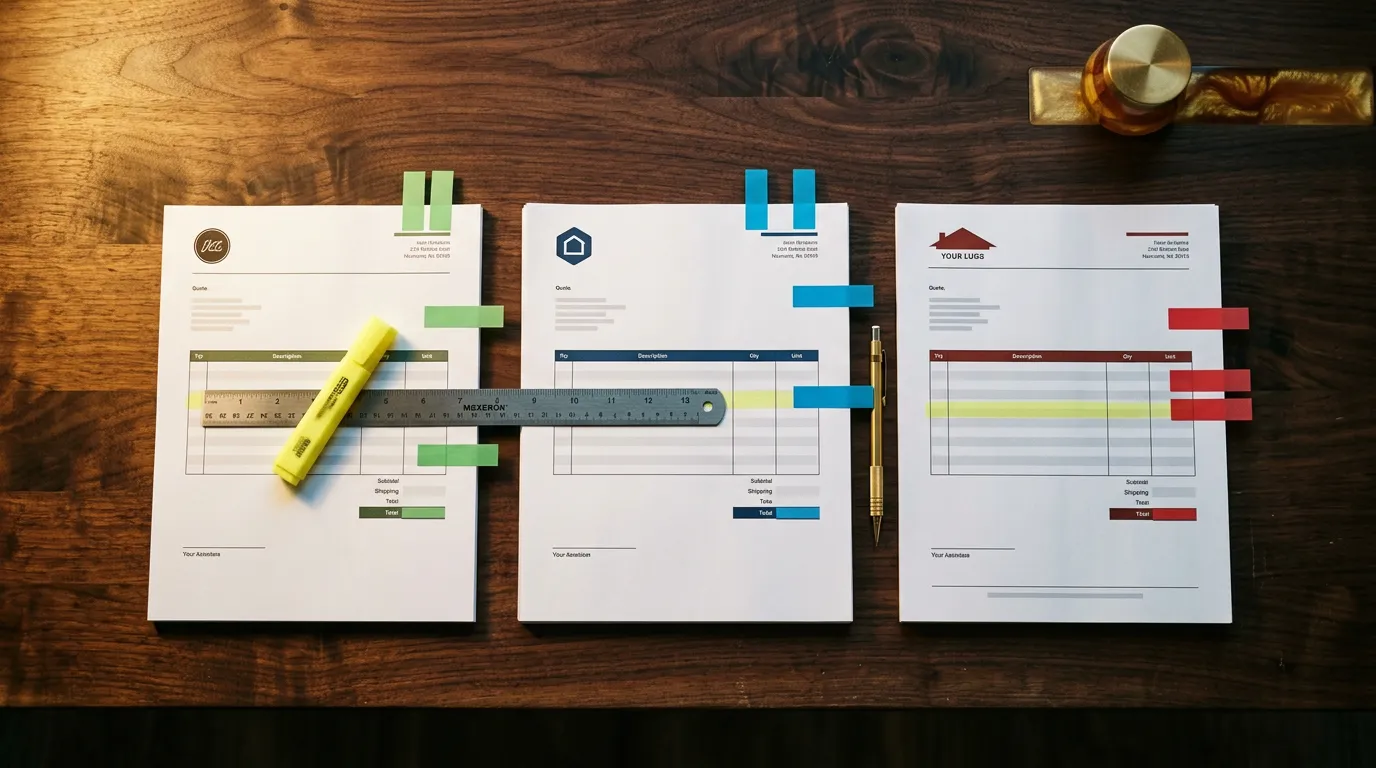
Line up scope, exclusions and payment terms before price. In the worked example the cheapest quote, £48,000, normalises to £55,150 once the gaps are added back.
Most people compare builder quotes the same way they compare anything else: they scroll to the bottom, look at the number, and pick the cheapest.
It's like buying a car based on the sticker price without checking whether one includes alloys and air conditioning while the other doesn't even have a spare tyre. The number means nothing until you know what it covers.
This guide is the method I wish every homeowner used before choosing a builder. Seven steps, one worked example, and a system you can use no matter what the project is. Bookmark it.
Why the cheapest quote is rarely the cheapest
Here's the uncomfortable truth. When you get three quotes for the same job - say £48,000, £52,000, and £58,000 - the cheapest one usually isn't the cheapest. It's just the one that's left the most stuff out.
Missing scaffolding. No skip hire. Building regs not included. Decoration excluded. Cheaper materials.
Add those back in and the "cheapest" quote is often level with the others. Sometimes it's more expensive.
This isn't speculation. It's the pattern we see in thousands of quotes uploaded to MyBuildAlly. The lowest headline number and the lowest actual cost are rarely the same thing.
So how do you compare properly? Here's the method.
Step 1: Get quotes based on the same brief
This sounds obvious. It isn't.
Most homeowners describe the job slightly differently to each builder. One gets a detailed walkthrough with drawings. Another gets a twenty-minute chat and a vague brief. The third gets a phone call and a couple of photos.
Then you wonder why the quotes are wildly different.
Write a single brief. One document that describes the work in as much detail as you can. Include:
- The scope of work (what you want done, room by room or phase by phase)
- Drawings or sketches if you have them
- Material preferences (e.g. "uPVC windows" or "aluminium bi-folds")
- Any constraints (access issues, conservation area, party wall)
- Your expected timeline
Give every builder the same document. The same drawings. The same spec. If they're all pricing the same job, the differences in their quotes actually mean something. If they're pricing different jobs, the comparison is meaningless.
Three quotes is the sweet spot. Fewer than three and you can't spot an outlier. More than five and you'll spend weeks chasing responses while the project stalls.
Step 2: Line up inclusions and exclusions
This is where the real work happens.
Open all three quotes side by side. Create a simple table - on paper, in a spreadsheet, whatever works for you. Down the left column, list every work item from the most detailed quote. Across the top, put each builder's name.
Then go through each quote, row by row, and mark whether it's included, excluded, or not mentioned.
Here's what that looks like:
| Work Item | Builder A | Builder B | Builder C |
|---|---|---|---|
| Groundworks and foundations | Included | Included | Included |
| Brickwork and blockwork | Included | Included | Included |
| Structural steel | Included | Excluded | Included |
| Scaffolding | Excluded | Included | Included |
| Skip hire | Excluded | Included (x3) | Not mentioned |
| Roof structure and covering | Included | Included | Included |
| Windows and doors | Included (uPVC) | Included (aluminium) | Included (uPVC) |
| Electrics (first and second fix) | Included | Included | Included |
| Plumbing (first and second fix) | Included | Included | Included |
| Plastering | Included | Included | Included |
| Decoration | Excluded | Included (2 coats) | Mist coat only |
| Building regs fees | Excluded | Included | Excluded |
| Flooring | Excluded | Included (vinyl) | Excluded |
Once you fill this in, the price differences start making sense. Builder A looks cheap because six items are excluded. Builder B looks expensive because they've included everything. Builder C is somewhere in between but hasn't even mentioned skip hire, which means you'll probably get a surprise invoice three weeks into the job.
If you're unsure what items should be on a quote in the first place, our full checklist of what a builder's quote should include covers the lot.
Step 3: Normalise the scope
Now you know what each quote includes and excludes, you can level the playing field.
Normalising means adjusting the prices so every quote covers the same scope. If Builder A excludes scaffolding and Builder B includes it at £2,000, add £2,000 to Builder A's total. If Builder C excludes decoration and Builder B includes it at £1,800, add £1,800 to Builder C.
You're not changing the quotes. You're calculating what each builder would charge if they all covered the same work.
This is the only way to compare the actual cost. Without normalising, you're comparing apples, oranges, and a pineapple - then complaining they taste different.
For the common items that get excluded and how much they typically cost, see our guide on hidden costs in home renovations.
Step 4: Check materials and specifications
Two quotes can have identical scope and wildly different prices because one specifies premium materials and the other doesn't.
Common areas where material specs make a big difference:
| Item | Budget spec | Premium spec | Price difference |
|---|---|---|---|
| Windows | uPVC, white | Aluminium, anthracite grey | £3,000–£8,000 |
| Kitchen units | Flat-pack, laminate doors | Shaker, solid wood doors | £2,000–£10,000 |
| Bathroom suite | Standard white ceramics | Designer wall-hung suite | £1,000–£5,000 |
| Flooring | Vinyl plank | Engineered oak | £2,000–£6,000 |
| Worktop | Laminate | Quartz or granite | £1,500–£4,000 |
| Boiler | Budget combi | Premium combi with smart controls | £800–£2,000 |
If one quote is cheaper, check the material spec. "Supply and fit bathroom" means nothing without knowing which bathroom. A budget white suite from a plumber's merchant costs £400. A wall-hung Villeroy & Boch set costs £3,000.
Same room. Same labour. Wildly different price. Both quotes are fair - they're just pricing different things.
Where quotes list specific brand names or model numbers, Google them. Check Screwfix, Toolstation, or the manufacturer's site. You'll quickly see whether the price gap is down to material quality or builder markup.
Step 5: Compare payment terms
This is the step most homeowners skip. Payment terms don't change the total price, but they change your risk.
Here's what to check:
Deposit. Industry standard is 10–15% to secure the start date and order materials. If a builder asks for 40% or 50% upfront, that's a red flag. Read our guide on builders who want a 50% deposit before agreeing to anything above 20%.
Stage payments. The best payment structure is milestone-based. You pay when specific work is completed - foundations done, walls up, roof on, first fix complete, second fix complete, snagging done. The worst structure is time-based ("£5,000 every two weeks") because it disconnects payment from progress.
Retention. Some contracts hold back 2.5–5% of the total until a snagging inspection is complete. This gives you leverage to get defects fixed. If a builder refuses retention, that's not necessarily a deal-breaker, but milestone payments with a decent final balance (10–15%) achieve a similar effect.
What to watch for. Front-loaded payment schedules - where you've paid 60–70% of the total before the job is half done - leave you exposed. If the builder walks off site, you've paid for work that hasn't been done and getting it back is painful.
Step 6: Verify credentials
A cheap quote from an uninsured builder is no bargain. If something goes wrong - a wall collapses, a pipe floods the kitchen, a worker falls through the ceiling - you're liable.
Check these before comparing price:
- Public liability insurance - minimum £2 million cover, ideally £5 million. Ask for a copy of the certificate.
- Employers' liability insurance - legally required if they have employees.
- Trade body membership - Federation of Master Builders, Chartered Institute of Building, or trade-specific bodies (Gas Safe, NICEIC, FENSA).
- Companies House - if they're a limited company, check they're active and there are no red flags in the accounts. It takes two minutes.
- Reviews and references - Checkatrade, Trustpilot, Google reviews. Ask for references from similar projects and actually call them.
A builder who's properly insured, accredited, and well-reviewed will cost more than one operating off the books with no insurance. That's not overcharging - that's the cost of doing business properly. You're paying for accountability.
For the full pre-hire checklist, see our guide on 5 things to check before hiring a builder.
Step 7: Make your decision
You've normalised the scope. Checked the materials. Compared payment terms. Verified credentials. Now you can actually compare.
The best quote isn't the cheapest. It's the one that:
- Covers everything - complete scope with clear inclusions and exclusions
- Uses decent materials - specified by name, not just "supply and fit"
- Has fair payment terms - small deposit, milestone payments, retention or a decent final balance
- Comes from a verified builder - insured, accredited, with genuine references
- Communicates well - responsive, clear, answers questions without getting defensive
Price is one factor among several. A quote that's 5–10% more expensive but ticks all five boxes is better value than a cheaper quote that's vague, front-loaded, and comes from someone you can't verify.
Worked example: three quotes for a kitchen extension
Let's put this method into practice. Sarah's got three quotes for a 25m² single-storey kitchen extension in Nottingham.
The headline numbers:
| Builder A | Builder B | Builder C | |
|---|---|---|---|
| Quoted price | £48,000 | £52,000 | £58,000 |
Builder A looks like a bargain. Builder C looks expensive. Most people would pick Builder A or B and move on.
But Sarah reads the quotes properly. Here's what she finds.
Scope comparison
| Item | Builder A | Builder B | Builder C |
|---|---|---|---|
| Foundations and groundworks | Included | Included | Included |
| Brickwork and steel | Included | Included | Included |
| Roof and insulation | Included | Included | Included |
| Windows (uPVC) | Included | - | - |
| Windows (aluminium bi-fold) | - | Included | Included |
| Electrics | Included | Included | Included |
| Plumbing | Included | Included | Included |
| Plastering | Included | Included | Included |
| Scaffolding | Excluded | Included | Included |
| Skip hire | Excluded | Included (x3) | Included (x4) |
| Building regs fees | Excluded | Excluded | Included |
| Decoration | Excluded | Included (2 coats) | Included (2 coats) |
| Flooring | Excluded | Included (LVT) | Included (engineered oak) |
| Kitchen units | Excluded | Excluded | Excluded |
Normalising the scope
Sarah prices up Builder A's exclusions:
- Scaffolding: £2,000
- Skip hire (3 skips): £1,050
- Building regs: £800
- Decoration: £1,800
- Flooring (LVT to match Builder B): £1,500
Builder A's normalised total: £55,150
Builder B excluded building regs:
- Building regs: £800
Builder B's normalised total: £52,800
Builder C included everything (and used aluminium windows like Builder B), so the total stays the same.
Builder C's normalised total: £58,000
The real comparison
| Builder A | Builder B | Builder C | |
|---|---|---|---|
| Quoted price | £48,000 | £52,000 | £58,000 |
| Normalised price | £55,150 | £52,800 | £58,000 |
Builder A isn't cheaper. Once you add the missing items, they're actually £2,350 more than Builder B.
But what about Builder C? Their normalised price is £5,200 more than Builder B. Is that worth it?
Sarah checks the specs. Builder C specified engineered oak flooring (not LVT), higher-spec insulation, and a 10-year structural guarantee. Builder B offers a 5-year guarantee.
She also checks payment terms. Builder B wants 25% upfront. Builder C wants 10% and milestone payments. Builder A wants 40% before starting - a proper red flag.
The verdict
Builder B is the best value. Comprehensive scope, fair price, aluminium windows included. The 25% deposit is on the high side, but Sarah negotiates it down to 15%.
Builder C is a reasonable alternative for someone who wants premium finishes and lower risk payment terms.
Builder A - the "cheapest" - is actually the most expensive and the riskiest.
That comparison took Sarah about an hour. Getting it wrong would have cost thousands.
Skip the spreadsheet
The method above works. But it takes time. You need to read three quotes line by line, build a comparison table, price the gaps, and normalise.
MyBuildAlly's quote-checking tool does all of this automatically. Upload your quote and the AI extracts every line item, flags what's missing, checks prices against regional benchmarks, and highlights anything unusual - see a sample report to see what the output looks like. It takes about 30 seconds instead of an hour, and at £10 per project it's a fraction of what a single scope gap would cost you.
It's not a replacement for the method - it's the method, automated. The same comparison logic, the same scope checks, the same price benchmarks. Just faster.
The bottom line
Comparing builder quotes properly takes an hour of your time. Getting it wrong costs thousands.
Don't pick the cheapest number. Pick the best value. That means comparing scope, materials, payment terms, and credentials - not just the figure at the bottom of the page.
Seven steps. One table. An hour of your time. That's all it takes to avoid the most expensive mistake in home improvement.
Ready to check your quote? Get started with MyBuildAlly and find out whether your builder's price is fair - before you sign anything.
Was this useful?