Practical Completion: What It Means and What to Check
Practical completion marks when building work is substantially done. Here's what it means for homeowners, what to inspect, and when to release final payment.
Your builder says the extension is "practically done." They want the final payment. There are paint scuffs on the skirting boards, a socket plate that's not flush, and the back door sticks slightly. Is the job actually finished?
In short: Practical completion is the point at which building work is substantially complete and fit for its intended purpose. Minor snagging items can remain, but the building should be usable. It's a defined contractual milestone that triggers payment obligations, warranty periods, and the defects liability period - so getting it right matters.
What practical completion actually means
Practical completion (often shortened to "PC") is a formal construction term that marks the point at which the work is finished enough to be used for its intended purpose. It doesn't mean every last detail is perfect. It means the building is substantially complete.
The concept comes from JCT (Joint Contracts Tribunal) contracts - the standard form contracts used on most UK building projects. JCT doesn't actually define practical completion precisely, which has led to decades of legal debate. But the generally accepted test is: can the building be occupied and used for its intended purpose?
If the answer is yes - even though the towel rail in the en-suite hasn't been fitted and there's a scratch on the kitchen worktop - that's practical completion.
If the answer is no - because the heating doesn't work, the stairs have no handrail, or the electrics haven't been signed off - that's not practical completion, regardless of what the builder says.
What triggers practical completion?
Practical completion isn't a date the builder picks arbitrarily. Several things should be true:
The work matches the specification. The build should align with the agreed drawings, specification, and any variations you've approved. If the contract says hardwood internal doors and you've got hollow-core doors, the work isn't complete - it's wrong.
All major systems are operational. Heating, plumbing, electrics, drainage - everything should be working and tested. "We'll come back and connect that" is not practical completion.
Building control has signed off (or is ready to). For work that requires building regulations approval, the relevant inspections should be done. You need that completion certificate - without it, you could have problems selling the property later. See our guide on building regulations key measurements for what inspectors check.
The space is safe to occupy. No exposed wiring, no missing stair treads, no unguarded drops. Health and safety isn't optional.
Only minor snagging items remain. A few paint touch-ups, a stiff door handle, a small chip in a tile - these are snags. They don't prevent you using the building. The builder should fix them, but their existence doesn't prevent practical completion.
The snagging list
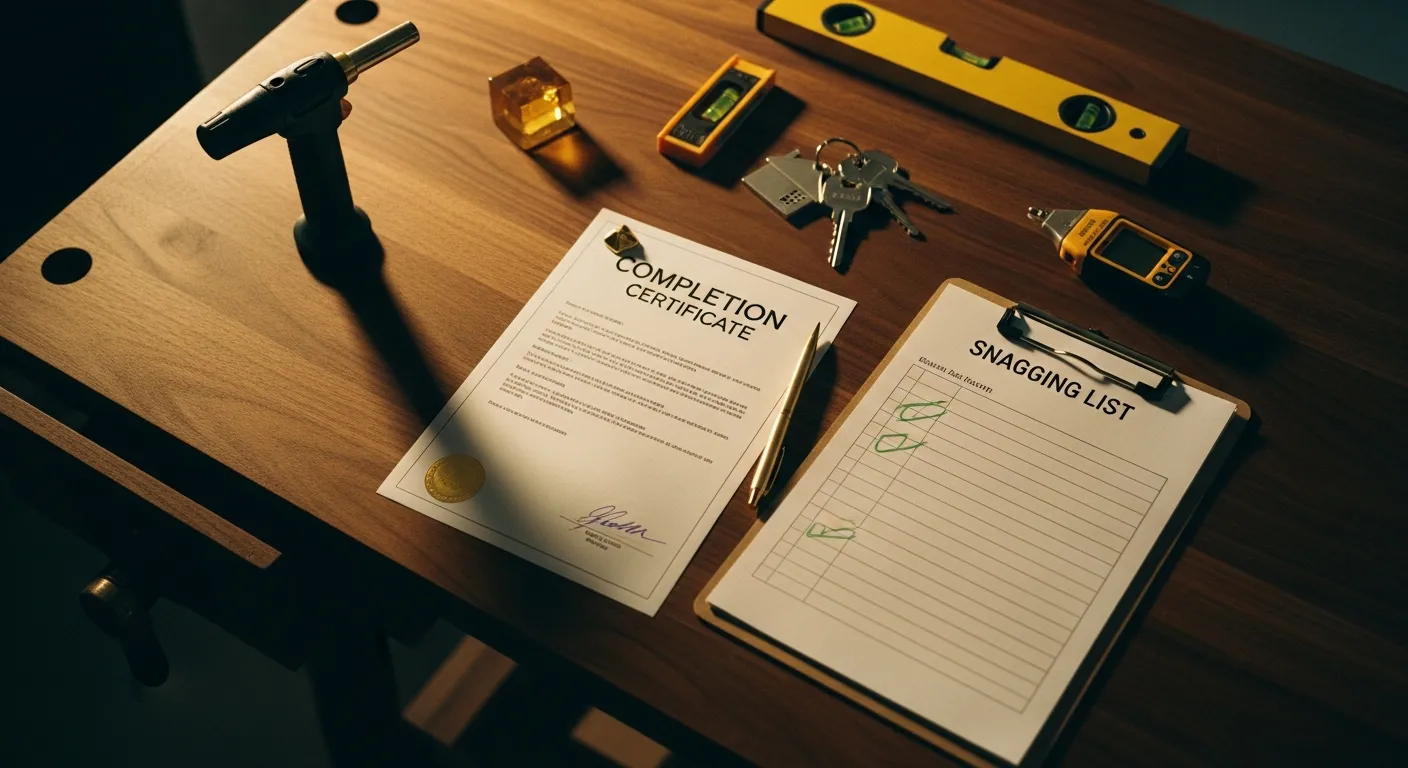
At practical completion, you should carry out a thorough inspection and create a snagging list - a written record of every minor defect, incomplete item, or cosmetic issue you can find.
This isn't being difficult. It's standard practice on every construction project, from a £20,000 bathroom to a £200 million hospital. The builder expects it.
Here's what to check room by room:
General
- Doors open and close smoothly, latches and handles work
- Windows open, close, and lock properly
- All light switches and sockets are fitted flush and working
- Radiators heat up evenly (no cold spots or air locks)
- Flooring is level, secure, and free from damage
- Paintwork is even with no runs, drips, or missed spots
- Sealant lines (around baths, worktops, windows) are neat and complete
Kitchen
- All appliances fitted and working
- Worktops properly joined and sealed
- Drawers and cupboard doors aligned and closing properly
- Plumbing connections (no drips under the sink)
- Extractor fan ducted and operational
Bathroom
- Taps run hot and cold, with adequate pressure
- Shower drains properly (no pooling)
- Toilet flushes and fills correctly
- Tiles grouted and sealed, no hollow-sounding tiles
- No leaks under bath panel or behind shower screen
External
- Brickwork pointed and clean
- Render even and crack-free
- Guttering fitted and directing water to downpipes
- Drainage gullies clear and accessible
- Any landscaping or making good completed
For a comprehensive guide to checking each trade, see our post on how to check builder work, which links to detailed guides for brickwork, plastering, electrics, plumbing, and more.
Top tip: Do the inspection during daylight, and bring a torch for under-stair cupboards and loft spaces. Take photos of every snag and share the list with the builder in writing - email is fine.
Retention: why you don't pay everything at practical completion
When the builder hits practical completion, you release the main payment - but not all of it. You hold back a percentage called retention.
Standard retention is 2.5% to 5% of the total contract value. On an £80,000 extension, that's £2,000 to £4,000 kept back.
Why? Because problems emerge after you start using a building. A hairline crack appears as the structure settles. A shower tray develops a slow leak. Condensation on windows reveals a ventilation issue. These things take weeks or months to show up.
The retention gives the builder a financial incentive to come back and fix defects during the defects liability period. If you've paid them in full, their motivation to return for a £150 fix drops considerably.
For more on structuring payments safely, see our guide on stage payments and retention.
The defects liability period
The defects liability period (DLP) starts at practical completion and typically runs for 6 to 12 months. During this period, the builder is contractually obliged to return and fix any defects that appear - at their own cost.
This covers genuine defects, not damage you cause yourself. If a door starts sticking because the frame has moved as the building settles, that's a defect. If you slam a door and break the handle, that's your problem.
Keep a running list of issues as they crop up during the DLP. Don't call the builder for every individual item unless it's urgent (a leak, for example). Collect the minor ones and send them in one batch - most builders prefer this.
At the end of the DLP, the builder returns to fix any outstanding items. Once everything is resolved, you've reached final completion - and you release the retention.
The timeline: practical completion to final completion
Here's how it typically works on a residential project:
-
Builder notifies you the work is substantially complete - They might call it practical completion, or just say "we're done." Either way, it triggers your inspection.
-
You inspect and create a snagging list - Walk the entire build. Note everything. Share the list with the builder.
-
Builder fixes the snagging items - This should take days, not weeks. If snagging drags on for months, that's a problem. Some items might need to wait (e.g., you can't check external drainage in a drought), but most should be sorted promptly.
-
You agree practical completion - Once the major snags are fixed and the building is usable, you formally agree that practical completion has been reached. This is usually confirmed in writing.
-
You release the main payment (minus retention) - Pay the balance of the contract, holding back the agreed retention percentage.
-
Defects liability period runs - Typically 6-12 months. You live in the space and note any issues.
-
End-of-DLP inspection - The builder returns to fix any defects that emerged during the period.
-
Final completion - Everything is resolved. You release the retention. The contract is complete.
What to do if you disagree with the builder
Sometimes the builder says "that's practical completion" and you disagree. Maybe the heating doesn't work properly, or a whole room hasn't been decorated, or the kitchen hasn't been installed yet.
If there are significant outstanding items, you're within your rights to refuse to certify practical completion. A building that can't be used for its intended purpose is not practically complete. Be specific: list exactly what's incomplete and why it prevents occupation.
If the dispute is about snags vs defects, the line can be blurry. A scratch on a window is a snag. A window that doesn't close is a defect that prevents practical completion. As a rule of thumb: if it affects the function or safety of the building, it's not a snag - it's incomplete work.
If the builder is pushing for payment, don't release the main payment until you're satisfied the work has genuinely reached practical completion. This is why stage payments matter - your payment schedule should be tied to milestones, not dates.
Put everything in writing. If you're withholding payment, explain why in a clear email referencing specific incomplete items. This protects you if the dispute escalates. Our guide on protecting yourself during building work covers the full range of consumer protections available to you.
Consider an independent inspection. If you and the builder fundamentally disagree on whether the work is complete, a chartered surveyor or building inspector can provide an independent assessment. It costs a few hundred pounds but can resolve the dispute quickly and provide evidence if you need it later.
Common mistakes homeowners make
Paying in full at practical completion. Always hold retention. Once the money's gone, your leverage disappears. See our post on whether you should pay your builder in cash for more on payment safety.
Not doing a proper snagging inspection. Walk every room. Open every door and window. Run every tap. Flush every toilet. Check under sinks. Look in the loft. If you don't check it now, you'll discover it later - and it'll be harder to get fixed.
Accepting a verbal "we'll come back." Get the snagging list in writing and get the builder to acknowledge it. A verbal promise to fix something next week has a way of becoming next month, then never.
Confusing practical completion with perfection. A brand-new extension won't be flawless. Minor cosmetic snags are normal. Don't withhold practical completion over a paint drip - but equally, don't accept a building with a non-functioning boiler and call it a snag.
Not getting building control sign-off. The completion certificate from building control is separate from practical completion with your builder. Make sure you get it. Without it, you could face problems with insurance, mortgage lenders, and future property sales.
Handover documents checklist
Every certificate, warranty, drawing and sign-off to collect before the final payment, with who issues each one, when, and what to check on it.
Quick checklist for practical completion
Before agreeing the work is practically complete:
- All rooms are usable for their intended purpose
- Heating, plumbing, and electrics are fully operational
- Building control has inspected (or is scheduled for final sign-off)
- You've done a thorough snagging inspection with a written list
- The builder has acknowledged the snagging list
- You've agreed a timeline for snagging fixes
- You know the retention amount and the defects liability period
- Payment terms are clear - main payment minus retention
Got a quote that doesn't mention practical completion, retention, or defects liability? That's a red flag. Upload it to MyBuildAlly and we'll flag what's missing before you commit.
Sources
- JCT (Joint Contracts Tribunal) - Standard form contracts defining practical completion, defects liability, and retention
- RICS (Royal Institution of Chartered Surveyors) - Professional guidance on contract administration and snagging
- Consumer Rights Act 2015 - Your statutory rights regarding building services and reasonable quality
- GOV.UK - Building regulations approval - When completion certificates are required
- NHBC (National House-Building Council) - Standards for new-build snagging and defects
Was this useful?