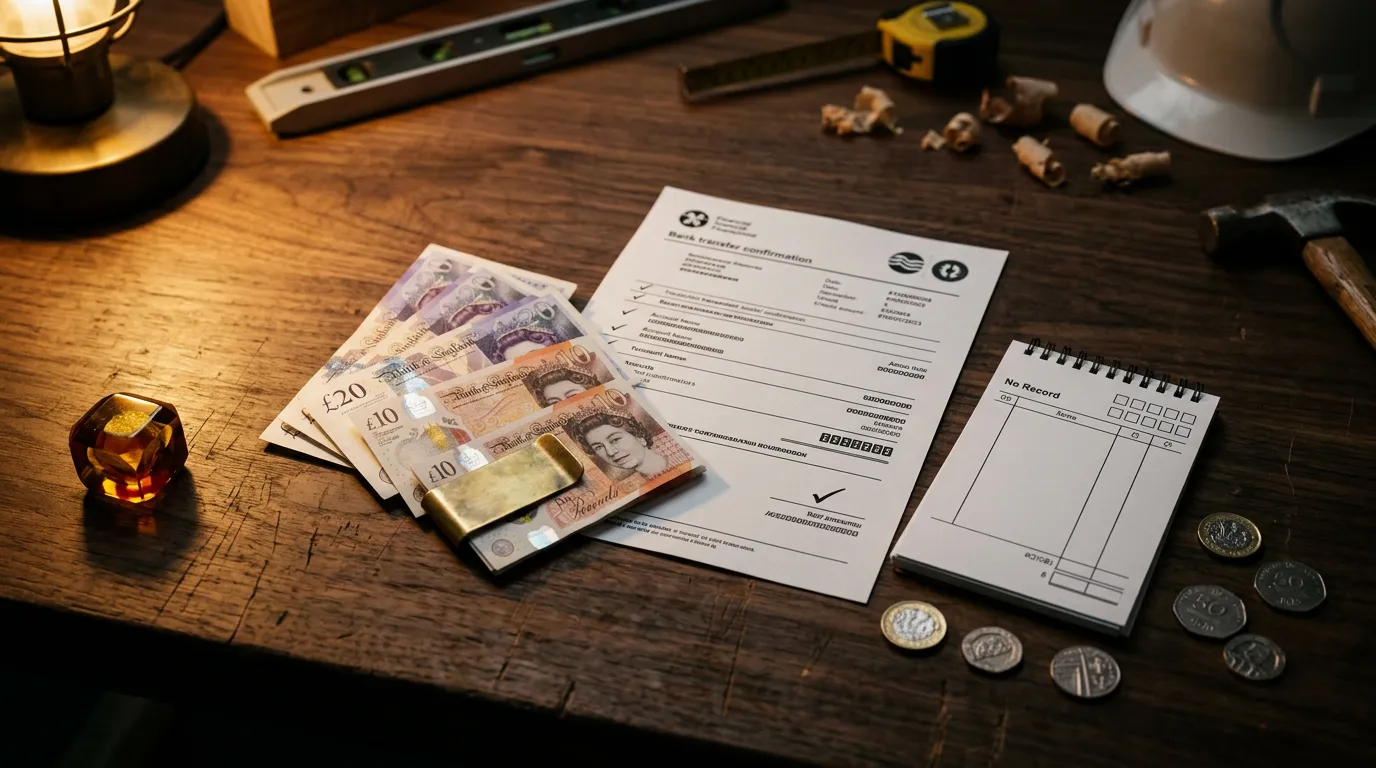
Should I Pay My Builder in Cash? Why It's Riskier Than You Think
Paying your builder in cash is legal - but risky. No paper trail, no receipt, no comeback. Here's why bank transfer is always the smarter choice.
Your builder's done a decent job. They hand you the invoice and say, "Cash would be easier, mate." Maybe they're offering a discount - 5%, 10% off if you pay cash.
Tempting? Sure. Smart? Almost never. Here's why.
Whatever you decide about cash, agree the stages first. This builds a schedule you can pay by bank transfer, one finished milestone at a time, with a reference on every payment.
Free tool
Build a payment schedule to hand to your builder
Four details in, and out comes a staged schedule: a 10% deposit, payments tied to work you can see, and a retention held back for snagging.
Is it actually legal to pay cash?
Yes. Paying cash is perfectly legal. There's no law against handing your builder an envelope of twenties.
The legal problem isn't the cash itself - it's what happens to it afterwards. If your builder takes your cash payment and doesn't declare it as income, that's tax evasion. And if you knew (or should have known) that was the reason for the cash request, you could be seen as aiding it.
In practice, HMRC rarely goes after homeowners. They go after the builder. But "rarely" isn't "never," and being dragged into a tax investigation is nobody's idea of a good time.
So yes, it's legal. But legal and wise are two different things.
The real problem: no paper trail
Forget the tax angle for a moment. The biggest risk of paying cash is much simpler: you have no proof you paid.
Think about what could go wrong:
- The builder denies receiving payment. You handed over £3,000 in cash for the deposit. Two weeks later, the builder says they never got it. Who can prove what?
- You need to make a warranty claim. The roof starts leaking six months later. The builder says you still owe them money and won't come back to fix it. Without a bank statement showing the payments, you've got no evidence that you paid in full.
- The work is substandard and you want to take legal action. A court will want to see evidence of what was paid, when, and for what. Cash payments with no receipts make your case significantly harder to prove.
- You need to claim on your home insurance. Some insurers ask for proof of expenditure on building work. No receipts, no bank transfers, no proof.
A bank transfer solves all of this. It's timestamped, traceable, and admissible as evidence. Cash in hand is none of those things.
VAT: the elephant in the room
This is where cash payments get properly risky.
The VAT threshold is £90,000, and it is not an annual figure. GOV.UK (read 23 September 2026) sets two separate tests, and a builder must register if either one is met: their total taxable turnover for the last 12 months goes over £90,000, or they expect their taxable turnover to go over £90,000 in the next 30 days. Once registered they are legally required to charge you VAT at 20% on top of their price and pay it to HMRC.
Two things follow that the usual "under £90,000 a year" shorthand hides. The first test rolls: it looks back over any twelve months, not over the tax year, so a builder can cross it in March as easily as in April. The second test can be triggered by a single job, so a builder who has never been near the threshold can be required to register on the strength of your extension alone.
A builder running a legitimate operation with a few employees and regular project work will almost certainly be above the threshold. Their turnover on a single extension project could be £50,000–£80,000. Add a few more jobs across any twelve months and they're well over £90,000.
If a VAT-registered builder asks you to pay cash and offers a "discount" of, say, 10% - here's what's likely happening:
The normal price is £60,000 + £12,000 VAT = £72,000.
The "cash price" is £60,000 - with no VAT charged.
That's not a discount to you. It's the £12,000 that should have reached HMRC staying with the builder instead, and your cash payment is what makes that possible. You haven't been given a deal. You've been made part of the arrangement.
What if they're not VAT registered?
If the builder's taxable turnover is genuinely below £90,000 on both tests above, they don't need to be VAT registered and won't charge you VAT. Sole traders doing smaller jobs often fall into this category.
In that case, there's no VAT issue. But all the other problems with cash - no paper trail, no proof, no comeback - still apply.
How to check if a builder is VAT registered
Ask for their VAT number. Every VAT-registered business has one and should put it on their invoices. You can verify it on the HMRC VAT number checker.
If they say they're not VAT registered, check that the scale of their business matches that claim. A builder with a team of five running multiple projects simultaneously is almost certainly over the threshold. If they say otherwise, something doesn't add up.
"Cash discount" - what it really means
Let's be direct about this. When a builder offers you a discount for cash, they're almost always offering to do the job off the books. That means:
- They won't declare the income to HMRC
- They won't charge VAT (even if they should)
- They probably won't give you a proper receipt or invoice
- If something goes wrong, you've got minimal evidence of the transaction
The "discount" is usually equivalent to the tax they're dodging. You're not saving money - you're helping them evade tax and giving up your consumer protections in the process.
Is it worth saving £500 on a £5,000 job if you've got no receipt, no warranty, and no legal standing when the plastering cracks three months later? Most people would say no.
If your builder's offering cash discounts alongside other questionable practices - vague quotes, no written contract, pressure to pay upfront - read our post on signs your builder is overcharging. These things tend to cluster together.
How you should pay instead
Bank transfer is the gold standard. BACS or faster payment, directly to the builder's business bank account. Here's why:
- Automatic paper trail. Your bank records every transfer with the date, amount, and recipient.
- Reference field. Include a description like "Kitchen extension - stage 2 payment" so you can identify each payment later.
- Traceable. If there's a dispute, the bank records are evidence.
- Non-reversible (for the right reasons). Once you've sent a bank transfer, it's done. The builder can't claim you didn't pay.
What about card payments?
Some builders now accept card payments through mobile terminals. This is fine - you'll get a receipt and the payment is traceable. The builder will pay a small transaction fee (1.5–3%), which they may pass on to you. That's fair, but ask about it upfront.
A credit card does something a bank transfer cannot. Under section 75 of the Consumer Credit Act 1974, where you have a claim against the supplier for misrepresentation or breach of contract, you have the same claim against the card company, which is jointly and severally liable with them. Section 75(3)(b) sets the limits by the cash price of the item, which must be more than £100 and no more than £30,000; it is the price of the job that counts, not the amount you put on the card. So paying even part of a £20,000 job on a credit card brings the card company in behind the whole of it. A debit card does not carry this, and nor does a bank transfer.
What about cheques?
Old-fashioned, but still a decent option. A cheque creates a record (payee name, amount, date) and can be traced through your bank. Just make sure the cheque clears before the builder claims payment was made.
What about paying a deposit or stage payment in cash for a small amount?
Even for small amounts - say a £500 deposit - use a bank transfer. It takes two minutes and gives you evidence of payment that cash simply can't provide. If the builder insists on cash for even small amounts, ask yourself why. And for more on deposits, see our post on why a 50% deposit is a red flag.
What to do if your builder insists on cash
Step 1: Ask why. There might be a mundane reason. Some sole traders don't have a card machine and find bank transfers fiddly. That's not ideal, but it's not sinister.
Step 2: Offer a bank transfer instead. Every builder has a bank account. If they won't give you their bank details for a transfer, that's a red flag.
Step 3: If they won't budge, get receipts. If you absolutely must pay cash (say, for a small job where the builder genuinely prefers it), get a signed, dated receipt for every single payment. The receipt should show the builder's name and business details, the amount, what it's for, and the date. Take a photo of it immediately.
Step 4: If they won't give receipts, walk away. A builder who wants cash and won't give receipts is asking you to trust them with your money and your consumer rights. Don't.
Protecting yourself
Regardless of how you pay, these habits will save you headaches:
- Get a written quote before work starts. Not a verbal agreement. A detailed, itemised quote. Check it covers everything using MyBuildAlly's quote checker.
- Use a written contract. The FMB and JCT homeowner contracts are cheap, clear, and legally sound.
- Pay in stages tied to milestones. Don't pay ahead of the work. Pay for what's been completed. Stage payments protect you and motivate the builder.
- Keep every invoice, receipt, and communication. Emails, text messages, WhatsApp chats - all of it. If a dispute goes to court or mediation, this evidence is invaluable.
- Check the builder's credentials. Companies House registration, public liability insurance, trade body memberships. A builder who operates transparently has nothing to hide.
If your builder's quote doesn't mention payment terms at all - how much, when, and by what method - that's a gap you should close before work starts. Our guide to what a builder's quote should include has the full checklist.
And if you're still not sure whether your quote is missing something important - like building regulations fees or a proper payment schedule - run it through MyBuildAlly before you commit.
The bottom line
Paying cash isn't illegal. But it strips away almost every protection you have as a consumer. No paper trail. No proof. No comeback.
A bank transfer costs nothing, takes two minutes, and gives you a permanent record of every penny you've paid. There's no good reason not to use one.
If a builder offers you a cash discount, they're not doing you a favour. They're doing themselves one - at your expense and HMRC's.
Pay by transfer. Keep the receipts. Sleep easy.
Check your quote before you pay anything →
Was this useful?