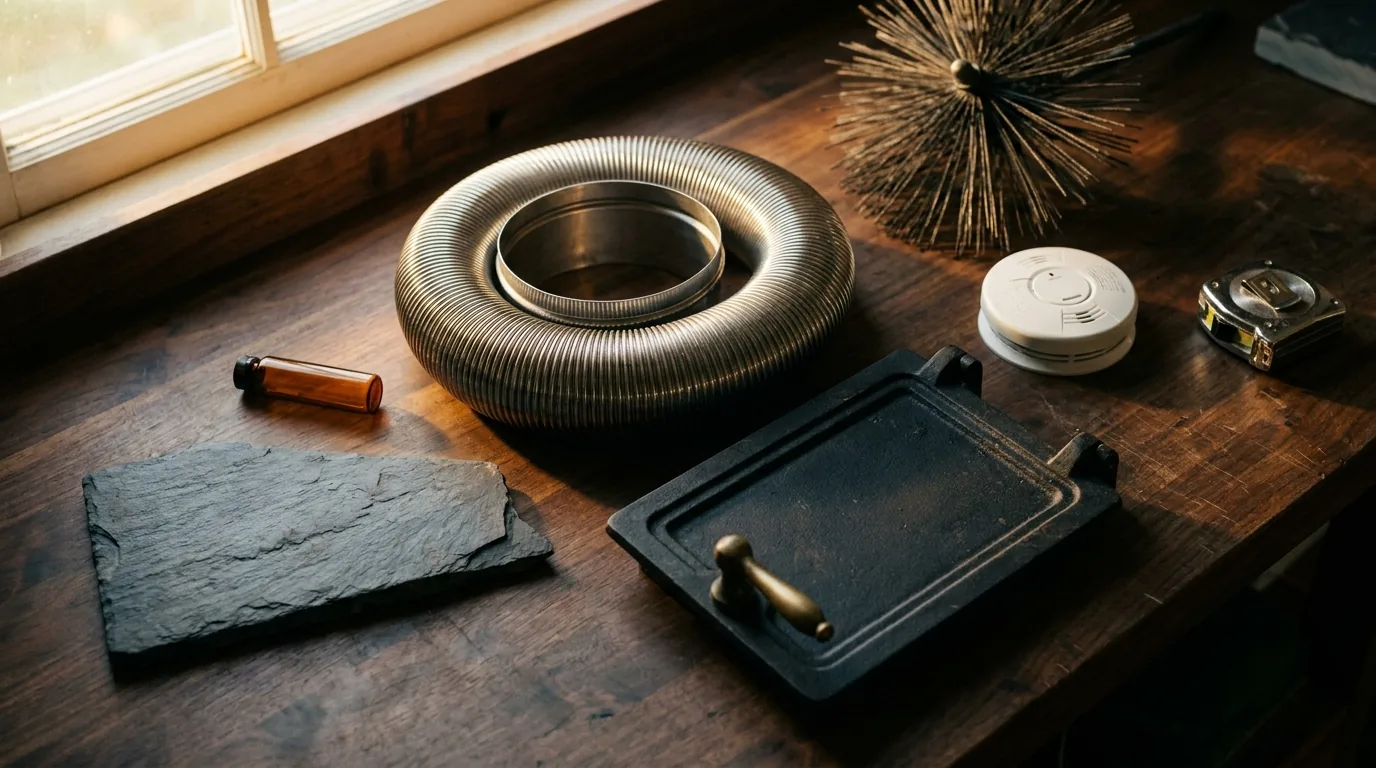
Log Burner Installation Quotes: Six Lines That Decide the Price
Log burner installation costs £2,500–£3,500 with a usable chimney, £4,600–£7,300 without. Here are the six quote lines that explain the gap. Part J explained.
In short: with a sound existing chimney, a complete log burner installation typically lands at £2,500–£3,500. Without a chimney, published 2026 installer figures put the same job at £4,600–£7,300. The stove itself is only £500–£2,500 of either figure, so almost the entire spread sits in lines most quotes describe in three words or fewer.
How much should a log burner installation quote be?
A standard installation into a working chimney, including a stainless steel flue liner, register plate, hearth, carbon monoxide alarm and certification, costs £2,500–£3,500 across most of the UK. The North sits at roughly £2,300–£3,200, the Midlands £2,500–£3,800, and London and the South East £3,200–£5,500 or higher. Where there is no chimney at all, a full twin-wall installation runs £4,600–£7,300, with the twin-wall flue element alone costing £1,800–£3,500 of that. The legal framework behind all of it is Part J of the Building Regulations 2010, which applies in England and Wales. The guidance quoted throughout this post is the England Approved Document J, the 2010 edition incorporating the 2010, 2013 and 2022 amendments, for use from 1 October 2022. Wales publishes its own Approved Document J, in force since 6 January 2025, which does not carry the 2022 English amendments, so Welsh readers should work from that version.
That is a spread of roughly £4,800 on jobs that look identical from the sofa. It is rarely dishonesty. It is that two installers have looked at the same fireplace and reached different conclusions about the flue, and neither has written down why.
Why the same job comes back at £2,500 and £7,300
Stove quoting is unusually seasonal, and this autumn the pressure has a number attached to it. Ofgem confirmed on 26 August 2026 that the price cap rises to £1,723 for a typical dual-fuel household from 1 October, an increase of £60, or 3.6%, which Ofgem rounds to 4%. Gas is up 8%; households without gas see under 1%. So a lot of people start ringing round for stove quotes in a hurry, at the point in the year when installer lead times are longest.
The variables that decide the price are invisible from the room. Whether the existing flue can be reused or has to be lined. Whether a liner is 316 or 904 grade. Whether the stack is sound or needs repointing first. Whether the floor under the proposed hearth is 125mm of concrete or 18mm of chipboard. Whether the installer can work off ladders or needs a scaffold. None of those appear in a one-line quote reading "supply and fit 5kW stove, £2,850". Two installers can price that same sentence £2,000 apart and both be quoting honestly, because they are quoting different work. This is the problem we describe in how to read a builder's quote: the number is not the information. The scope is.
| Component | Typical 2026 cost | What moves it |
|---|---|---|
| Stove (supply only) | £500–£2,500 | Output, brand, cassette vs freestanding |
| 316 grade flue liner, installed | £800–£1,200 | Wood-only use, 10–15 year life |
| 904 grade flue liner, installed | £1,000–£1,800 | Multifuel use, 15–25 year life |
| Twin-wall flue system (no chimney) | £1,800–£3,500 | Number of storeys, internal or external route |
| Hearth | £300–£1,200 | Slate or granite basic, cut stone or raised feature at the top |
| Installation labour | £500–£1,500 | One to two days, two installers; day rates £180 per installer in the North to £450 in London |
| Chimney sweep and survey | £60–£120 | Often billed separately from the install |
| Certification and notification | £50–£200 | Competent person scheme certificate |
| Air vent, CO alarm, sundries | £120–£350 | Depends on stove output and property airtightness |
| Access or scaffolding | £400–£700 | Two-storey work at the stack |
Figures are typical UK ranges compiled from BookaBuilderUK's 2026 wood burning stove installation cost guide and LogBurnerCost's chimney lining and no chimney data, checked September 2026. Access costs are from our own scaffolding quote analysis. Treat all of it as a benchmark, not a valuation of your specific chimney.
The six lines your quote must name
1. The stove, by make, model and kW output. "5kW multifuel stove" is not a specification. The rated output drives the air supply calculation and the flue sizing, so you want the manufacturer, the model and the kW. Every new stove placed on the UK market has had to meet Ecodesign emission and efficiency limits since January 2022, so "Ecodesign ready" on a 2026 quote states the legal minimum rather than a feature. A quote leaning on that phrase while omitting the model number is selling you the wrong thing.
2. The flue route, with the liner grade or twin-wall specification. This is the biggest cost variable and the one most often reduced to the word "flue". A 316 grade liner is rated for wood-only burning and lasts 10–15 years. A 904 grade liner handles the acidic residues from mineral fuels and lasts 15–25 years, at roughly 30% more. If you intend to burn smokeless fuel and the quote specifies 316, you are buying a liner that will need replacing early.
3. The chimney survey, sweep and test. Approved Document J paragraph 1.36 is explicit: where a flue is brought back into use, or reused with a different type or rating of appliance, it should be checked and, if necessary, altered to satisfy the proposed use. A quote that prices a liner without pricing an inspection has skipped the step that tells you whether the liner is needed at all.
4. The hearth, with its build-up and thickness. Paragraph 2.24 requires a constructional hearth of solid non-combustible material at least 125mm thick, including any non-combustible floor and decorative surface. The exception at paragraph 2.23 allows a 12mm non-combustible board, sheet or tile only where the appliance is not in an appliance recess and has been tested to show it cannot raise the upper hearth surface above 100°C. Paragraph 2.28 stops combustible material placed on or beside a constructional hearth extending under a superimposed hearth by more than 25mm, or coming closer than 150mm measured horizontally to the appliance. A 20mm slate slab dropped onto a suspended timber floor meets none of this.
5. The air supply and the carbon monoxide alarm. Table 1 of Approved Document J sets permanently open vent provision for stoves without a flue draught stabiliser at 550mm² per kW of rated output above 5kW in a typical existing home. Note "above 5kW": a 4.9kW stove often needs no dedicated vent, which is one reason so many are sold at that output. Paragraph 2.34 separately requires a carbon monoxide alarm in the room where a new or replacement fixed solid fuel appliance is installed, and paragraph 2.36 sites it between 1m and 3m horizontally from the appliance, on the ceiling at least 300mm from any wall or high on a wall but not within 150mm of the ceiling. Both belong on the quote as priced items.
6. The notification route and the certificate you will receive. This is the difference between a compliant installation and a problem at resale. It should name either the competent person scheme the installer is registered with, or the fact that you will be submitting a building notice. If it names neither, the work is not being notified.
Installing a solid fuel appliance is notifiable building work in England and Wales. There are two routes most homeowners will actually meet. Either the installer is registered with a competent person scheme and self-certifies the work, notifying your local authority for you, or the work is notified to a building control body before it starts and inspected. For a domestic stove that normally means a building notice to your local authority, though a full plans application or a private registered building control approver are also open to you. GOV.UK is clear that you do not need to get approval yourself if you use someone registered with a competent person scheme.
HETAS is not the law. Part J is.
This is the point retailer and installer marketing routinely gets wrong, and it costs homeowners money. HETAS describes itself accurately as the only competent person scheme specialising in solid fuel and biomass installation. Specialising is not the same as being mandatory. GOV.UK's list of authorised competent person schemes names six operators covering solid fuel including biomass: APHC, BESCA, Certsure trading as NICEIC, HETAS, NAPIT and OFTEC.
A non-registered installer is not automatically a cowboy either. A competent stove fitter who is not on a scheme can lawfully do the work, provided you submit a building notice and building control inspects it. Local authorities set their own fees for this, and a building notice for a solid fuel appliance commonly runs to a few hundred pounds, so check your own authority's published fee schedule before assuming the non-registered route is a saving. What you must not do is use a non-registered installer and notify nobody. That surfaces years later when a buyer's solicitor asks for the certificate, which is exactly the scenario we cover in what happens when a quote is missing building regs.
The test on a quote is simple. If the installer claims scheme registration, ask for the scheme name and registration number and check it on that scheme's own register before you pay a deposit. If they are not registered, ask who is submitting the building notice and who is paying the fee. For the difference between local authority building control and a private registered building control approver, the role that replaced the approved inspector in April 2024, see our guide to building control and approved inspectors.
Outside England, none of the above applies as written. Part J itself covers England and Wales, but every paragraph number quoted here is from the England Approved Document. Wales has its own version, in force since 6 January 2025 and without the 2022 English changes, so check the Welsh document before relying on a paragraph reference. Scotland runs on the Building Standards Technical Handbook (Domestic), with the April 2026 edition applying to building warrant applications made on or after 6 April 2026, and the approval route there is a building warrant rather than English-style self-certification. Northern Ireland uses Technical Booklet L. If you are in Scotland, confirm the route with your council's building standards team before accepting a quote, and see our Scottish building costs guide for how regional pricing differs.
Do you need a flue liner? Only if the chimney fails the test
Search this question and you will find a hundred pages answering "yes". That is wrong, and believing it can add £1,000–£1,800 to a job that did not need it. Approved Document J permits an existing flue to be brought back into use where it is checked and, where necessary, altered to suit the appliance. The decider is a test, set out in Appendix E, not a default:
- Sweep first. Appendix E11 requires an existing flue to be swept before a smoke test.
- Coring ball test. A heavy ball roughly 25mm smaller in diameter than the flue is lowered on a rope from the outlet to the base, proving minimum diameter and finding obstructions. It comes before smoke testing and is never used on a flexible metal liner, which it would damage.
- Smoke test I. Doors and windows closed, the flue warmed to establish a draught, smoke pellets ignited at the base, the base sealed, smoke seen to issue freely from the terminal, then the top sealed and the full length checked for significant leakage over at least five minutes.
In practice a large share of Victorian and Edwardian chimneys do fail, because they were built for open fires, are oversized for a modern stove, and have degraded parging. Paragraph 1.38 also notes a flue may need lining purely to reduce its area to suit the appliance, since oversize flues can be unsafe. So the liner is often genuinely necessary. The point is that your quote should be able to say which of those reasons applies to your chimney.
One more clause catches people replacing an old stove. Paragraph 1.39 says that where a chimney was relined in the past with a metal system and the appliance is being replaced, the metal liner should also be replaced, unless it can be proven recently installed and seen to be in good condition. A "we can reuse the existing liner" saving needs evidence behind it.
Ask for the completed Appendix A checklist. Approved Document J contains a standard form for hearths, fireplaces, flues and chimneys, and it records exactly what you want to know: whether the flue is new or existing, the liner type and make, the ventilation provision, the hearth construction and thickness, and the results of the visual, sweeping, coring ball, smoke and spillage tests. Asking for it before you sign tells you immediately whether the installer intends to test the flue or just line it.
No chimney: the line that doubles the price
If there is no chimney, the flue has to be built. A twin-wall insulated system runs from the stove, either up through the storeys internally or out through the wall and up the external face, terminating above the roofline at a height that satisfies Part J's terminal position requirements. That means structural work, a roof penetration or wall brackets, and usually access equipment.
This is where published figures diverge most sharply and underquoting is most common. A complete no-chimney installation with a mid-range Ecodesign stove, twin-wall flue, hearth, register plate, carbon monoxide alarm and certification sits at £4,600–£7,300 in 2026 data, with the twin-wall element alone accounting for roughly £1,800–£3,500 of it. If you have been quoted £3,000 for a no-chimney install, the question is not whether it is a bargain. It is which component has been left out.
Access is the other line that vanishes. Two-storey work at the stack usually needs a scaffold at £400–£700, more on a taller or awkward property. Some installers include it, some assume ladders, some do not mention it until the week before. Our scaffolding cost guide sets out a fair access price. Strip access out of all three quotes before comparing, as in our method for comparing builder quotes.
Smoke control areas, Ecodesign and DEFRA exemption are three different things
Competitor coverage blurs these constantly. Only one of them is about where you live.
| Concept | What it actually means | Who it binds |
|---|---|---|
| Ecodesign | Emission and efficiency limits a new appliance must meet to be placed on the UK market, in force since January 2022 | The manufacturer and retailer, not you |
| DEFRA exempt appliance | An appliance on the published exempt list, which may burn unauthorised fuel such as wood inside a smoke control area | Only relevant if you are in a smoke control area |
| Smoke control area | A designated area where you cannot release smoke from a chimney and may only burn authorised fuels unless using an exempt appliance | You, based on your address |
An Ecodesign stove is not automatically a DEFRA exempt appliance. Most modern stoves are both, but the quote should confirm exemption by name if you are in a smoke control area. GOV.UK sets the penalties: up to £300 for smoke emission from a chimney in England, and up to £1,000 for buying unauthorised fuel for use in an appliance that is not exempt. Your council's environmental services team confirms whether your address is designated, and that call is worth making before you order a stove rather than after.
What is changing, correct as at September 2026
Defra ran a consultation on reducing smoke emissions from solid fuel burning from midday on 22 January 2026 to midday on 19 March 2026, covering new stove emission limits, labelling of stoves and fuels, and higher penalties for non-compliance with existing regulations. As at the date of this post the consultation is closed and the government response has not been published.
Two things follow. First, none of it changes what is legal to install today. Proposals are not rules, and any installer telling you to buy now before a ban is selling, not advising. Second, if you are buying this autumn, buy a current-standard appliance from a mainstream manufacturer and keep the paperwork, because that is the position that ages best whatever the response says. We will update this post when the outcome lands.
Common mistakes
Treating "HETAS registered" as the whole compliance answer. It is a route to compliance, not compliance itself. What you need at the end is a certificate and a notification lodged with your local authority. Ask which scheme, ask for the registration number, and ask when the notification will be filed.
Accepting a liner without a flue test. If nobody has swept and tested the chimney, nobody knows whether the liner is necessary, whether the flue is oversized, or whether the stack needs repointing first. You may be paying £1,200 to solve a problem that does not exist.
Letting the hearth be described in one word. The 125mm constructional hearth requirement, and the narrow 12mm exception that depends on the appliance being tested to keep the hearth surface below 100°C, are the most commonly ignored parts of Part J in domestic installs. A decorative slab on a timber floor looks finished and is not compliant. Get the build-up written down.
Comparing three quotes that assume different flue routes. One installer has assumed the existing chimney is fine, one has priced a 316 liner, one has priced 904. Those are three different jobs. Normalise the scope before you look at the totals, using our guide to what a builder's quote should include.
Forgetting the running costs and the annual sweep. A stove is not free heat. You need dry seasoned or Ready to Burn fuel, dry storage for it, and an annual sweep at £60–£120. If you are weighing a stove against upgrading your main heating instead, our boiler replacement cost guide gives the comparison figures.
Before you sign
The whole game with stove quotes is forcing the invisible parts onto paper. A quote naming the stove model, the liner grade or twin-wall specification, the flue test, the hearth build-up, the vent calculation and the notification route can be compared and challenged. One that says "supply and fit stove" cannot be compared to anything, including itself.
Got a log burner quote? Check whether the flue liner grade, hearth build-up and Part J notification are actually priced in
See how your costs compare to thousands of real UK quotes.
Get my estimateWas this useful?