Boiler Quote: What to Check Before You Sign
A boiler quote should name the model, state 92% ErP efficiency and, for a combi in England, name one of four extra measures. Nine checks before you sign it.
Boiler quotes are short. That is the problem. A roof replacement quote runs to two pages because there are twenty things to describe. A boiler quote is often four lines and a total, and those four lines hide a set of Building Regulations requirements that most homeowners have never heard of and a price spread of well over £1,000 for the same job.
September to December is when most of these quotes land, because that is when marginal boilers fail. Here is what should be on the piece of paper.
What should you check on a boiler quote?
Check nine things: the exact make, model and kW output of the boiler; the seasonal efficiency, which should be at least 92% ErP for a wet gas system in an existing English home; which of four permitted extra measures is being fitted if it is a combi; the room controls; the separate time control for hot water and space heating; the boiler interlock; the system clean and inhibitor; the flue and condensate route; and the sign-off, meaning the Building Regulations notification and the warranty registration. Those nine come almost entirely from Approved Document L, Volume 1: Dwellings, 2021 edition incorporating 2023 amendments. Everything else on the quote is commercial negotiation. Those nine are the difference between an installation you can certify and one you cannot.
Table 6.2 sets a minimum seasonal efficiency of 92% ErP for gas wet heating in an existing dwelling, with a narrow exception permitting a lower figure in the exceptional circumstances defined by the Condensing Boiler Installation Assessment Procedure. Paragraph 6.2 requires that a gas combination boiler installed in an existing dwelling is accompanied by at least one of four energy efficiency measures. Paragraph 5.20 requires thermostatic room controls in each heated room when a boiler is replaced, and paragraph 5.25 requires a boiler interlock. This guidance applies in England.
The nine lines that should be on the quote
A compliant quote states each of these explicitly. A vague quote leaves them to the day of the install, which is when they get skipped.
| Line | What a proper quote says | Why it matters |
|---|---|---|
| Boiler identity | Make, model and output, for example "Worcester Bosch Greenstar 4000 30kW combi" | "Supply and fit new combi" can mean a £700 boiler or a £1,800 one |
| Seasonal efficiency | "92% ErP or better" | Table 6.2 minimum in England for gas wet heating in an existing home |
| Combi extra measure | Names one of the four measures below | Paragraph 6.2. The single most commonly missing line |
| Room controls | Room thermostat plus a thermostatic valve on every emitter outside that room | Paragraph 5.20 to 5.22, triggered by replacing the boiler |
| Time control | Separate time control for hot water and space heating, where they are separately controlled now | Paragraph 5.24 |
| Boiler interlock | "Controls wired so boiler and pump shut down when there is no demand" | Paragraph 5.25 |
| Clean and inhibit | "System cleaned and flushed to BS 7593, inhibitor added, magnetic filter fitted" | Paragraph 8.8 requires cleaning and inhibitor before the new appliance goes on |
| Flue and condensate | Flue position and termination, plus where the condensate drains to | External condensate runs freeze and lock the boiler out in January |
| Sign-off | "Notified to building control via competent person scheme; manufacturer warranty registered" | Paragraph 8.5 gives 30 days from completion for the notice |
Two of these carry more weight than the rest. The combi extra measure is a Building Regulations requirement that a large share of quotes simply do not mention, and the room controls requirement is triggered by the boiler swap itself, not by any separate decision you make.
The controls point catches people out because it applies to the whole house. If your boiler is being replaced, every heated room needs a thermostatic room control. In practice that means a room thermostat somewhere, and a thermostatic radiator valve on every radiator outside that room. Approved Document L is explicit that thermostatic radiator valves should not be fitted in the same room as the thermostat, because the two fight each other. There are narrow exceptions where a heating zone may be controlled instead of individual rooms: single-storey open-plan dwellings in which the living area is greater than 70% of the total floor area, and pairs of adjacent rooms with a similar function, such as a kitchen and utility.
If a quote says "new boiler, existing controls retained" and your radiators have manual valves, the installer is either about to add valves for free or about to leave you non-compliant. Ask which.
The combi rule most quotes miss
If the boiler going in is a gas combi and the property is an existing dwelling in England, paragraph 6.2 requires at least one of exactly four measures. Not a smart thermostat specifically. One of these four.
| Measure | What it does | Indicative add-on | Suits |
|---|---|---|---|
| Flue gas heat recovery | Recovers heat from flue gases to pre-heat incoming mains water | £400–£700 | Homes with heavy hot water use; needs space around the boiler |
| Weather compensation | Outdoor sensor drops flow temperature as outside temperature rises | £100–£250 where the boiler supports the input | Most homes; cheapest route to real efficiency gains |
| Load compensation | Modulates flow temperature against the gap between room and target temperature | £0–£150, often built into the manufacturer's own control | Homes where an outdoor sensor is awkward to run |
| Smart thermostat with automation and optimisation | Learns warm-up times and adjusts the heating programme | £150–£400 | Homes that want app control anyway |
Those bands are indicative ranges drawn from typical UK installer pricing rather than a published dataset, so treat them as a sense-check rather than a benchmark to argue from. They depend heavily on whether the boiler you are being quoted already supports the input, and whether the installer has to run a new cable to an external wall. A weather compensation sensor on a boiler that natively accepts one is a cheap job. The same sensor on a boiler that needs a separate interface module is not.
The point for you is simpler than the engineering. Ask which of the four you are getting, and get it named on the quote. A quote that names one has been written by someone who knows the rule. A quote that names none has usually been written from a template, and the measure will be decided on the day by whatever is in the van.
Be equally wary in the other direction. "Building Regulations require a smart thermostat" is a common upsell and it is not true. It is one of four options, and it is not always the best one. Weather compensation usually delivers more saving for less money, because it lowers flow temperature continuously rather than just switching earlier or later.
Sizing: the number nobody asks for
Oversizing is the most expensive mistake on a boiler quote and it never appears as a line item.
Approved Document L paragraph 5.8 says the specification of a space heating system should be based on an appropriate heat loss calculation for the dwelling and a recognised sizing methodology, and that systems should not be significantly oversized. Paragraph 5.9 adds that a gas combi should be selected to modulate down to the typical heating load of the property.
In practice, a lot of replacements are sized off the badge on the old boiler. A 30kW combi comes out, a 30kW combi goes in, and nobody calculates anything. Most three-bed semis lose nowhere near 30kW. The result is a boiler that cycles on and off, runs above its condensing range, and costs more to run than the smaller unit would have. The 2026 edition of Approved Document L, which takes effect on 24 March 2027 in England for work that is not connected to higher-risk buildings, states the point flatly: sizing a replacement heating appliance using the heat output of the currently installed appliance is not appropriate.
A combi's kW rating is mostly about hot water flow rate, not space heating. That is a legitimate reason to fit a larger output than the heat loss alone suggests, but it is a reason your installer should be able to say out loud. "You need 28kW because you have two bathrooms and want 12 litres a minute at the shower" is an answer. "That's what was there before" is not.
Ask for the heat loss figure. You do not need to check the arithmetic. You need to know whether anyone did it.
England only, and what applies elsewhere
Everything above is England. Approved Document L is guidance on how to comply with Part L of the Building Regulations 2010. Those Regulations apply across England and Wales, but Wales amends them separately and publishes its own Approved Documents, so the English guidance, and the paragraph numbers in it, stop at the border.
Wales publishes its own Approved Document L, with a separate 2026 edition taking effect on 4 March 2027. Scotland does not use Approved Documents at all; it works to the building standards technical handbook for domestic buildings, maintained by the Scottish Government. Northern Ireland runs its own technical booklets. The general shape of the requirements is similar across all four nations, but the paragraph numbers, the efficiency floors and the combi measure rule are not automatically the same, so do not let an installer quote you an English paragraph number in Glasgow. Our guides to building costs in Scotland and home improvement costs in Wales cover the regional labour picture.
Gas safety is the one thing that does not vary. Under the Gas Safety (Installation and Use) Regulations 1998, anyone working on a gas appliance in a domestic property must be on the Gas Safe Register, and HSE guidance is clear that the engineer's ID card lists which appliance types they are actually qualified for. Check the card, not the van livery. Our plumber's quote guide covers the wider set of qualifications that go with heating work.
The "boiler tax" line that should not be on your quote
Since 2024 there has been a steady drip of coverage about a boiler tax pushing up prices. The underlying policy is real. The charge on your quote is not.
The Clean Heat Market Mechanism sets heat pump targets for boiler manufacturers above a sales threshold. In scheme year 1 the target was 6% of qualifying gas boiler sales above 19,999 units. For scheme year 2, running from April 2026, it rose to 8%. Manufacturers earn credits by selling heat pumps, surrender them by 1 October after each scheme year, and pay £500 for each unit of unmet target, due by 30 November. The first surrender date, 1 October 2026, is a compliance deadline for manufacturers. Nothing happens to your price on that day.
In early 2024 several major manufacturers announced per-boiler surcharges of roughly £95–£120 and blamed the mechanism. They withdrew them within weeks, after the scheme's start was pushed back to April 2025. We are not aware of any manufacturer currently publishing an itemised Clean Heat Market Mechanism charge, and there is no verified per-boiler levy figure to quote in 2026. List prices have risen since 2024 for several reasons at once, and the mechanism is one claimed factor among general cost inflation rather than a separately identifiable line.
The 8% target is in force and it is also genuinely contested, with parts of the heating industry campaigning to have it dropped. That argument is live. It is not a reason to accept a mystery charge.
If your quote shows a line called boiler tax, CHMM levy, or anything similar, ask the installer to explain what it is and who it is paid to. There is no such charge to pass on to you. Ask for the quote to be reissued without it, or take the quote elsewhere.
This is also where the "ban" pressure shows up. Nobody is banning the replacement of the boiler in your existing home, and our guide to what the 2027 rules actually say sets out the difference between new build and existing homes. A quote that leans on a deadline to close the sale is a quote to be sceptical of.
The £7,500 grant is not for gas boilers
This one is worth stating bluntly because it comes up constantly on doorsteps and in comparison sites. The Boiler Upgrade Scheme funds heat pumps and biomass boilers only. Fossil fuel heating is what the scheme pays you to replace. It is never what the scheme pays for.
So there is no grant against your gas boiler quote. It only becomes relevant if you decide to price a heat pump alongside it, in which case our Boiler Upgrade Scheme guide covers the current rates and how the money should appear on the paperwork. If anyone offers you a government grant against a gas boiler, they have either misunderstood the scheme or they are hoping you have.
What goes wrong
The boiler is never named. "Supply and fit new combination boiler" with a single price is the most common defect in the whole category. Between a budget unit and a premium one there can be over £1,000 of trade cost, five years of warranty and a real difference in modulation range. Without a make, model and kW figure you are not comparing quotes, you are comparing guesses. Our guide to what a quote should include applies the same test across every trade.
Nobody names the combi measure. The quote is silent, the install happens, and the extra measure is either fitted from whatever is in the van or quietly skipped. You will not spot it. Get one of the four named in writing before the deposit.
The flush is a word, not a job. Paragraph 8.8 requires the system to be thoroughly cleaned and flushed and an inhibitor added before the new appliance goes on. "Chemical flush" on a quote can mean a full powerflush with a machine or twenty minutes with a hosepipe. Ask which, ask how long it takes, and ask whether a magnetic filter is included. Sludge from an old system is the fastest way to void a new boiler's warranty.
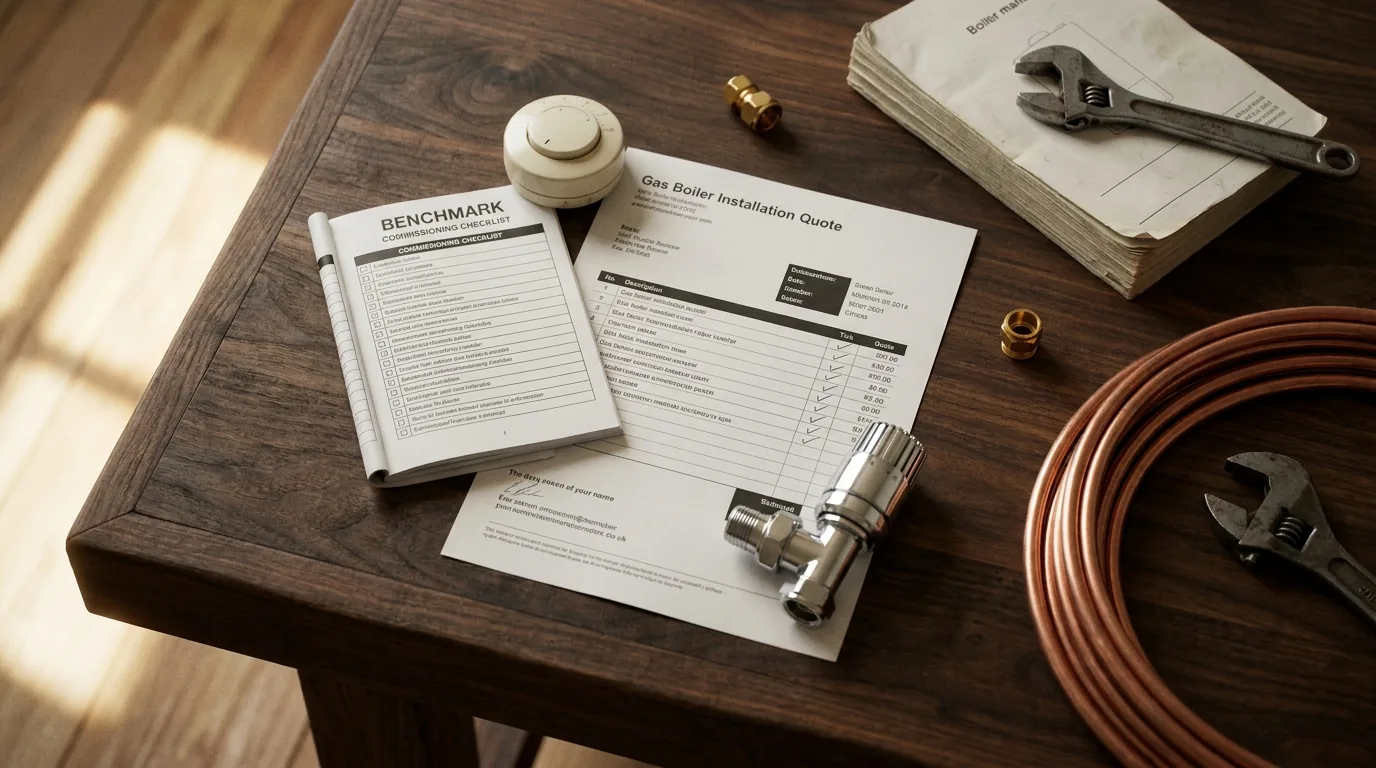
The Benchmark checklist is left blank. Every boiler comes with a Benchmark commissioning checklist in the back of the manual. It records the gas rate, the flow and return temperatures, the inhibitor used and the commissioning date, and manufacturers routinely require it to be completed for the warranty to stand. Approved Document L also expects you to be given operating and maintenance instructions including a completed commissioning sheet. Check the pages are filled in and signed before the installer leaves. A blank Benchmark is a warranty claim waiting to be refused.
The certificate never turns up. The notice to building control is due within 30 days of completion, and you should receive a compliance certificate afterwards. Missing paperwork is easy to ignore until you sell, at which point it becomes a delay and a price negotiation. If a quote does not mention notification at all, that is a signal worth acting on. Our guide on quotes that skip building regs explains what to do about it.
Before you sign
Get three quotes, and compare the nine lines rather than the three totals. Our boiler replacement cost guide gives the regional price bands to benchmark against.
The cheapest boiler quote is usually cheapest because something on that list is missing. Find out which one before you find out in January.
Got a boiler quote? Check the 92% efficiency line, the combi measure and the sizing
See how your costs compare to thousands of real UK quotes.
Get my estimateWas this useful?