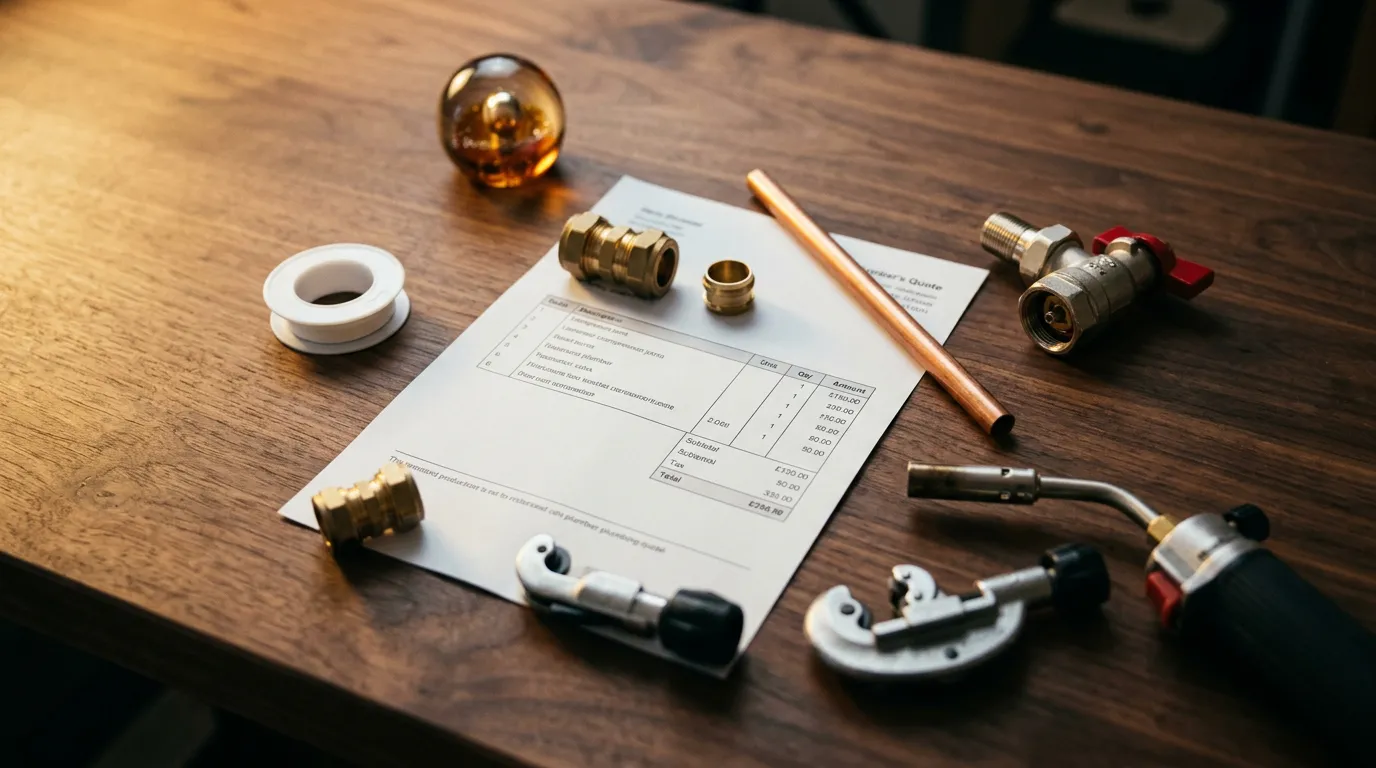
Plumber's Quote - What to Check Before You Say Yes
What should a plumber's quote include? Here's exactly what to look for, typical UK costs for 2026, and the red flags that cost homeowners thousands.
Plumbing quotes can be baffling. You ask three plumbers to price the same job and you get three wildly different numbers, three different formats, and three different levels of detail. One's a text message. One's a two-page PDF. One's scribbled on the back of an invoice.
The problem isn't that plumbers are bad at quoting. It's that there's no standard. Nobody teaches them how to write a quote. So the detail you get depends entirely on who you ask. That means the job of spotting what's missing falls on you.
Here's what to look for - and what most homeowners miss.
What a good plumber's quote looks like
A proper plumbing quote should read like a shopping list with prices attached. Every item should be individually named, and every cost should be clear.
For a bathroom refit, that means lines like:
- Remove existing suite and dispose
- Supply and fit close-coupled toilet (Roca Debba or equivalent)
- Supply and fit pedestal basin with mono mixer tap
- Supply and fit thermostatic shower valve, riser rail, and fixed head
- First fix pipework (the pipe runs done before tiling - hot, cold, and waste connections)
- Second fix connections (fitting the actual taps, shower, and toilet after the tiles are on)
- Isolation valves (small shut-off valves fitted to each appliance so you can turn off one thing without shutting down the whole house)
For a boiler install, you should see the boiler make and model by name - not just "supply and fit boiler." There's a massive difference between a Baxi 228 and a Worcester 8000. The quote should tell you which one you're getting.
Labour and materials should be shown separately. If they're bundled into a single "supply and fit" line for each item, that's acceptable - but you should still be able to see the total labour cost versus the total materials cost somewhere on the quote.
If you're not sure what a properly structured trade quote should include, our guide on what a builder's quote should include covers the fundamentals. The same principles apply to plumbing.
What plumbing jobs cost in 2026
These are typical UK prices outside London. Add 15–25% for London and the South East.
| Job | Typical cost (2026) |
|---|---|
| Boiler install (combi, like-for-like swap) | £2,500–£4,500 |
| Boiler install (system change - e.g. conventional to combi) | £3,500–£6,000 |
| Full bathroom plumbing (first fix and second fix, no tiling) | £1,500–£3,000 |
| Unvented hot water cylinder swap (a pressurised cylinder that gives mains-pressure hot water - requires G3 qualification) | £800–£2,000 |
| Single radiator install (including pipework) | £250–£500 |
| Full central heating system (8–10 radiators, new pipework) | £3,500–£6,000 |
| Emergency callout (first hour) | £100–£200 |
| Day rate (general plumbing) | £200–£350 |
| Shower install (electric, over bath) | £250–£500 |
| Outside tap installation | £100–£200 |
| Waste pipe rerouting | £150–£400 |
A few things skew these numbers. Access is a big one - if the plumber needs to lift floorboards to run pipes under a suspended timber floor, that adds time. Concrete floors are worse: chasing pipes into concrete or running them through the ceiling below is slower and messier.
The age of your property matters too. Victorian houses often have lead pipes, cast-iron waste stacks, and pipework routed in ways that make no logical sense. Expect the price to reflect that.
Red flags in plumbing quotes
No Gas Safe registration number
If any part of the work involves gas - boiler install, gas hob connection, gas fire, or even disconnecting an old gas appliance - the plumber must be Gas Safe registered. This isn't optional. It's a legal requirement.
A proper quote for gas work should include the plumber's Gas Safe registration number. You can verify it at GasSafeRegister.co.uk. If they don't mention it, ask. If they can't provide it, walk away. Unregistered gas work is dangerous and illegal, and it'll cause problems when you sell the house.
"Per day" pricing without a total
Day rates are fine for small, unpredictable jobs - tracing a leak, diagnosing a boiler fault, fixing a dripping tap. For anything bigger, you need a fixed total.
"Bathroom plumbing: approximately 4–5 days @ £280/day" sounds reasonable until the job takes eight days and you're suddenly £2,240 deep with no end in sight. Ask for a fixed price. If the plumber genuinely can't estimate the scope, ask for a capped day rate - "day rate up to a maximum of £X."
Won't specify the boiler brand or model
"Supply and fit new combi boiler: £3,200" tells you nothing about what you're actually getting. Is it a budget Baxi at £800 trade price or a premium Viessmann at £1,800? The difference matters - not just in price, but in reliability, warranty length, and running costs.
A good plumber will name the exact boiler, including the output (kW rating), and explain why they've chosen it for your property. If they won't commit to a specific model, they're keeping their options open - and that usually means fitting whatever's cheapest on the day.
Wanting full payment upfront
No reputable plumber asks for full payment before the work is done. A small deposit for materials - 10–20% - is normal for bigger jobs like a boiler install. Paying for the boiler itself upfront is understandable, as the plumber shouldn't be financing your equipment.
But 50% or more before they've turned a spanner? That's a red flag. For more on how deposits should work, read our guide on whether a builder asking for 50% deposit is reasonable. The same logic applies to any trade.
What's often missing from plumbing quotes
These are the items that cause arguments after the job starts. They're not on the quote because nobody thought to mention them - but somebody has to pay for them.
Building control notification
Certain plumbing work needs to be notified to your local authority's building control department. The big one is unvented hot water cylinders (pressurised cylinders that deliver mains-pressure hot water). Installing or replacing one of these requires notification under Building Regulations Part G. The plumber should either be registered with a competent persons scheme (which lets them self-certify) or arrange a building control inspection.
If they don't mention it, ask. An uninspected unvented cylinder is a safety risk and a problem when you sell.
Waste pipe runs
Connecting a basin or shower to the soil stack (the main vertical waste pipe, usually the big pipe on the outside of your house) is straightforward if the stack is nearby. But if you're fitting a new bathroom at the other end of the house, the waste pipe run could be several metres - through floors, along joists, or externally down the side of the house.
Long waste runs add cost and complexity. They need a minimum fall (gradient) to drain properly. If the quote just says "connect to waste" without specifying the route, ask where exactly the waste pipe is going.
Making good after pipe chasing
When pipes run through walls, the plumber chases channels (cuts grooves) into the plasterwork and brickwork. Once the pipes are in, those channels need plastering over.
Most plumbers don't plaster. That's a different trade. So if the quote says "first fix plumbing" and doesn't mention making good, you'll be left with chased-out walls and a plasterer to organise yourself. Clarify who's responsible.
Isolation valves
These are small shut-off valves fitted to each appliance - basin, toilet, washing machine - so you can isolate one item without turning off the water to the entire house. They cost about £5 each. But if the plumber doesn't fit them, you'll notice the first time a toilet cistern starts leaking at midnight and you have to shut off the mains to stop it.
Good plumbers fit them as standard. If they're not mentioned on the quote, ask.
Pressure testing
Once new pipework is installed, it should be pressure tested before it gets hidden behind plasterboard or tiles. This confirms there are no leaks. It takes 10 minutes and saves thousands in water damage later.
If the quote doesn't mention testing, it's probably happening anyway - but it's worth confirming in writing.
How to compare plumbing quotes
Getting three quotes for the same job is the bare minimum. But comparing them properly means looking beyond the total.
Check the scope matches. Does each quote cover the same work? One plumber might include waste pipe routing while another excludes it. One might include isolation valves, another won't. Line up the scope items side by side.
Check what's excluded. The cheapest quote is often cheapest because it's missing things. Hidden renovation costs are the number one cause of budget overruns - our guide to hidden costs covers the usual suspects.
Check the brands. If one plumber quotes a £3,200 boiler install and another quotes £4,100, the difference might be the boiler itself, not the labour. Compare make and model, not just the bottom line.
Check qualifications. Gas Safe for gas work. G3 qualified (unvented hot water) for pressurised cylinder work. WIAPS registered (Water Industry Approved Plumber Scheme) is a bonus. These aren't just badges - they mean the plumber has been assessed and can self-certify their work.
Ask about guarantees. Labour guarantees of 12 months are standard. Some offer longer. Manufacturer warranties on boilers and cylinders vary from 2 to 12 years - but only if the installer registers the product within 30 days. Make sure that's included.
When the work is complete, our guide on how to check plumbing and drainage tells you exactly what to inspect.
Get a benchmark before you commit
Not sure if the numbers you're seeing are fair? Use our free cost estimator to get a ballpark for your specific job, location, and spec. It takes a couple of minutes and gives you something concrete to compare against.
If you've already got a quote and want a second opinion, upload it to MyBuildAlly and we'll check the pricing, flag missing items, and tell you whether the scope covers everything it should. An independent check takes minutes - and it's a lot cheaper than finding out you've overpaid after the pipes are in the wall.
Was this useful?