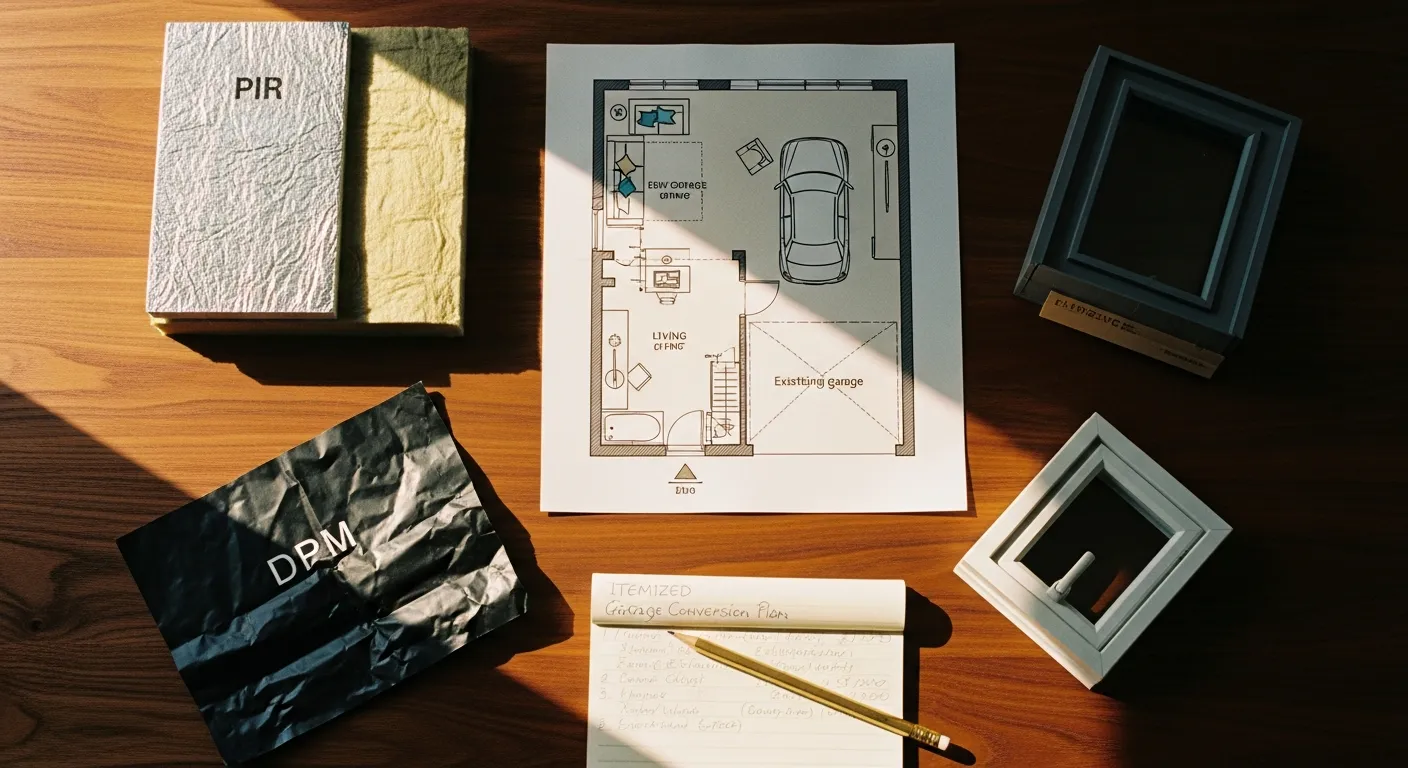
Garage Conversion Cost UK 2026: Full Breakdown
Garage conversion costs in the UK range from £8,000 to £25,000 depending on specification. Full breakdown by type with real 2026 prices.
In short: A single garage conversion costs £8,000–£18,000 depending on specification. A double garage gives you more options but expect £15,000–£25,000+. It's one of the cheapest ways to add a room to your home - no foundations, no roof, no planning permission in most cases. But the devil is in the detail, and quotes vary wildly because builders define "garage conversion" differently.
Quick cost summary
| Type | Basic | Standard | High spec |
|---|---|---|---|
| Single garage (15m²) | £8,000–£11,000 | £12,000–£15,000 | £16,000–£18,000 |
| Double garage (30m²) | £13,000–£17,000 | £18,000–£22,000 | £22,000–£25,000+ |
| Integral garage (single) | £7,000–£10,000 | £10,000–£14,000 | £14,000–£17,000 |
Integral garages (built into the house) are cheaper because at least one wall is already insulated and connected to the house structure. Detached garages cost more - and if the garage is separate from the house entirely, you're looking at additional costs for connecting services.
Costs based on BCIS regional benchmarks and MyBuildAlly quote analysis, Q1 2026. Your actual costs will vary based on specification, access, and local labour rates.
What makes it basic, standard, or high spec?
The difference between an £8,000 conversion and a £25,000 conversion is mostly about finish and features:
Basic - insulated walls and ceiling, concrete floor with vinyl or laminate, one window replacing the garage door, basic electrics (lights, a few sockets), plastered and painted. Functional but no frills.
Standard - as above plus underfloor insulation, a proper damp-proof membrane, new window and replacement front wall (brick or rendered block), consumer unit upgrade, radiator or electric heating, and a reasonable finish throughout. This is where most people land.
High spec - full specification with bi-fold or French doors, en-suite or WC, underfloor heating, high-quality flooring, built-in storage, smart lighting, and a finish that matches the rest of the house. If you're adding a bathroom, expect plumbing costs to jump significantly.
Trade-by-trade breakdown
Here's where the money actually goes on a standard single garage conversion:
| Trade | Cost range | Notes |
|---|---|---|
| Garage door removal & new front wall | £1,500–£3,500 | Brick/block infill with window. Bi-fold doors add £2,000–£4,000 |
| Floor insulation & screed | £1,200–£2,500 | Dig down if headroom is tight - adds £1,000+ |
| Wall insulation & plasterboard | £1,000–£2,000 | Stud walls with insulation batts, or insulated plasterboard direct to walls |
| Ceiling insulation | £400–£800 | Depends on existing roof structure |
| Electrics | £1,200–£2,500 | Lights, sockets, consumer unit upgrade if needed |
| Plumbing & heating | £800–£2,000 | Radiator extension from existing system. En-suite adds £3,000–£5,000 |
| Plastering | £800–£1,500 | Skim coat on plasterboard |
| Flooring | £500–£1,500 | Vinyl from £500, engineered wood from £1,000 |
| Decoration & finishing | £500–£1,000 | Paint, skirting, architrave, door furniture |
| Windows & external door | £600–£1,500 | If adding side or rear windows beyond the front wall |
Total for a standard single garage conversion: £12,000–£15,000
Building regulations - what's required
Garage conversions don't usually need planning permission, but they always need building control sign-off. The Approved Documents quoted below apply to England. Wales has its own Approved Documents with different figures, Scotland works to the Building Standards Technical Handbooks and needs a building warrant granted before work starts, and Northern Ireland uses Technical Booklets. Building control will check:
- Thermal performance - Part L sets maximum U-values, not insulation thicknesses. Converting a garage is a change to energy status under Approved Document L Volume 1 (2021 edition incorporating 2023 amendments), paragraph 11.6, so the retained garage walls, floor and roof must be upgraded to Table 4.3 column (b): 0.30 W/m²K for a wall insulated internally or externally, 0.25 W/m²K for the floor and 0.16 W/m²K for the roof. Anything genuinely new, such as the infill wall replacing the garage door, has to meet the tighter Table 4.2 standards of 0.18 W/m²K for walls and floors and 1.4 W/m²K for windows and doors. Insulation depth is whatever the build-up needs to reach those numbers, so ask the builder which U-value the quote is priced to rather than accepting a thickness on trust
- Structural adequacy - the existing structure must support the new use. Garage floors are often thinner than habitable room floors and may need upgrading
- Fire safety - if you convert only part of an integral garage and the rest stays a garage, Approved Document B Volume 1 paragraph 5.6 requires the new dividing wall to give 30 minutes of fire resistance (REI 30) from the garage side, and paragraph 5.7 requires any door between the two to be a self-closing E 30 Sa fire doorset with the opening at least 100mm above the garage floor, or the garage floor laid to fall away to the outside. Convert the whole garage and there is no garage left, so that separation stops applying. What applies either way is paragraph 1.8: a new habitable room at ground level with no final exit of its own needs a fire detection and alarm system, with mains-powered smoke alarms in the circulation spaces
- Ventilation - habitable rooms need adequate ventilation. Trickle vents in windows and potentially an extract fan
- Damp proofing - a proper DPC (damp-proof course) and DPM (damp-proof membrane) are essential. See our guide to checking DPC work
- Drainage - if you're adding a WC or shower, drainage connection and soil pipe routing
Building regulations approval typically costs £300–£600 through your local authority, or you can use a private registered building control approver (the private route was renamed from "approved inspector" on 6 April 2024).
The floor - your biggest hidden variable
Garage floors are the single biggest cost variable that catches people out. Most garage floors are:
- Lower than the house floor - you may need to raise the floor level, which means digging out and relaying with insulation underneath
- Not insulated - a new insulated floor build-up takes 150–200mm of depth
- Not damp-proofed - a new DPM is essential
If your garage floor is already at the right level relative to the house, you might get away with insulated plasterboard on top of the existing slab. If it needs digging out and relaying, that's £1,500–£3,000 on its own. Always check this before accepting a quote - a builder who hasn't mentioned the floor level is either planning to bodge it or hasn't thought it through.
Single vs double garage conversion
A double garage (typically 5.5m × 5.5m or 30m²) gives you genuine options:
- Single large room - home office, playroom, or living space
- Two rooms - bedroom plus en-suite, or office plus utility room
- Room plus storage - keep some garage storage with a partition wall
The cost per square metre is lower for a double garage conversion (£500–£700/m²) compared to a single (£550–£800/m²) because the fixed costs - building regs, electrics, heating connections - don't double.
If you're converting a double garage and adding an en-suite bathroom, budget an extra £3,000–£5,000 for the plumbing, sanitaryware, tiling, and extract ventilation. Check our bathroom fitter quote checklist for what should be included.
Regional price differences
| Region | Factor vs national avg |
|---|---|
| Greater London | ×1.15–1.25 |
| South East | ×1.05–1.15 |
| South West | ×0.95–1.05 |
| Midlands | ×0.90–1.00 |
| North West | ×0.85–0.95 |
| North East | ×0.80–0.90 |
| Scotland | ×0.85–0.95 |
| Wales | ×0.80–0.90 |
For regional detail, see our guides to building costs in the South East, North England, Scotland, Wales, and the Midlands.
Common extras that inflate the price
Watch out for these in (or missing from) your quote:
- Skip hire - £250–£400 for removing old garage contents and rubble
- Drainage - if adding a bathroom, connecting to the existing drainage run can cost £500–£2,000 depending on distance and whether you need to go under the house
- External rendering - matching the new front wall to the rest of the house. £500–£1,500
- Driveway reinstatement - if the existing driveway extends into the garage, you may want to landscape or re-pave. £500–£2,000
- Utility relocation - if the gas meter or consumer unit is in the garage, moving them costs £300–£800 each
- Building regs fees - £300–£600, sometimes excluded from builder quotes
How to keep costs down
- Keep the existing slab if possible - raising the floor is cheaper than digging it out
- Don't over-spec the front wall - rendered blockwork is cheaper than matching brickwork and often looks fine
- Skip the en-suite - a WC alone is much cheaper than a full bathroom
- Use your existing heating system - extending a radiator circuit is cheaper than standalone electric heating in most cases
- Get the spec right before you start - knowing what a quote should include helps you compare like-for-like
What about your project?
Garage conversions look simple on paper but the specification differences between quotes can be enormous. One builder's "garage conversion" might include a new front wall with window, full insulation, and underfloor heating. Another's might mean plasterboarding over bare brick and laying vinyl on the existing slab. Upload your quote to MyBuildAlly and we'll flag any scope gaps, check the price against regional benchmarks, and make sure nothing important has been left out.
Sources
- BCIS Average Building Prices - regional cost benchmarks, Q1 2026
- Planning Portal - Garage Conversions - planning and building regulations guidance
- Approved Document L: Conservation of Fuel and Power - thermal performance requirements
- Approved Document B: Fire Safety - fire resistance requirements for integral garages
- Analysis of residential construction quotes submitted to MyBuildAlly, January–March 2026
Was this useful?