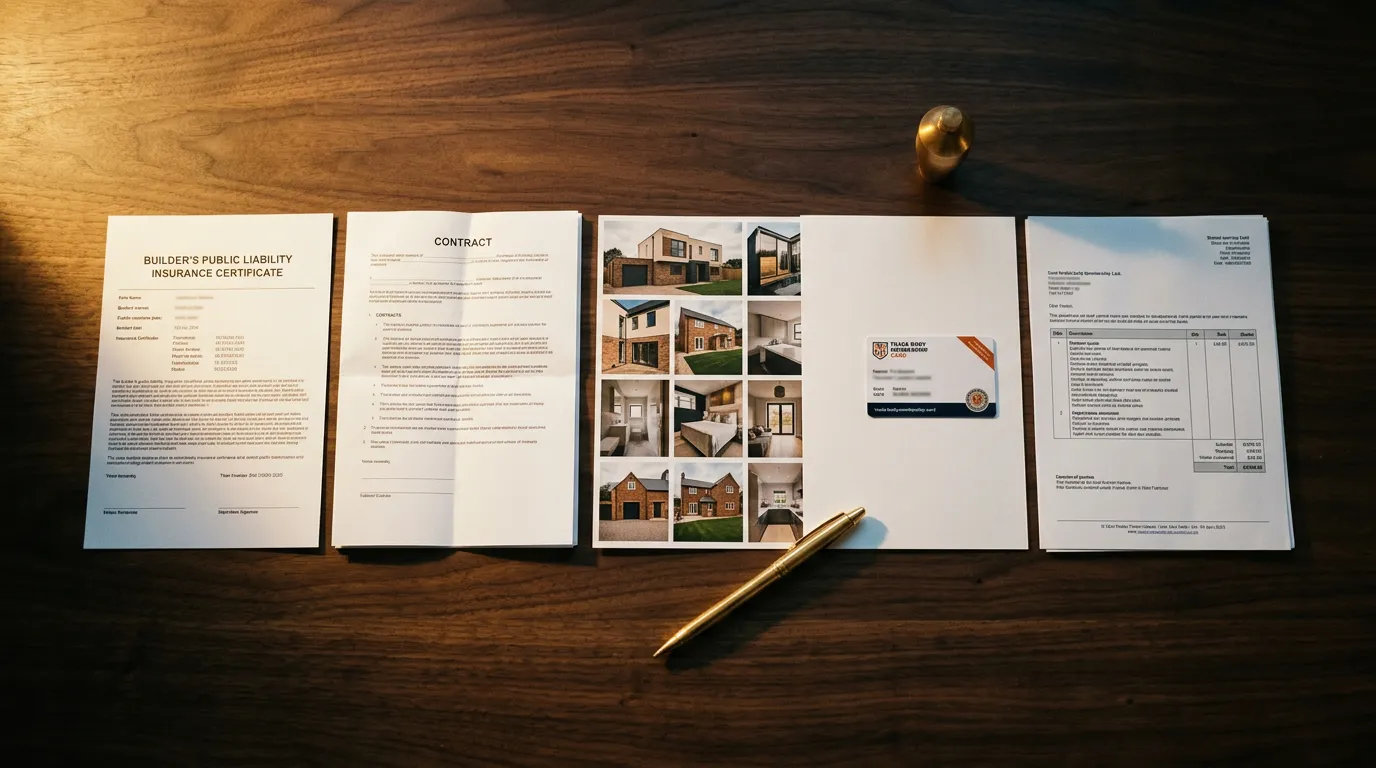
5 Things Every Homeowner Should Check Before Hiring a Builder
A practical checklist for vetting builders in the UK - from insurance and references to spotting red flags in quotes. Don't sign until you've checked these five.
Hiring a builder is one of the biggest financial decisions you'll make as a homeowner - and one of the easiest to get wrong. Horror stories fill local Facebook groups daily: ghosted after a deposit, shoddy workmanship, costs spiralling with no end in sight. Our complete checklist of what a builder's quote should include covers the documentation side - this post focuses on vetting the builder themselves.
The good news? Most problems are avoidable if you do your due diligence upfront. Here are five things to check before you sign anything.
1. Verify their credentials and insurance
This is the bare minimum, yet a surprising number of homeowners skip it.
What to check:
- Public liability insurance - at least £2 million cover. Ask for a copy of the certificate, not just their word
- Employer's liability insurance - legally required if they have employees
- Relevant trade certifications - Gas Safe for any gas work, NICEIC or NAPIT for electrics, FENSA for windows
- Company registration - check Companies House if they're a limited company. How long have they been trading?
Red flag: A builder who gets defensive when you ask for proof of insurance is a builder you don't want near your house. Our guide to checking a builder is legitimate in ten minutes walks through each register in order, with what to type and what a pass looks like.
If you're not sure what qualifications and sign-offs your project needs, our Certificates & Inspections guide covers every common scenario.
2. Get (and actually check) references
Any builder can hand you a glossy portfolio. What matters is what their recent customers say when the builder isn't listening.
How to do it properly:
- Ask for 3 references from jobs completed in the last 12 months
- Actually call or visit them - don't just read written testimonials
- Ask specific questions: "Did they finish on time?", "Were there any surprise costs?", "Would you hire them again?"
- Check online reviews on Checkatrade, MyBuilder, or Trustpilot - but read the negative ones carefully. Online reviews can be faked - learn how to verify builder reviews are real. A single bad review among dozens of good ones is normal. A pattern of complaints about the same issue isn't
Questions to ask previous clients:
- Was the final cost within 10% of the original quote?
- How did the builder handle problems or changes?
- Was the site left clean at the end of each day?
- Did they finish on the agreed date? If not, how late were they?
3. Compare quotes properly (not just the bottom line)
Three quotes is the standard advice - but comparing them is harder than it sounds when each one uses a different format and includes different items.
What to look for:
- Scope of works - is every task you discussed actually listed? If it's not on paper, it's not included
- Material specifications - "supply and fit bathroom" tells you nothing. You need brands, models, or at least quality grades
- Payment schedule - staged payments tied to milestones (foundations complete, roof on, etc.) not calendar dates. Never pay more than 10–15% upfront
- Exclusions - the most important section. This is where the price difference between a "cheap" quote and a "fair" quote usually lives
A quote that's 30% cheaper than the others usually isn't a bargain - it's a thinner scope. Our Red Flags in Builder Quotes resource walks through the warning signs in detail.
For a deeper dive into dissecting quotes, read our guide on how to read a builder's quote.
4. Agree a written contract before work starts
Verbal agreements are technically enforceable in the UK - but proving what was said three months later is practically impossible.
Your contract should include:
- Detailed scope of works (attach the quote as a schedule)
- Total price or pricing mechanism (fixed price is better for you)
- Payment schedule with clear milestones
- Start date and estimated completion date
- Process for variations (changes in scope) and how they're priced
- Defects liability period - typically 6–12 months after completion
- Dispute resolution process
- Right to withhold final payment until snagging items are resolved
You don't need a solicitor for a standard domestic contract. The JCT Homeowner contracts or the FMB's standard contract template are both solid options that protect both sides. Our guide to building contracts for homeowners compares the main contract types and explains what each one covers. If your project needs planning permission, make sure the contract covers who's responsible for the application.
Our What to Ask Your Builder checklist covers every question you should raise before signing.
5. Trust your instincts (but verify with data)
After checking credentials, references, and quotes, you'll usually have a gut feeling about each builder. That matters - you'll be working closely with this person for weeks or months.
Signs of a professional builder:
- Responds to messages within 24 hours
- Turns up when they say they will
- Gives a clear, itemised quote without being chased
- Talks through the project in terms you understand
- Is upfront about potential complications and costs
- Has a clean, organised van (seriously - this correlates)
Signs to walk away:
- Asks for a large upfront payment (more than 10–15%)
- Pressures you to decide quickly ("this price is only good until Friday")
- Won't put anything in writing
If you've already hired a builder and they haven't started work, act quickly.
- Can't provide references or insurance documents
- Their quote is vague, with lump sums and no breakdown
Get an independent check on your quotes
Not sure if a builder's quote is fair? Use MyBuildAlly's free estimator to get benchmark costs for your project, or try our Budget Planner to map out the full picture. Then upload the actual quote for AI-powered analysis. We'll flag scope gaps, check pricing against regional benchmarks, and give you the confidence to negotiate - or walk away.
Was this useful?