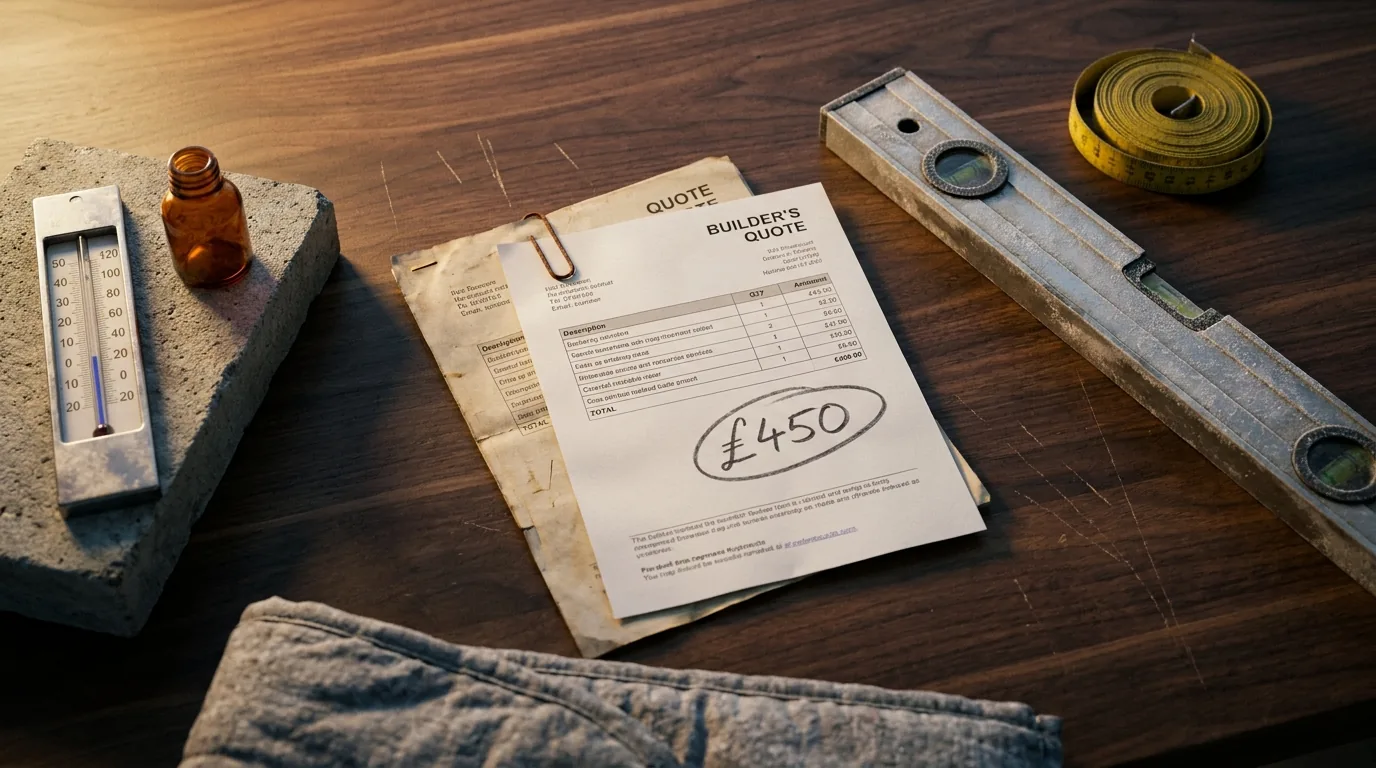
Are Builders Cheaper in Winter? How to Check a January Discount
Are builders cheaper in winter? Sometimes, but a real January discount shows as a lower labour line, not a headline percentage. Six checks before you sign.
A builder rings in the third week of November. The quote you got in September was £18,400. If you commit before Christmas, they can do it for £16,900, because January is quiet. It sounds like the first piece of good news in the whole process.
It might be. It might also be the same job with the scaffolding taken out of the price.
Are builders cheaper in winter?
Sometimes, and rarely by as much as the offer implies. A genuine winter saving comes from one thing: a builder with an unfilled slot in January or February who would rather work at a thinner margin than not work at all. That shows up as a lower labour figure on an itemised quote for an identical scope of works. It does not show up as a percentage stuck on the front of a headline price. Winter also genuinely costs more to build in, through short days, weather stoppages and protection for fresh concrete and mortar, so on some jobs the discount and the extra cost simply cancel each other out. Where a lower price is presented as a time-limited offer, the claim itself is regulated. Part 4 of the Digital Markets, Competition and Consumers Act 2024 has governed unfair commercial practices since 6 April 2025, replacing the Consumer Protection from Unfair Trading Regulations 2008, and the CMA's guidance on unfair commercial practices (CMA207) sets out how businesses are expected to apply it.
So the question is not whether winter is cheaper in the abstract. It is whether this quote, for this scope, is cheaper than the same builder would have charged you in May.
Where the winter discount numbers actually come from
You will see two figures repeated across the internet: 5–10% off general building work in January and February, and 10–15% off double glazing and other installer-fitted products. Both are worth knowing, and neither is independent data. They trace back to trade directories, installer marketing pages and builder lead-generation blogs - businesses that sell the work being discussed. Treat them as claims to test against your own quotes, not as a benchmark to negotiate towards.
What is observable is that the effect is uneven by trade. Anything driven by external work and by homeowners deciding in the spring is more exposed to a winter gap: glazing, roofline, roofing, landscaping, driveways. Anything internal tends to hold up better, because a kitchen or a bathroom is a January job as readily as a June one. The site's complete guide to UK building costs covers the wider seasonal picture across project types.
The practical version: if a builder is offering you a winter price, ask which of their trades is quiet. A firm that is genuinely short of external work in January can tell you that in one sentence. A firm that just wants a signature this week cannot.
What winter actually changes on site
Some of the extra cost in a winter build is real, and a builder who prices it honestly is not fleecing you. Here is what changes.
| What changes in winter | Practical effect | Normally carried by |
|---|---|---|
| Daylight hours | Roughly eight hours of daylight in southern England around the solstice, closer to six and a half in northern Scotland. Fewer productive hours per day on external work | The builder, priced into labour |
| Frozen or waterlogged ground | Foundations cannot be poured onto frozen ground, and trenches collapse or fill in sustained rain | The builder, unless conditions are exceptional |
| Fresh concrete | Must be kept above 5 degrees Celsius until it gains early strength, which means insulated blankets, covers or admixtures | The builder, priced into groundworks |
| Mortar and render | Bricklaying and rendering stop in frost. Mortar that freezes before it sets loses strength permanently | The builder |
| Drying times | Plaster, screed and paint all take longer in cold, damp conditions, which stretches the programme | Shared: the builder's time, your patience |
| Site protection | More sheeting, more temporary covering, more making good after wind and rain | The builder |
| Scaffolding hire | A longer programme means a longer hire period, which is charged weekly | You, if the quote is on a weekly hire basis |
That last line is the one to read twice. Scaffolding costs are usually quoted with an included hire period and a weekly rate after it. A winter job that runs three weeks longer than a summer one adds roughly £150–£360 through the scaffolding line alone, at the £50–£120 weekly extension rates typical on domestic work, even on a fixed-price build, if the contract makes extended hire your cost.
The concrete rules, and where they come from
This is the point most winter building articles get wrong, so it is worth being precise. The trigger for cold weather concreting in the UK is an air temperature below 5 degrees Celsius, or one forecast to fall below 5 degrees within 24 hours. That comes from BS 8500, the British Standard for concrete, and it is reflected in NHBC Standards chapter 3.2, Cold weather working, which is the document most UK housebuilders and warranty providers actually work to. It is not the American ACI 306 test of three consecutive days averaging below 4.4 degrees, which is what a lot of UK-facing content quietly copies.
Once poured, concrete has to be maintained above 5 degrees until it reaches 5 N/mm2 compressive strength. In practice that is usually 48 to 72 hours, with a minimum of three days commonly recommended in genuinely cold conditions. The number that matters is the strength, not the hours. The reason is physical: water expands by about 9% when it freezes, and if that happens inside concrete before it has gained early strength, the expansion disrupts cement hydration and the damage is permanent.
Cold weather concreting limits are not building regulations. They come from BS 8500 and NHBC Standards, and no Approved Document contains them. The genuine building control frost requirement is foundation depth. Paragraph 2E4 of Approved Document A, the statutory guidance for England, says that except where they are founded on rock, strip foundations "should have a minimum depth of 0.45m to their underside to avoid the action of frost". The same paragraph adds that this depth "will commonly need to be increased in areas subject to long periods of frost", and that in shrinkable clays the foundation goes to a depth where ground movement will not impair stability, which near trees is usually far greater. Wales, Scotland and Northern Ireland publish their own equivalents. If a builder tells you the regs stop them pouring this week, they mean the concrete standard, not the law.
If you want the detail on depths and what a compliant pour looks like, see minimum foundation depth in the UK.
The winter line items: which are legitimate
A winter quote should look almost identical to a summer quote for the same job. The difference should be in the labour figure and the programme, not in a stack of new charges.
| Line item | Legitimate? | What to ask |
|---|---|---|
| Higher labour figure for the same scope | Yes | Nothing. This is the builder pricing lost days honestly |
| Longer programme, more weeks | Yes | Get the weeks written down, with a start and a target completion date |
| Extended scaffolding hire | Yes | Ask whether the included hire period covers the whole winter programme, and what the weekly rate is after it |
| Frost protection for concrete and masonry | Yes | Ask whether it is included in the groundworks price or charged separately |
| Additional site sheeting and covering | Yes | Should be a small, itemised figure, not a round number |
| Temporary site heating as a homeowner line item | Rarely | This is a commercial and US site practice. On a domestic extension, UK builders normally stop work when it freezes rather than heat the site. Ask what exactly it pays for |
| "Winter surcharge", unattached to scope | No | Ask which specific tasks it covers. If the answer is vague, it is a margin uplift with a season attached |
| A discount that appears without the scope changing | Check | Compare the two quotes line by line before believing it |
That last row is the whole exercise. The single most common way a winter discount evaporates is that something quietly left the scope: the scaffolding, the skip, the making good, the decoration, a provisional sum that used to be a fixed figure. Our method for comparing builder quotes is built around exactly this, and a provisional sum that appears in the cheaper version is not a saving, it is a deferred cost.
"Sign tonight for the January price"
This is the part of the winter pitch that carries actual legal weight, and it works in your favour.
Falsely stating that a product is only available for a limited time, or only on particular terms for a limited time, in order to get an immediate decision and deprive you of time to make an informed choice, sits on the list of practices that are unfair in all circumstances. It is paragraph 7 of Schedule 20 to the Digital Markets, Competition and Consumers Act 2024. No balancing test, no argument about whether the average consumer would have behaved differently. If the deadline is invented, the practice is banned.
Fake "was" prices and invented discounts are a different case, and it is worth being accurate about it because plenty of consumer content overstates the position. They are not on that automatic list. They can still be caught as a misleading action under the general prohibition, where false or deceptive pricing information is likely to make the average consumer take a decision they would not otherwise have taken. That is a harder test to meet, which is why the limited-time claim is the stronger point to press.
The stronger protection is simpler and older.
A contract you sign at your own kitchen table is an off-premises contract. Regulation 29 lets you cancel without giving any reason, and regulation 30 sets that cancellation period at 14 days. Two carve-outs are worth knowing: regulation 6(1)(e) puts contracts for the construction of a new building, or a substantially new building formed by converting an existing one, outside these Regulations entirely, and regulation 28(1)(e) removes the cancellation right where you specifically asked the trader to visit to carry out urgent repairs or maintenance. Neither normally catches an extension or a planned refit. If the trader failed to give you the required written information about that right, regulation 31 extends the cancellation period by up to 12 months. If they supply the information late, within that year, the period ends 14 days after you receive it. These regulations remain in force in 2026.
So the correct response to a doorstep deadline is not to argue about whether the deadline is real. It is to sign nothing, take the quote away, and read it against the others. And if you have already signed at home, check the date, and check whether they gave you cancellation information at all. You can read regulation 31 in full on legislation.gov.uk.
Who pays for the days lost to weather
The honest answer for most homeowners is: the builder, and it should already be in the price.
Ordinary British winter weather is not an excuse. Under a JCT contract, only exceptionally adverse weather is a relevant event. Normal seasonal cold and rain is the contractor's own risk, because a contractor pricing a January start is expected to have priced January. That distinction gets lost constantly, and it is the reason a lot of winter delay arguments go nowhere.
Two further points that matter if you are on a formal contract:
An extension of time is not money. Exceptionally adverse weather is a relevant event, entitling the contractor to more time on the programme. It is not a relevant matter, so it carries no entitlement to loss and expense. The builder gets a later completion date. They do not get to invoice you for the standing time.
JCT does not define "exceptionally adverse". Unlike NEC, which uses a once-in-ten-years test against recorded weather data, JCT leaves the judgement to the contract administrator. That vagueness is a known source of dispute, and it is why the threshold is worth discussing before work starts rather than in February. If you are choosing a contract, note that the JCT Minor Works 2016 edition has been superseded and is only available during a transitional period ending 31 December 2026, so use the 2024 edition. Our guide to building contracts for homeowners covers the options.
And one thing to stop looking for: there is no standard Christmas shutdown clause. Not in JCT Minor Works, not in the JCT Building Contract for a Home Owner/Occupier, not in the FMB contract. If you want the site secure and the dates agreed over the holiday, you write it in yourself.
Before you accept a winter start, get three things in writing: the dates the site will be shut down over Christmas and New Year, who is responsible for securing and weatherproofing the site during that period, and what the revised completion date is. Add them to the quote or contract as a numbered clause. None of the standard homeowner contracts do this for you.
Common mistakes
Treating the percentage as the discount. A price that drops by 8% while the scope drops by 12% is a price rise. Put the two quotes side by side and compare line by line: scaffolding, skips, making good, decoration, VAT treatment, and every provisional sum. Only then look at the total.
Letting a deposit sit over the shutdown. A large payment made in mid-December buys you nothing until the site reopens, and it is the money most exposed if the firm gets into trouble in the quiet quarter. The same discipline applies year-round: see why a 50% deposit is a red flag.
Buying a start date instead of a sequence. The question is not when the job starts, it is when the groundworks and the external envelope happen. A January start that puts foundations and brickwork into the worst eight weeks of the year is worse value than a March start that gets the shell up in April. Ask the builder to walk you through the programme week by week.
Assuming bad weather will get you money back. It will not, on any standard contract. Weather delay buys the contractor time, not you compensation. What protects you is a written completion date and a variation process, which is exactly what a quote alone does not give you.
Believing "this price is only good until Friday". On a domestic build it is almost always a sales device. It is also the one claim in the whole pitch that is banned outright when the deadline is invented. A firm that genuinely has a January gap will still have it on Monday.
The six checks before you accept a winter price
- Ask for the September quote and the November quote as separate documents, and diff the scope, not the total.
- Confirm the labour figure specifically. That is where a real winter discount lives.
- Check the scaffolding hire period against the winter programme length, and get the weekly extension rate.
- Get the Christmas and New Year shutdown dates in writing, plus who secures the site.
- Ask which stages fall in January and February, and whether any of them are groundworks, brickwork or roofing.
- If you signed at home, note the date. You have 14 days, or up to 12 months if they never gave you cancellation information.
Got a winter start quote? Check the labour line, the scaffolding hire period and the shutdown dates
See how your costs compare to thousands of real UK quotes.
Get my estimateA winter discount is worth having when it is real. It is real when the scope is identical, the labour figure has moved, and the builder can tell you which of their trades is quiet. Everything else is a percentage.
Sources
- Digital Markets, Competition and Consumers Act 2024, Part 4 - the unfair commercial practices regime in force since 6 April 2025
- Digital Markets, Competition and Consumers Act 2024, Schedule 20 - practices unfair in all circumstances, including false limited-time claims
- CMA: Unfair commercial practices (CMA207) - regulator guidance for businesses
- Consumer Contracts Regulations 2013, regulation 31 - extended cancellation period where cancellation information is not given
- Approved Document A: Structure - foundation depth and frost heave
- JCT: Minor Works Building Contract - edition status and transitional withdrawal date
Was this useful?