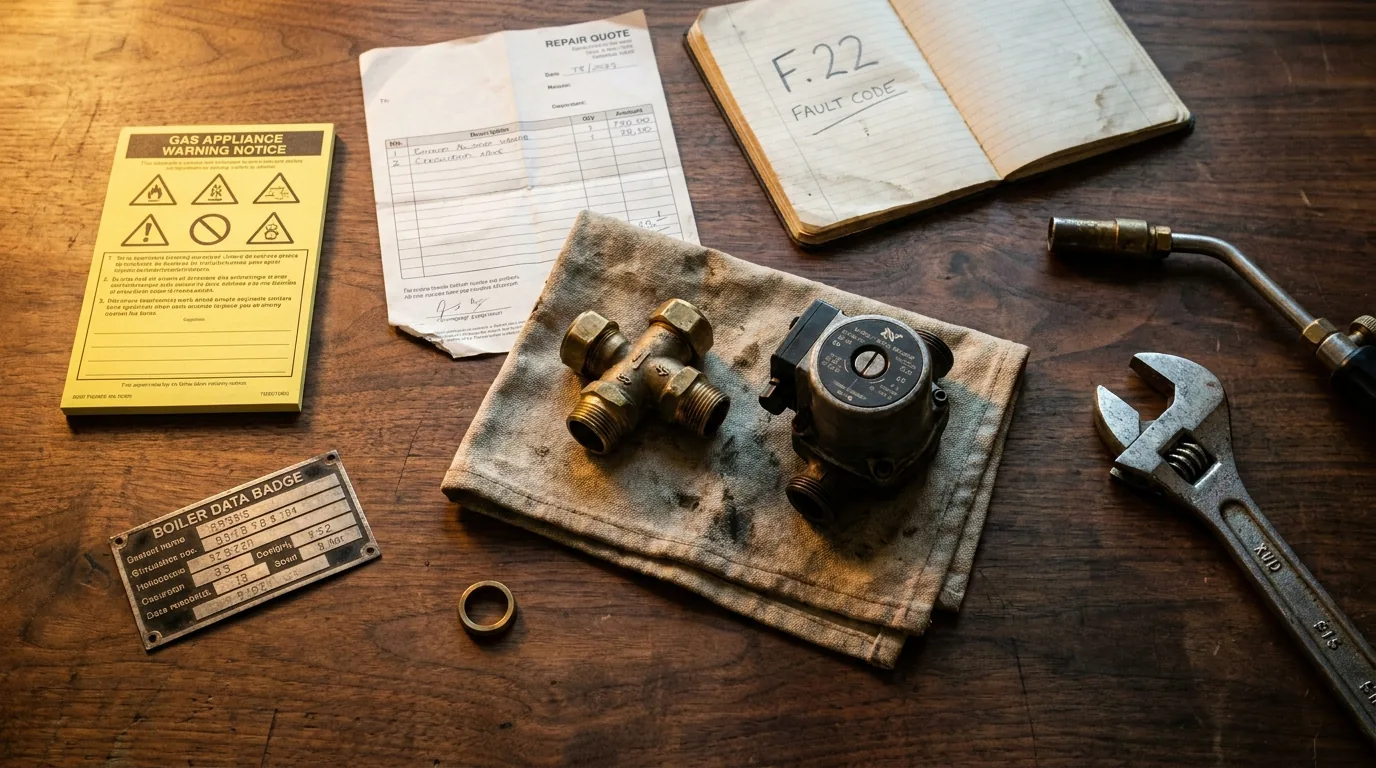
Boiler Beyond Economical Repair? How to Check the Verdict
Beyond economical repair is a commercial judgement, not a safety verdict. Only a Gas Safe verdict condemns a boiler. Check yours before you spend £3,000.
Is your boiler really beyond economical repair?
There is no such verdict in gas safety law. "Beyond economical repair" is a commercial judgement about money, usually made either by a boiler cover insurer declining a claim or by the same engineer who would like to sell you the replacement. The only formal findings a Gas Safe registered engineer can record are Immediately Dangerous and At Risk under the Gas Industry Unsafe Situations Procedure, and since the procedure's seventh edition both carry the same warning label, "Danger Do Not Use". Those are safety findings. Beyond economical repair is not one, it carries no label, no notice and no legal force, and you are entitled to test it before you spend anything.
That distinction matters most in October, when the first proper cold snap exposes every marginal boiler at once, you are in a cold house, and the person handing you a £3,000 replacement figure is the person who has just told you the old one is finished.
The four things you might have been told, and how they differ
Homeowners use "condemned", "failed" and "beyond economical repair" interchangeably. The industry does not. Work out which one you have actually been given, because they lead to completely different next steps.
| What you were told | Who issues it | What it is | Paperwork you should have | Can you still use the boiler? |
|---|---|---|---|---|
| Immediately Dangerous | Gas Safe registered engineer | Safety classification: danger present now | Warning notice, "Danger Do Not Use" label on the appliance | No |
| At Risk | Gas Safe registered engineer | Safety classification: one or more faults that could become dangerous | Warning notice, "Danger Do Not Use" label on the appliance | No |
| Beyond economical repair | An insurer, a cover provider, or an engineer's opinion | Commercial judgement about repair cost versus value | A claim decision letter, or nothing at all | Usually yes, if no safety notice was issued |
| "It needs a new boiler" | Anyone | An opinion, sometimes a sales opening | Nothing | Usually yes |
If nobody handed you a warning notice and nothing is labelled, your boiler has not been condemned. It has been priced.
The law puts the duty not to use a dangerous appliance on the "responsible person" for the premises, which in an owner-occupied house is you. Regulation 34(1) states that the responsible person "shall not use a gas appliance or permit a gas appliance to be used if at any time he knows or has reason to suspect that it cannot be used without constituting a danger to any person". Regulation 34(3) puts a separate duty on anyone carrying out work who knows or has reason to suspect a danger: they must "forthwith take all reasonably practicable steps to inform the responsible person for the premises" and, where different, the owner of the appliance. Nothing in the regulations mentions cost, value, or economical repair.
What a Gas Safe engineer can and cannot decide
An engineer attending a breakdown is doing two separate jobs, and it helps to keep them apart in your head.
The first job is safety, and it is not optional. If the appliance is unsafe, they classify it, label it and issue a warning notice. Under the Gas Industry Unsafe Situations Procedure, published by Gas Safe Register and set out in IGEM/G/11, they must ask your permission before turning the appliance off and disconnecting it. If you refuse, they record the refusal and, where the situation is immediately dangerous, escalate it. The old third category, Not to Current Standards, was removed from the procedure because those situations were not actually unsafe, which is worth knowing if an older engineer still uses the phrase at you.
The second job is commercial: diagnosing the fault, pricing the part and telling you what they think you should do. That part carries no authority at all. It is a trade opinion from someone with a financial interest in the outcome, in exactly the way that a builder's opinion on whether you need underpinning is a trade opinion. The signs of a trade quietly overcharging apply here as much as anywhere else.
The honest version of the conflict is not that engineers are dishonest. It is that a breakdown call-out pays a few hundred pounds and a replacement pays a few thousand, that diagnosis on an obscure fault can take an hour of unpaid head-scratching, and that "it needs replacing" is the answer that is never wrong in hindsight.
Where the insurer's version comes from
If the verdict arrived from a boiler cover provider rather than an independent engineer, it is a claim decision, and it will usually rest on one of four policy clauses rather than on the state of the appliance:
- An age limit. Many policies decline repairs on appliances over a stated age, and that age differs sharply between providers. Check the policy wording, not the phone call.
- Parts unavailability. If the manufacturer no longer supplies a part, the policy typically converts the claim into a beyond economical repair decision automatically. This is the most common route, and the most checkable.
- A repair cost cap. Some policies cap the value of any single repair, or the total in a policy year.
- Pre-existing fault or wear and tear exclusions. Common where the boiler was already faulty when cover started.
None of these is a statement that your boiler is unsafe or unrepairable. They are statements that the insurer is not paying. Those are very different things, and you can still have the repair done privately.
Most boiler cover is a regulated insurance product, so if you think the decision is unfair you can put it through the provider's complaints procedure and then, if you are not satisfied with the final response, to the Financial Ombudsman Service. Some maintenance plans are sold as service contracts rather than insurance and sit outside that route, so check which one you have before you spend time on it.
What common boiler repairs actually cost
This is the arithmetic the verdict turns on, and it is arithmetic you can do yourself once you have a part name.
| Repair | Typical cost, part and labour | Notes |
|---|---|---|
| Expansion vessel recharge or replacement | £120–£350 | Recharging is cheap, replacing an internal vessel is not |
| Pump replacement | £250–£400 | Common on system and regular boilers |
| Fan replacement | £250–£450 | Frequent on boilers past 8 years |
| Diverter valve | £250–£450 | Classic "heating works, hot water does not" fault |
| Gas valve | £300–£500 | Part price varies sharply by model |
| Printed circuit board (PCB) | £350–£600 | Often the point where replacement gets suggested |
| Primary heat exchanger | £500–£900 | On an older appliance this is a genuine replace-or-repair decision |
These are typical trade ranges for a domestic gas boiler in the UK, part and labour combined, as at August 2026. They are not a published index, and they move a long way with the part price for your specific model and the local labour rate. Qualified plumber day rates run roughly £200–£350 outside London, as covered in our guide to checking a plumber's quote, and emergency or out-of-hours attendance is priced separately again.
Set those against replacement. A like-for-like combi swap runs £2,200–£3,500 and a system boiler £2,500–£4,000, with the full breakdown in our boiler replacement cost guide. So a £380 fan on a nine-year-old Worcester with parts freely available is not a close call, and neither is a £780 heat exchanger on a fifteen-year-old appliance that has already had two other parts this year. The awkward middle is a £500 repair on a twelve-year-old boiler, and that one genuinely depends on how long you intend to stay in the house.
The five things to ask before you accept the verdict
You are not arguing with the engineer. You are collecting the four or five facts that let anyone else price the same job, which is the only way to compare two opinions.
Before the engineer leaves, write down the make, model and GC number from the data badge on the boiler, the fault code showing on the display, the name and part number of the component they say has failed, and the price they have quoted for that part fitted. Ask whether they have checked the part is still available from the manufacturer, and ask for the verdict in writing. If a warning notice was issued, keep it: it is the document that proves what was actually found.
Then the five questions:
- What is the part number, and is it still available? A genuine beyond economical repair verdict on parts grounds means someone checked. If they cannot name the part, no repair has been priced and there is nothing to compare against the replacement figure.
- What is the fault code? Codes are model-specific and documented. A second engineer can start from the code rather than starting again.
- Is anything labelled Danger Do Not Use? If yes, treat the appliance as out of use. If no, nothing is stopping you running the boiler while you collect other opinions, and you have time.
- What is the boiler's history? Two parts in eighteen months on a fourteen-year-old appliance is a pattern. One part on a nine-year-old appliance is an event.
- Is this quote priced as an emergency? A call-out on a Friday evening in October carries a premium that a replacement booked for a fortnight's time does not.
Common mistakes
Treating "condemned" and "beyond economical repair" as the same thing. They are issued by different people, for different reasons, with different paperwork. Only one of them stops you using the boiler, and it is not the one about money. Homeowners who conflate the two replace safe appliances under a sense of urgency that nobody actually created.
Taking the replacement quote from the person who declared it dead, on the day. Even where the diagnosis is right, the price rarely is. Quotes for the same combi swap move a long way between installers, driven by whether the flue run and gas supply need altering, the brand tier fitted and the length of the warranty, so a single same-day quote is a number with no context. Get two more before you commit, and check what each one includes: flue, controls, magnetic filter, system flush, old boiler disposal, making good and the building regulations notification.
Accepting a verbal verdict with no written record. A trade that will not put its findings in writing is a problem in itself, and it is the same warning sign as a builder who will not give a written quote. Without a part number and a fault code, you cannot get a comparable second opinion, which is precisely why a thin verdict is so often followed by a fat quote.
Assuming the insurer's decision settles the question. A declined claim is a decision about the policy, not about the appliance. You can still repair it privately, and if you think the decision was unfair you have a complaints route and then the ombudsman. Do not let a claims outcome become a replacement decision by default.
Expecting a grant on a gas boiler. The Boiler Upgrade Scheme is for heat pumps and biomass only, at £7,500 for air source or ground source, £5,000 for biomass and £2,500 for air-to-air. A further £1,500 is added to the air source and ground source rates only, and only where the property has no mains gas connection and is currently heated by oil or LPG, which gov.uk lists as running until March 2027. There is no gas boiler grant. Our Boiler Upgrade Scheme guide covers the eligibility rules, and if you are weighing the switch rather than a like-for-like swap, start with heat pump quotes.
Panicking about a ban. Nothing obliges you to replace a working gas boiler, and nothing stops you fitting another one when this one dies. The 2027 rules apply to new dwellings, as set out in our gas boiler ban explainer.
If you do go ahead, the paperwork is not optional
Replacing a heating system is notifiable work. Gov.uk lists "install or replace a heating system" among the alterations that need building regulations approval, and states that you do not need to arrange it yourself if you use someone registered with a competent person scheme, which for gas work means the Gas Safe Register. The installer notifies and you receive a compliance certificate. Skip it and, as gov.uk puts it, "you will not have the certificates of compliance you may need when you want to sell your home".
One useful nuance for anyone being rushed: gov.uk also confirms you "do not need advance approval for emergency repairs to your boiler or heating system". Emergency repair is not the same as a full replacement booked under pressure, and the distinction is worth knowing when someone tells you the paperwork means it has to happen today.
Check the engineer's registration and the categories of work they are qualified for on the Gas Safe Register before they start, not after. And when the new boiler is in, our guide to checking plumbing and drainage work covers what to inspect before you release the final payment.
Told your boiler is beyond economical repair? Check the replacement quote for the parts diagnosis, the emergency call-out premium and the building regs notification
See how your costs compare to thousands of real UK quotes.
Get my estimateSources
Repair and replacement figures correct as at August 2026. Grant rates change, so confirm them on gov.uk before you rely on one in a quote.
- HSE: domestic gas safety FAQs - the Gas Industry Unsafe Situations Procedure, the "Danger Do Not Use" label, and the removal of the Not to Current Standards category
- Gas Safety (Installation and Use) Regulations 1998, regulation 34 - duties of the responsible person and of anyone carrying out work
- Gas Safe Register: gas appliance warning labels - what the warning notice and label mean in practice
- Gov.uk: building regulations approval - heating system replacement as notifiable work, competent person schemes, and emergency repairs
- Gov.uk: Boiler Upgrade Scheme, what you can get - current grant rates and the off-gas-grid uplift
Was this useful?