Loft Insulation Depth: Why 270mm Is the UK Building Regs Benchmark
UK building regs expect roughly 270mm of mineral wool loft insulation for a 0.16 U-value. Here is what the depth means, what your quote should specify, and how to check it.
Loft insulation is the highest-return energy upgrade most homes can make, and it is also one of the most common things a builder's quote gets vague about. "Insulate loft" tells you nothing. The number that matters is the depth, because depth is what turns into a U-value, and the U-value is what the building regulations actually care about. Here is the benchmark, why 270mm is the figure you keep seeing, and how to check your quote meets it.
The benchmark: 270mm of mineral wool
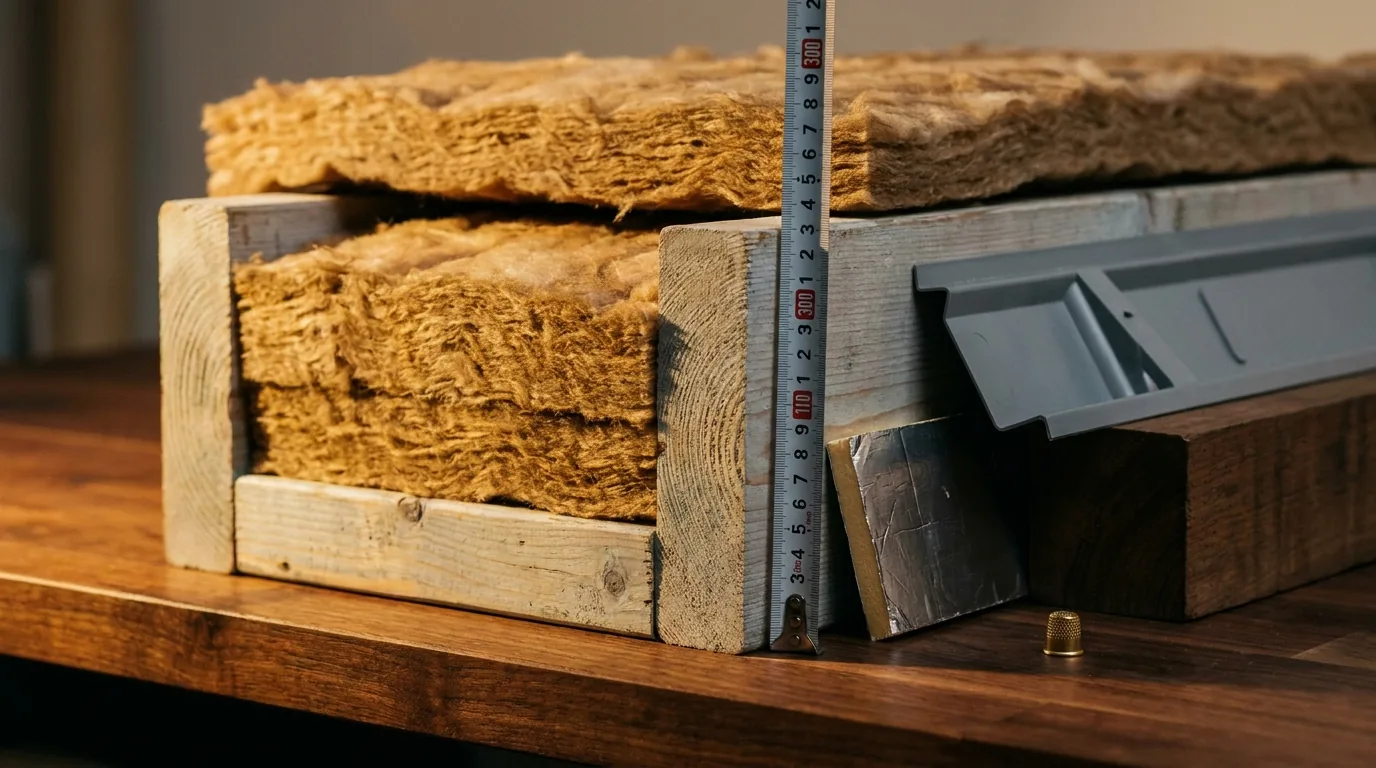
In England, Approved Document L Volume 1, 2021 edition incorporating the 2023 amendments, sets 0.16 W/m²K as the U-value a renovated loft in an existing home should reach (Table 4.3, column b, "Improved"). The same table sets a 0.35 threshold in column a: an existing roof already better than 0.35 does not have to be touched, and one worse than it should be brought to 0.16 when you renovate or retain it in a loft conversion. With standard mineral wool (glass or rock wool), reaching 0.16 takes roughly 270mm of insulation: about 100mm laid between the ceiling joists and a further 170mm laid across them. New-build roofs have the same 0.16 W/m²K limiting value under Table 4.1, which covers all roof types. The 0.11 W/m²K figure often quoted for new build is not a limiting standard: it is the notional dwelling roof value in Table 1.1, used to set the whole-dwelling energy target, which is why new roofs are usually specified well past 0.16.
Note the edition, because a second one now exists. Approved Document L Volume 1, 2026 edition takes effect on 24 March 2027 for building work not connected with higher-risk building work, and 24 September 2027 for work that is. It keeps the roof numbers identical, 0.16 for a renovated roof and 0.16 for all new roof types, but it renumbers the tables: Table 4.1 becomes Table 3.1 and Table 4.3 becomes Table 3.3, and the notional dwelling specification moves out of the document into the Future Homes Standard 2026 notional building document and SAP 10.3. So a quote or a surveyor citing "Table 4.3" after March 2027 is quoting the older edition. The depth you need does not change. Wales, Scotland and Northern Ireland set their own equivalents, so check the standard for your nation.
The 270mm figure is not a law in itself. It is simply the thickness of common mineral wool that hits the 0.16 U-value the regulations expect. If your installer uses a higher-performance material such as rigid PIR board, they can reach the same U-value in less depth (PIR usually needs somewhere around 130mm to reach the same 0.16, depending on the board's declared thermal conductivity, so ask for the U-value calculation rather than trusting a depth), which matters where headroom is tight, like a room-in-roof.
Approved Document L also has a specific concession for exactly that case. Note 3 to Table 4.3 says that where hitting the standard would limit headroom, a lesser standard may be appropriate, provided the insulation plus any required air gap is at least as deep as the rafters and the material chosen achieves the lowest practicable U-value. That is a real allowance, not a loophole: it does not let a builder skip insulation, it lets them fill the rafter depth with the best material available and document why.
This is the loft equivalent of the cavity wall insulation thickness question, and the two together cover most of the heat a typical house loses.
Why depth beats "insulated"
A ceiling with 100mm of old insulation loses far more heat than one with 270mm. The first 100mm does a lot of work, but the regulations target assumes the full modern depth. Two practical points:
- A cross-layer beats a single deep layer. Laying the top 170mm across the joists (rather than all of it between them) covers the timber, which itself conducts heat. This is why the standard spec is "100mm between, 170mm over".
- Compression kills performance. Mineral wool only works at its rated thickness. If it is squashed under boarding or storage, it loses much of its value. Raised loft boarding on legs is the correct fix if you need storage up there.
The ventilation gap people forget
Insulation and ventilation have to coexist. Push insulation hard into the eaves and you block the airflow that keeps the loft dry, which leads to condensation and, over time, damp timbers.
Check that the quote keeps a clear ventilation gap at the eaves (commonly 25-50mm) and fits eaves baffles or vents where needed. "Insulate to 270mm" with no mention of eaves ventilation is an incomplete spec, especially on an older roof.
When the regs actually bite
For a simple top-up of an open loft, you are improving the home rather than triggering a formal building control sign-off. The regs become directly relevant when insulation is part of a bigger job:
- A loft conversion must insulate the new roof slopes and walls to current standards. See loft conversion costs for the full picture.
- A re-roof is the moment to upgrade insulation, and many quotes quietly leave it out to look cheaper.
- Any work where you claim a grant or an EPC improvement needs the spec and paperwork to match, or it will not count.
If your quote covers a loft conversion or re-roof and says nothing about insulation depth or U-value, that is a missing building regs item, not a saving.
What your quote should specify
A clear loft insulation quote names:
- The material (mineral wool, sheep's wool, PIR board)
- The finished depth or the target U-value (270mm / 0.16, or better)
- Whether it is a top-up or a full replacement
- Eaves ventilation and baffles
- Loft boarding on raised legs if storage is needed
- Loft hatch insulation and draughtproofing (a cold spot people forget)
Grants in 2026
Loft insulation is one of the measures funded under the government's Warm Homes Plan, published in January 2026. The Great British Insulation Scheme closed on 31 March 2026, and the Energy Company Obligation is being wound down, with the extended ECO4 scheme ending on 31 December 2026. Household grant support in England now runs mainly through the Warm Homes: Local Grant, for low-income owner-occupiers and private renters in EPC band D to G homes, and the Warm Homes: Social Housing Fund. Scotland, Wales and Northern Ireland run their own schemes. Eligibility depends on your income, benefits, and property, so check the current scheme before assuming you qualify, and make sure any grant-funded work still specifies the depth and ventilation above.
Got a loft, roof, or insulation quote? Check the spec
See how your costs compare to thousands of real UK quotes.
Get my estimateCheck your quote against the standard
If you are holding a quote for a loft conversion, re-roof, or insulation upgrade, upload it and we check whether the insulation spec actually meets the 0.16 U-value the regulations expect, and flag it when the depth, the ventilation gap, or the loft hatch has been left out. It takes under a minute.
Was this useful?