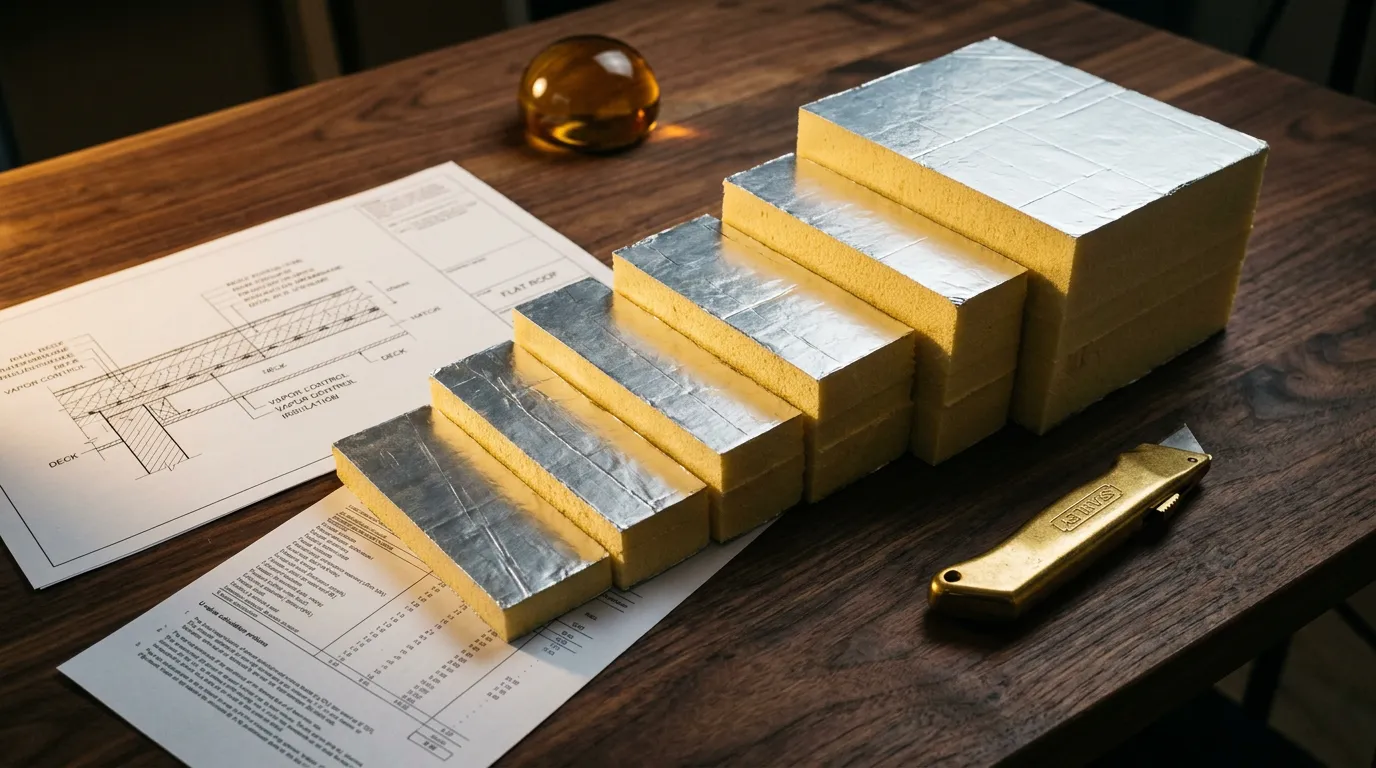
Flat Roof U-Values and Insulation: UK Building Regs Explained
Building regs need 0.16 W/m²K on a new flat roof, 0.15 on an extension: about 140–150mm of PIR on a warm roof. Warm vs cold roof, and what fails sign-off.
What U-value does a flat roof need?
The required U-value for a flat roof in a new build is 0.16 W/m²K under Table 4.1 of the current Approved Document L Volume 1, the 2021 edition incorporating 2023 amendments, which applies in England. A flat roof on an extension to an existing dwelling has to do better still at 0.15 W/m²K under Table 4.2. Where an existing flat roof is renovated, for example by replacing the waterproof membrane, the whole element should be upgraded to 0.16 W/m²K under Table 4.3 column (b). Warm roof construction (insulation above the deck) is strongly preferred over cold roof (insulation between joists) because it virtually eliminates condensation risk.
What this means for your project
If you're building a flat-roofed extension or replacing an existing flat roof, the U-value target determines how much insulation goes into the roof build-up. And with flat roofs, where you put that insulation matters as much as how much of it you use.
Warm roof is the preferred approach and the one your builder should be specifying unless there's a specific reason not to. In a warm roof, the structural deck (typically plywood or OSB) is laid first, then a vapour control layer, then the insulation boards, then the waterproof membrane on top. The entire structure stays warm because the insulation sits above everything. No temperature gradient through the structure means no condensation.
The insulation is almost always PIR (polyisocyanurate) or PUR (polyurethane) board - rigid, lightweight, and with excellent thermal performance. For the 0.16 W/m²K target, you're looking at roughly 140–150mm of PIR board, depending on the product's lambda value. Manufacturers like Celotex and Kingspan provide U-value calculators on their websites that let you input the full roof build-up and get the required thickness. Use them - or make sure your builder has.
Cold roof construction puts the insulation between or below the joists, with a ventilated air space above. This was the traditional approach, and it's cheaper to build. But cold roofs have a fundamental problem: warm moist air from the room below migrates through the insulation and meets the cold deck above. If there isn't enough ventilation to carry that moisture away, it condenses - leading to timber rot, mould, and failed insulation.
For renovations, the target is 0.16 W/m²K. This applies when you're upgrading an existing flat roof as a "thermal element", and Approved Document L treats replacing the waterproof membrane on a flat roof as a renovation. It bites when more than 50% of that element's surface is renovated, or where the work is a major renovation affecting more than 25% of the external envelope. If you're building a new flat-roofed extension, the target is tighter still at 0.15 W/m²K, no matter how small the extension is.
Flat roofs in new dwellings must achieve a U-value of no worse than 0.16 W/m²K (Table 4.1). A flat roof on an extension to an existing dwelling must achieve 0.15 W/m²K (Table 4.2). For a renovated thermal element, including where you replace the waterproof membrane on an existing flat roof, the target is 0.16 W/m²K (Table 4.3, column (b)). A condensation risk analysis may be required to demonstrate that the proposed construction will not suffer from interstitial condensation.
Confirm with your builder whether the flat roof is warm or cold construction. For warm roofs, check the insulation product and thickness against the manufacturer's U-value calculator. Verify that a vapour control layer is specified below the insulation. For cold roofs, confirm that adequate ventilation (typically 25mm air gap above the insulation) is detailed.
Common mistakes
Inadequate ventilation in cold roof construction. A cold flat roof needs a continuous 25mm ventilated air gap above the insulation, with ventilation openings at two opposing edges. In practice, getting consistent cross-ventilation across a flat roof is difficult - especially with internal walls and service penetrations breaking up the void. This is why warm roof is preferred: it sidesteps the ventilation problem entirely.
Skipping or poorly sealing the vapour control layer. The VCL is the unsung hero of flat roof construction. It prevents moisture-laden air from migrating into the insulation layer. But it only works if it's continuous - every joint sealed with appropriate tape, every pipe and cable penetration sealed with grommets or mastic. A VCL with holes in it is worse than useless because it concentrates moisture at the puncture points.
Tapered insulation calculated incorrectly. Flat roofs aren't actually flat - they need a fall (typically 1:40 to 1:80) to drain rainwater. Tapered insulation achieves this while providing thermal performance. But the U-value calculation must use the average thickness across the roof, not the maximum thickness at the thickest point. Underspecified tapered insulation hits the drainage target but misses the thermal target at the thin end.
Flat Roof Insulation Checklist
A printable checklist: the U-value for a new roof, an extension and a renovation, plus the warm deck, cold deck and drainage checks.
Was this useful?