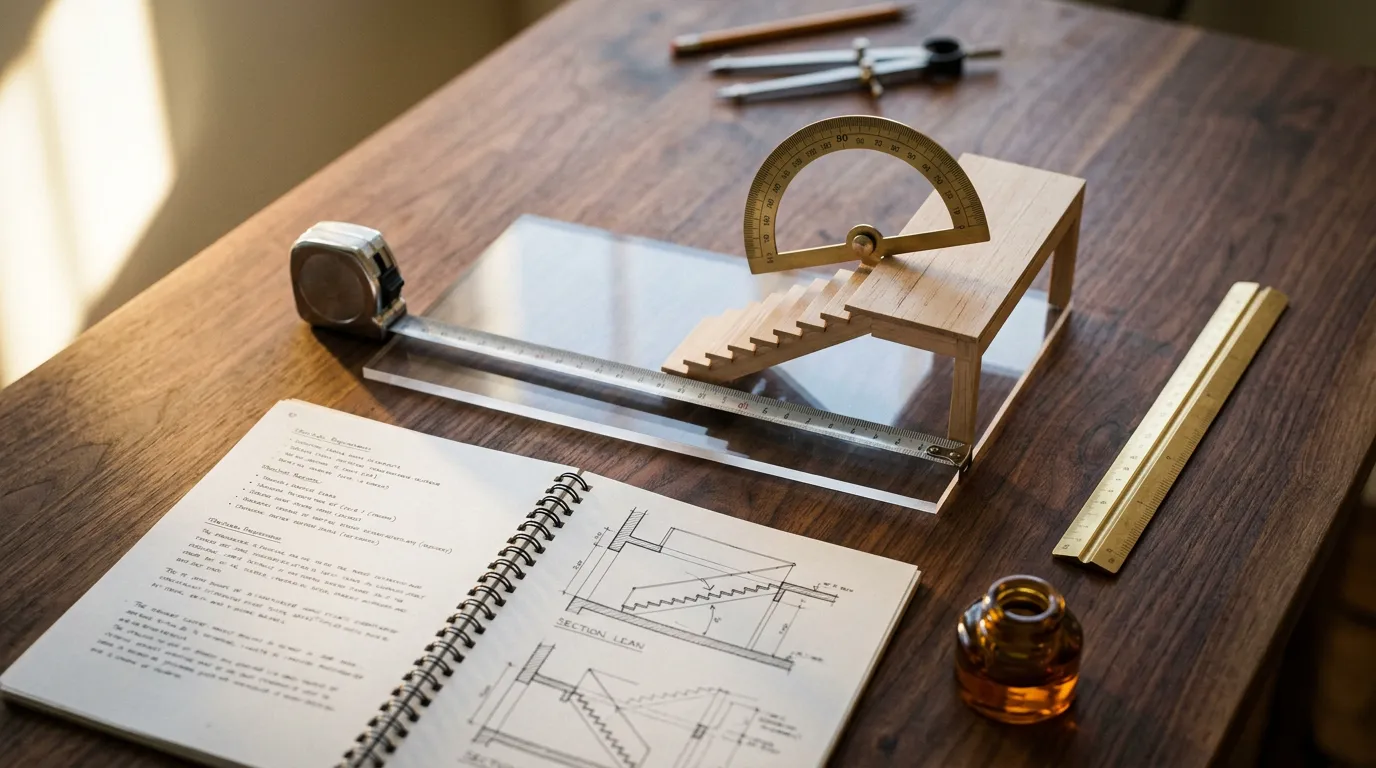
Loft Conversion Headroom and Staircase Rules: UK Building Regs
Approved Document K sets 1.9m stair headroom for loft conversions, 220mm max rise and 42 degree max pitch. No minimum room height or stair width. Part K and Part B explained.
What headroom and staircase dimensions does a loft conversion need?
Approved Document K sets no minimum room height for a loft conversion and no minimum stair width for a dwelling. It requires 2 metres of headroom over the stair, relaxed to 1.9 metres at the centre of the stair width and 1.8 metres at the side in a loft conversion, with a maximum rise of 220mm, a minimum going of 220mm and a maximum pitch of 42 degrees. Where the new storey sits more than 4.5 metres above ground level, Approved Document B requires a protected stairway to a final exit rather than escape windows.
What this means for your project
Loft conversions are where building regulations bite hardest, because you're working within the constraints of an existing roof structure. You can't just move a wall or dig down - the ridge height, roof pitch, and available floor area are fixed. Either your loft has enough headroom, or it doesn't. The figures below are from the Approved Documents, which apply in England. Wales has its own Approved Documents, Scotland works to the Technical Handbooks and Northern Ireland to the Technical Booklets, and the stair and headroom rules differ, so check the right document for where you are building.
Headroom is the first thing to check, even though no regulation sets a minimum room height. Grab a tape measure and get up into your loft. Measure from the top of the ceiling joists (not the top of the existing insulation) to the underside of the ridge. If you're getting 2.4m or more at the ridge, you're probably in good shape once the floor is built up and a ceiling finish added. If you're at 2.2m or less at the ridge, a standard loft conversion will struggle - you might need a dormer to create the height.
The staircase is the second big challenge. It needs to go somewhere, and that somewhere is carved out of your existing first-floor accommodation. A staircase at the 750mm width most builders work to, with the rise and going dimensions Approved Document K does require, takes up more floor space than most people expect. The position of the staircase also determines the layout of the loft room above, so it's worth spending time on this with your designer before committing.
The fire safety requirements are non-negotiable and often underestimated. Adding a third storey to a dwelling changes the fire strategy for the entire house. Every floor needs interlinked smoke alarms. Every room opening onto the stairway needs a fire door, minimum E 20 (FD20) under Approved Document B, although FD30 doorsets are what most suppliers stock. The escape route from the loft down to the final exit must be protected, which normally means upgrading the existing doors on the lower floors too.
The escape window is sometimes forgotten until building control visits. In a bungalow loft conversion, where the new floor sits no more than 4.5 metres above ground level, each habitable room needs a window with at least 0.33m² unobstructed openable area, at least 450mm high and 450mm wide, with the bottom of the opening no more than 1100mm above the floor. Above 4.5 metres, which covers most two storey houses, an escape window is not an accepted escape route and the protected stairway does that job instead.
Approved Document K sets no minimum room height and no minimum stair width for a dwelling. It requires 2m headroom over the stair, relaxed to 1.9m at the centre and 1.8m at the side for loft conversions (para 1.13), and for private stairs a maximum rise of 220mm, a minimum going of 220mm and a maximum pitch of 42 degrees (Table 1.1). Guarding to stairs, landings and the edges of internal floors in a single family dwelling should be at least 900mm high (Diagram 3.1). Where a loft conversion creates a storey more than 4.5m above ground level, Approved Document B requires a protected stairway to a final exit with fire resisting doors (minimum E 20) and partitions (minimum REI 30), plus a Grade D2 Category LD3 alarm system. The 0.33m² escape window applies only where the storey is a maximum of 4.5m above ground level.
Measure your existing loft headroom from joist top to ridge underside. Subtract approximately 200mm for floor build-up and ceiling finish. No regulation sets a minimum room height, but if the result leaves you under about 2.2m at the highest point the room stops being comfortable and the regulated stair headroom of 1.9m at the centre of the stair width gets hard to achieve, so a dormer is usually the answer. Get your staircase position planned early - it determines both first-floor and loft-room layouts.
Common mistakes
Assuming existing headroom is sufficient. The headroom you measure in a raw loft isn't what you'll have in the finished room. Floor build-up (joists, insulation, boarding) adds 150-200mm from the bottom. Ceiling finish and insulation at rafter level takes another 50-100mm from the top. A loft that measures 2.5m from joist to ridge might only deliver 2.2m of finished headroom, which is tight but workable.
Treating alternating tread stairs as a shortcut. Space-saver stairs with alternating treads look like an easy solution to tight staircase spaces, but building control will push back hard. Paragraph 1.29 of Approved Document K allows them, in one or more straight flights, only in a loft conversion, only where there is not enough space for a stair meeting paragraphs 1.2 to 1.24, and only where the stair serves one habitable room and, if you want, a bathroom and a WC, provided that is not the only WC in the dwelling. That bathroom and WC allowance is routinely missed, and it is often the difference between a workable loft layout and a redesign. They're also steeper and harder to use, which matters for daily access and emergency escape. Design for a proper staircase first; only consider alternatives when every other option has been exhausted.
Assuming there is nothing below an alternating tread stair. There is one more rung down. Where even an alternating tread stair will not fit, paragraph 1.32 permits a fixed ladder with fixed handrails on both sides, again only for access in a loft conversion containing one habitable room, and only where there is not enough space, without altering the existing space, for a stair that meets paragraphs 1.2 to 1.24. Paragraph 1.31 is the limit on it: a retractable ladder is not a means of escape. Treat the fixed ladder as the last option rather than a design decision, but know that it exists before you conclude the loft cannot be converted at all.
Forgetting the fire doors and smoke alarms. Fire doors to the protected stairway are not optional. Approved Document B sets the minimum at E 20 (FD20) for doors forming the enclosure to a protected stairway in a single family dwellinghouse, and they are needed to every room opening onto that stairway, not just the loft room. FD30 doorsets are what most suppliers stock, so FD30 is what you will usually see on a quote. Interlinked smoke alarms on every floor are also mandatory, and "interlinked" means they all sound together when any one detector activates. Battery-operated standalone detectors don't meet the standard. If your builder hasn't included these in the quote, the quote is incomplete.
Loft Conversion Headroom & Safety Checklist
A printable checklist covering headroom, staircase dimensions, escape windows, and fire safety requirements.
Was this useful?