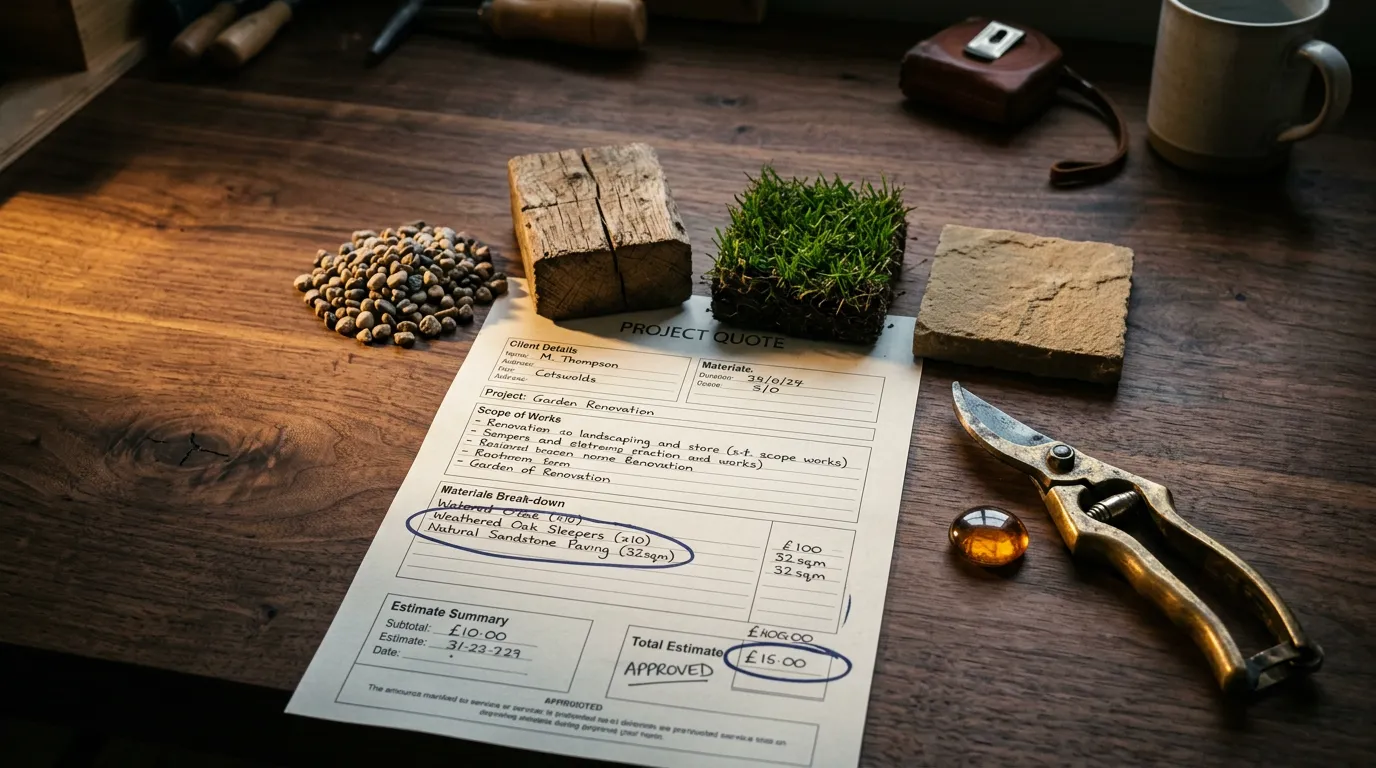
Landscaping Quote - How to Compare Without Getting Stung
Comparing landscaping quotes? Here's what each should include, typical UK costs for 2026, and the hidden extras that catch people out.
You want the garden done. You've got three quotes on the kitchen table. One's £4,800, one's £9,200, and one's £14,500. Same garden. Same brief. How can they be that far apart?
Because landscaping quotes are all over the place. Some include everything down to the topsoil. Others give you a price for laying slabs and leave you to sort out the skip, the drainage, the lighting, and the six tonnes of rubble that need removing first.
Here's how to tell which quote is actually the best value - not just the cheapest number on the page.
What a good landscaping quote looks like
A proper landscaping quote should read like a recipe. Every ingredient listed, every step explained, nothing left to guesswork.
Here's what should be in there:
Site preparation - this is the boring bit that makes everything else work. It should mention clearing the existing garden, removing old paving or turf, and what happens to the waste. If there are tree stumps, old concrete, or rubble to dig out, that needs listing separately.
Ground levels and formation - your garden probably isn't flat. A good quote will mention levelling, or at least state what the finished levels will be relative to your house. Getting this wrong means rainwater running towards your back door instead of away from it.
Sub-base details - this is the compacted gravel layer that sits underneath any paved area. Without it, your patio will sink and crack within two years. The quote should state the material (usually MOT Type 1, which is a specific crushed stone mix) and the depth (typically 100-150mm for a patio, 150-200mm for a driveway area).
Materials list with actual names and sizes - "Indian sandstone patio" isn't enough. You need the stone name, slab sizes, and thickness. "Kandla Grey sandstone, 22mm calibrated, mixed sizes" tells you exactly what you're getting. Same goes for fencing - "6ft closeboard fence" is vague. "1.8m closeboard fence, 75mm treated softwood posts, concrete gravel boards, arris rails" is specific.
Planting list with species - if planting is included, you should see actual plant names, sizes at planting, and quantities. "Selection of shrubs" is meaningless. "3x Lavandula angustifolia (English Lavender), 2L pot, 40cm spacing" is a plan.
Drainage provision - where does the rainwater go? If you're laying a patio, there needs to be a fall (a slight slope) directing water away from the house. The quote should mention this. For larger areas, you might need a soakaway (an underground chamber that lets water drain slowly into the ground) or channel drains.
Fencing specification - height, material, post type (concrete or timber), whether it includes gravel boards (the horizontal board at the bottom that stops the panels rotting), and how many panels.
Lighting - if garden lighting is included, the quote should list the number and type of lights, the cable runs, and whether a qualified electrician is doing the connection. This matters - we'll come back to it.
Waste removal - how many skips, or whether they're using a grab lorry. This isn't a minor line item. Removing old paving, soil, and rubble from an average back garden can cost £500-£1,500.
What it should cost - 2026 UK prices
These are ballpark figures for an average-sized UK garden. Your actual costs depend on access, ground conditions, materials, and where you live.
| Work | Typical cost (2026) |
|---|---|
| Full garden redesign (50-80m²) | £5,000–£15,000 |
| New patio (15-25m²) | £1,500–£5,000 |
| Artificial lawn | £60–£80 per m² |
| Natural turf (supply and lay) | £15–£25 per m² |
| Fencing (per metre run) | £80–£150 |
| Retaining wall (per linear metre) | £150–£300 |
| Garden lighting (full scheme) | £500–£2,000 |
| Decking (softwood, per m²) | £80–£120 |
| Raised beds (sleeper, each) | £200–£500 |
London and the South East tend to run 15-25% higher. Rural areas with difficult access can also push costs up because of the extra time and effort getting materials in.
If you want a quick sanity check on costs before approaching landscapers, our cost estimator gives you a ballpark based on your project details and location.
Red flags that should make you pause
No mention of drainage
Water has to go somewhere. If your quote says nothing about falls (the slight gradient that directs water away from your house), drainage channels, or soakaways, ask why. A beautiful patio that floods every time it rains isn't a good investment.
Vague material specs
"Block paving to drive and patio area" tells you nothing. What type of blocks? What size? What colour? What laying pattern? A decent landscaper will specify the manufacturer and product name so you know exactly what you're paying for.
No ground preparation included
This is where cheap quotes hide the gap. Laying slabs straight onto soil - without a proper sub-base - is a bodge. The quote might look cheap because it skips the most important step. Within a year, you'll have uneven, rocking slabs and weeds pushing through everywhere.
Quoting without a site visit
Any landscaper who gives you a price from photos or a phone call is guessing. They haven't checked the access, the ground conditions, the drainage, the levels, or what's underneath the existing surface. That price will change once they actually see the site.
Suspiciously low price
If one quote is 40% below the others, something's missing. Usually it's the sub-base, the drainage, the waste removal, or all three. The cheapest quote often becomes the most expensive once the "extras" start appearing mid-project. We've written more about this pattern in our guide to spotting overcharging.
What's often missing from landscaping quotes
Even decent quotes leave things out. Sometimes intentionally, sometimes through oversight. Here's what to check for:
Site clearance and access
Getting rid of the existing garden - old slabs, turf, concrete, shrubs - costs money. If the quote just covers the new work, ask who's dealing with the old stuff. Also check access: if materials can only come through the house, that's slower and more expensive than dropping them over a side gate.
Skip hire and waste disposal
Landscaping generates a shocking amount of waste. Old soil, rubble, broken paving, tree roots. A single skip costs £280-£400, and most garden jobs need two or three. If the quote doesn't mention waste removal, you might be expected to sort it yourself.
Topsoil delivery
If you're turfing or planting, you'll probably need fresh topsoil. Your existing soil might be full of clay, rubble, or builder's waste from when the house was built. Topsoil costs £30-£50 per tonne delivered, and a typical garden needs 5-15 tonnes.
Drainage and soakaways
A soakaway is an underground chamber - usually filled with gravel or plastic crates - that collects rainwater and lets it slowly drain into the ground. If you're covering a large area with paving, you almost certainly need one. They cost £500-£1,500 to install and are easy to leave out of a quote.
Lighting electrics
Here's the one that catches people out. Your landscaper can dig the cable trenches and position the lights. But connecting them to the mains? That's electrical work. In England, installing a new outdoor circuit is notifiable under Part P of the Building Regulations. There is no such thing as a Part P qualified electrician, and you are not obliged to use a scheme member. Notifiable work has to be certified by one of three routes: self-certification by an electrician registered with a competent person scheme such as NICEIC or NAPIT, certification by a registered third-party certifier, or notifying your local building control body before the work starts. Using a scheme-registered electrician is simply the easiest of the three. Scotland and Northern Ireland have their own rules. If your quote includes lighting but doesn't say who is making the connection or how it will be certified, ask.
Planning permission for front gardens
This one surprises a lot of people. In England, if you're laying more than 5 square metres of hard surface in the front garden between your house and the road, it stays permitted development only if one of two things is true: the surface is permeable, such as gravel, permeable block paving or porous asphalt, so water drains straight through, or the run-off is directed to a lawn, border or other permeable area inside your own garden where it can soak away naturally. Impermeable block paving or tarmac over 5m² that sheds its water into the road or a drain does need planning permission. Wales, Scotland and Northern Ireland have their own rules.
Your landscaper should know this. If they don't mention it, ask. Getting caught without planning permission means you could be forced to rip it all up. There's more on this in our guide to hidden renovation costs.
How to compare landscaping quotes properly
Comparing landscaping quotes isn't about finding the lowest number. It's about finding the most complete one at a fair price.
Step 1: Line them up side by side
Create a simple table with every item from each quote. You'll quickly see where one includes things the others don't. The cheapest quote often looks very different once you add in the missing items.
Step 2: Check the specs match
"Indian sandstone" could mean a £20/m² slab from a builder's merchant or a £60/m² hand-picked stone. If the quotes don't name the exact product, you're not comparing like for like.
Step 3: Ask about ground prep
If one quote is significantly cheaper, ask specifically about sub-base depth and material. "We'll use what's there" is not the same as "150mm MOT Type 1, fully compacted." The sub-base is the difference between a patio that lasts twenty years and one that cracks after two.
Step 4: Confirm what's excluded
Ask each landscaper to list everything that's NOT included. Waste removal, topsoil, electrical connections, planning applications - if it's not in the quote, it's on you to arrange and pay for.
Step 5: Check credentials
Any landscaper can call themselves a landscaper - it's not a protected title. Look for membership of the British Association of Landscape Industries (BALI) or the Association of Professional Landscapers (APL). Check reviews on Checkatrade or Google. Ask for photos of recent jobs and, if possible, a reference you can actually call.
Before you sign anything
A good landscaping quote should leave you with no questions about what you're getting, what it costs, and what's not included. If you're still unsure, read our guide on what a builder's quote should include - the principles are exactly the same for landscapers.
Want to check whether a landscaping quote stacks up against typical UK costs? Upload it to MyBuildAlly and our AI will flag anything that looks off - missing drainage, vague specs, or prices that don't match the market. Takes less than a minute and it might save you thousands.
Was this useful?