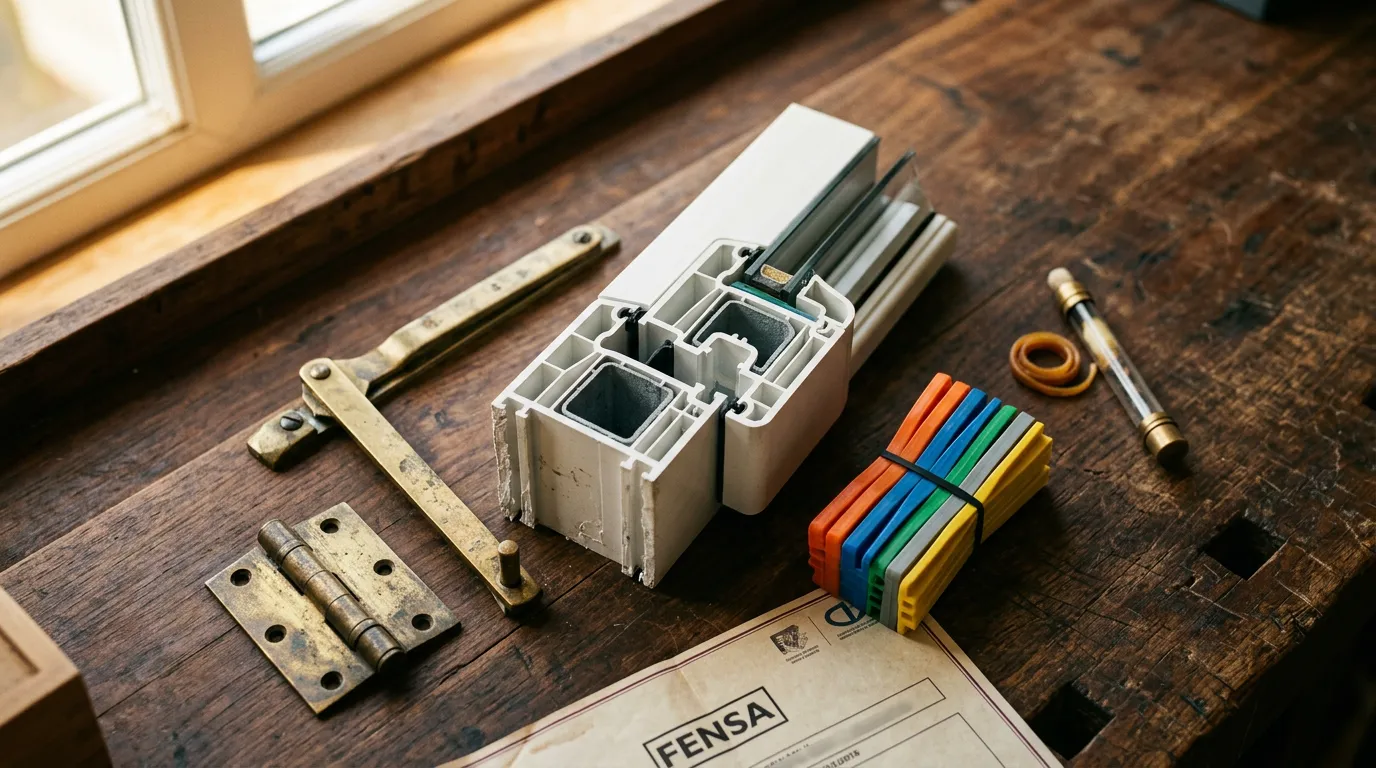
How to Check Window and Door Installation Quality
How to inspect window and door installation yourself. FENSA certificates, trickle vents, U-values, fire doors, and draught seals with building regulations explained.
Windows and doors sit at the boundary between inside and outside. Get them wrong and you get draughts, water ingress, condensation, heat loss, security problems, and - in a loft conversion - a failure of your emergency escape route. They account for around 9% of recorded building defects, but the regulatory landscape around them has changed significantly in recent years, and a lot of installers haven't caught up.
Since 15 June 2022, replacement windows in England have had to provide background ventilation, and the same date brought in the tightened U-values of the 2021 edition of Approved Document L. The 2023 amendments to that document dealt with district heat networks, not U-values. Fire door requirements have been strengthened following Grenfell. This guide covers what you should be checking and what the installer should be providing.
TL;DR Checklist
- FENSA or CERTASS certificate received for all replacement glazing
- Trickle vents present and operational (mandatory since June 2022)
- Escape windows: 0.33m² clear opening, no dimension under 450mm
- Continuous draught seals around all opening lights - no gaps
- U-value of 1.4 W/m²K or better for replacement windows
- All opening mechanisms work smoothly without binding or sticking
- Weather bar fitted to bottom of external doors
- Fire doors: correct rating for the location (FD20 minimum to a protected stairway in a house, FD30S to an integral garage), intumescent strips on all three closing edges, self-closer on the garage door
The Full Guide
FENSA or CERTASS certification
This is the non-negotiable starting point. If you're having replacement windows or external doors installed in England and Wales, the work must comply with Building Regulations, and the way that's typically demonstrated is through a competent person scheme. FENSA and CERTASS are the main ones. The Approved Document figures quoted in this guide are the England editions. Wales publishes its own Approved Documents, Scotland uses the Technical Handbooks and Northern Ireland the Technical Booklets, and the numbers there can differ.
When your installer is registered with FENSA or CERTASS, they self-certify the work and notify your local authority's building control. You receive a compliance certificate, which goes on the building control register. This certificate confirms the installation meets the Building Regulations requirements for thermal performance, ventilation, and safety.
Without this certificate, you have uncertified work. When you come to sell, your conveyancer will flag it, and your buyer's surveyor will raise it as an issue. You'll either need retrospective building control approval (which means an inspector examining work that may now be covered up) or indemnity insurance, which isn't ideal.
Replacement windows and doors are controlled work under the Building Regulations. Installation must be carried out by a person registered with a competent person scheme, or separate building regulations approval must be obtained from the local authority.
Ask your installer for their FENSA or CERTASS registration number before work starts. You can verify this on the FENSA or CERTASS website. After installation, you should receive a certificate within a few weeks - chase it if you don't.
Trickle vents
Since the June 2022 update to Approved Document F, trickle vents are mandatory on all replacement windows. This was a significant change - previously, replacement windows only needed trickle vents if the originals had them. Now, all replacements must have them.
Trickle vents are small openable slots built into the window frame (usually at the top) that provide background ventilation when the window is closed. Where the existing windows already had ventilators, the new ones must be no smaller than the originals (paragraph 3.14). Where the existing windows had none, paragraph 3.15 sets minimum equivalent areas (the measure of how much air they let through) of 8,000mm² for habitable rooms, 8,000mm² for kitchens and 4,000mm² for bathrooms.
Check that the vents are actually there, that they open and close, and that they're the right size. Some installers skip them to save cost or because they don't want to cut the frame. Others install undersized vents that don't meet the minimum requirement. Both result in a non-compliant installation.
Replacement windows should include background ventilators. Where the original windows had them, the new ventilators must be no smaller (paragraph 3.14). Where they did not, the minimum equivalent areas are 8,000mm² for habitable rooms, 8,000mm² for kitchens and 4,000mm² for bathrooms (paragraph 3.15). Alternative routes apply where the dwelling has continuous mechanical extract ventilation or mechanical ventilation with heat recovery. Background ventilation must be provided when windows are in the closed position.
Emergency egress
In rooms where the window is the means of escape in a fire, typically bedrooms on the ground storey and on upper storeys a maximum of 4.5m above ground level, the window must meet specific opening requirements. This is governed by Approved Document B. Above 4.5m the escape strategy changes to a protected stairway.
The clear openable area must be at least 0.33m², with no dimension less than 450mm. "Clear openable area" means the actual gap you could climb through, not the overall window size. The bottom of the openable area should be no more than 1100mm above the finished floor level, low enough that you can get through it in an emergency. Approved Document B sets no minimum sill height for escape windows, only that 1100mm maximum. Where a sill is low and there is a drop outside, separate guarding provisions may apply.
This applies on storeys a maximum of 4.5m above ground level. In a loft conversion that takes a storey above 4.5m, which is the usual case when a two-storey house gains a third storey, Approved Document B paragraph 2.5 requires a protected stairway with fire resisting construction, and an escape window is not an acceptable substitute for it. Check the actual opening, not just the window specification. A window that looks big enough but only opens to a restricted angle might not provide the required 0.33m² clear opening.
Escape windows must provide an unobstructed openable area of at least 0.33m², at least 450mm high and 450mm wide, with the bottom of the openable area not more than 1100mm above the floor. They should also be capable of remaining open without being held. They apply to habitable rooms (excluding kitchens) on the ground storey and on upper storeys a maximum of 4.5m above ground level served by only one stair. Where a storey is more than 4.5m above ground level, paragraph 2.5 requires a protected stairway instead.
Draught seals
Draught seals are the rubber or brush strips that run around the edges of opening windows and doors, forming a seal between the opening light and the frame when closed. They're the primary barrier against air infiltration.
Check that seals are continuous around all four edges of every opening light. Run your finger along the seal - it should be smooth, intact, and spring back when pressed. Look for gaps at corners, compressed sections that don't spring back, and missing strips (particularly at the bottom of casement windows where water collects and degrades the rubber).
On a windy day, hold your hand around the edges of a closed window. You shouldn't feel any draught. If you can feel air movement, either the seals are inadequate or the window isn't closing tightly against them - which usually means the hinges need adjusting.
U-value compliance
The thermal performance of a window is measured by its U-value - the lower the number, the better the insulation. For replacement windows in existing dwellings, Approved Document L requires a whole-window U-value of 1.4 W/m²K or better.
"Whole-window" is important - it's the U-value of the complete unit including the frame, not just the glass. Double-glazed units with a low-emissivity coating and argon gas fill typically achieve 1.2 to 1.4 W/m²K depending on the frame material and profile.
Check the energy rating label on the window - it should be displayed or available from the installer. The U-value should also be recorded on your FENSA certificate. If the installer can't tell you the U-value of the windows they're fitting, that's a significant concern.
Replacement windows must achieve a whole-window U-value of 1.4 W/m²K or better, or a Window Energy Rating of band B or above. New build windows must meet the U-value specified in the SAP calculation, typically around 1.2 W/m²K.
Operation and hardware
Every opening light should operate smoothly. Open and close each window and door, testing all mechanisms - handles, espagnolette locks (the multi-point locking bars), friction stays (the hinges on casement windows), and tilt-and-turn mechanisms.
Things to check: handles should turn without excessive force. Locking points should engage and disengage smoothly. Friction stays should hold the window open at any position without the window dropping or swinging. Tilt-and-turn windows should switch between tilt and turn modes cleanly.
For external doors, check the threshold. A weather bar at the bottom of the door prevents rain driving under the door. The threshold should be level and the door should seal against it without binding. Wheelchair-accessible thresholds (Part M) have a maximum 15mm upstand.
Fire doors
If your project includes fire doors - and it should if you're converting a loft, creating a room above an integral garage, or altering a three-storey house - they need specific features to perform their function.
An FD30 fire door provides 30 minutes of fire resistance. Approved Document B Volume 1 Table C1 item 11 sets FD20 (E 20) as the minimum for doors enclosing a protected stairway in a single family dwellinghouse, although FD30 is commonly specified and is often what building control will expect on a loft conversion. Only the door between the house and an integral garage carries a smoke seal requirement (E 30 Sa, FD30S). Intumescent strips on the closing edges expand in heat to seal the gap between the door and the frame.
Self-closers are not required on fire doors inside a house. Approved Document B Volume 1, Appendix C paragraph C5 exempts fire doorsets within dwellinghouses and flats, so a loft conversion stair door does not need one. The exception is the door between the house and an integral garage, which must have a self-closing device. Where a closer is fitted, test it: open the door to 90 degrees and let go, and it should close completely under its own power and latch shut. A closer that cannot fully close the door, or that has been propped open, defeats the purpose entirely.
Check the gap between the door and the frame on the closing edges. Approved Document B does not set a figure for this; the doorset manufacturer's installation instructions do, and the gap should be even all the way round. Too wide and the intumescent strip may not seal properly in a fire, too tight and the door will bind. Also check that any door furniture (viewers, letterboxes, hinges) is fire-rated. Standard letterboxes and viewers are not fire-rated and will compromise the door's performance.
In a house, Table C1 item 11 sets the minimum door standards: E 20 (FD20) for doors forming the enclosure to a protected stairway in a single family dwellinghouse, E 20 (FD20) for doors in other fire resisting construction, and E 30 Sa (FD30S) between the house and an integral garage. Only the garage door needs a self-closing device, because paragraph C5 exempts fire doorsets within dwellinghouses. Many designers and building control bodies specify FD30 throughout a loft conversion, which exceeds the minimum.
Common Problems
Missing trickle vents on replacement windows. This is now one of the most common compliance failures. The June 2022 requirement caught many installers off guard, and some are still fitting windows without vents. Without them, the installation doesn't comply with Part F and the FENSA certificate shouldn't have been issued.
Garage fire door propped open. Approved Document B Volume 1 paragraph C5 requires a self-closing device on the door between a house and an integral garage, and in a house that is the one door where a closer is mandatory. If the closer is removed or the door is wedged open, the separation is defeated. Paragraph C6 allows the door to be held open by an automatic release mechanism activated by the fire detection and alarm system, by a door closer delay device, or by a fusible link where the opening is not a means of escape.
Condensation between double-glazed units. Misting inside the sealed unit means the seal has failed and moisture has entered the cavity between the panes. This is a manufacturing or handling defect, not an installation issue. The failed unit needs replacing - it can't be repaired.
Draughts around the frame-to-wall junction. The gap between the window frame and the masonry is typically sealed with expanding foam and finished with silicone or mastic. If the foam is incomplete or the external seal has gaps, you'll feel draughts and may get water ingress around the frame. Check both inside and outside.
Questions to Ask Your Builder
- "Are you FENSA or CERTASS registered, and can I have your registration number?" - Verify it online before work starts. If they're not registered, they'll need to arrange building control approval, which adds cost and time.
- "Are you fitting trickle vents to these replacement windows?" - The answer must be yes. If they say "only if the old ones had them," they're working to the pre-June 2022 rules.
- "What's the whole-window U-value of the units you're installing?" - They should know this. If they can't answer, they may not know whether the windows meet Part L.
- "Will the escape window in the loft give me 0.33 square metres of clear opening?" - If it's a loft conversion, this is critical. Ask them to demonstrate the clear opening with the window fully open.
- "Is the fire door FD30 rated, and does it have intumescent strips?" - Check the door edge yourself. The strips should be visible recessed into the door edge on the top and both sides.
Windows & Doors Quality Checklist
A printable checklist to take on site.
Was this useful?