How to Check a Garden Room Quote: What's Included, What's Missing
Garden room quotes are notorious for exclusions. Here's the complete checklist of what should be included and the red flags to watch for.
You've got a garden room quote. Maybe two or three. The prices are wildly different and you're trying to work out why one company wants £14,000 and another wants £28,000 for what looks like the same room. The answer is almost always in the exclusions.
In short: Garden room quotes are notorious for leaving out foundations, electrics, plumbing, groundwork, and internal fit-out. A £15,000 "headline price" can easily become £22,000-£28,000 once you add everything needed to actually use the room. Before you compare quotes, strip each one back to the same line items using the checklist below.
Garden room suppliers are not builders in the traditional sense. Many are manufacturers who supply and install a product. Their quote covers the product. Everything around it - the ground, the power, the plumbing, the path to the door - is treated as "site-specific" and excluded. This isn't dishonest, but it is confusing if you're expecting a builder's quote that covers everything.
The headline price trap
That "garden rooms from £12,000" on the website? Here's what it typically includes:
- The structural frame
- Insulation
- Exterior cladding
- Roof covering
- Windows and doors
- Internal wall lining (maybe)
- Delivery and installation (maybe)
And here's what it typically does not include:
- Foundations or base (£1,500-£5,000)
- Electrical connection from the house (£1,500-£3,500)
- Plumbing, if you want a WC or kitchenette (£2,000-£5,000)
- Site preparation and levelling (£500-£2,000)
- Rainwater drainage (£300-£800)
- Building regulations fees (£300-£800)
- Internal fit-out: flooring, decorating, furniture (£500-£3,000)
- Landscaping reinstatement (£500-£2,000)
Add the exclusions up: that's £6,800-£22,100 on top of the headline price. Suddenly a £12,000 room costs £19,000-£34,000. For the full cost breakdown by size and type, see our garden room cost guide.
Line-by-line checklist
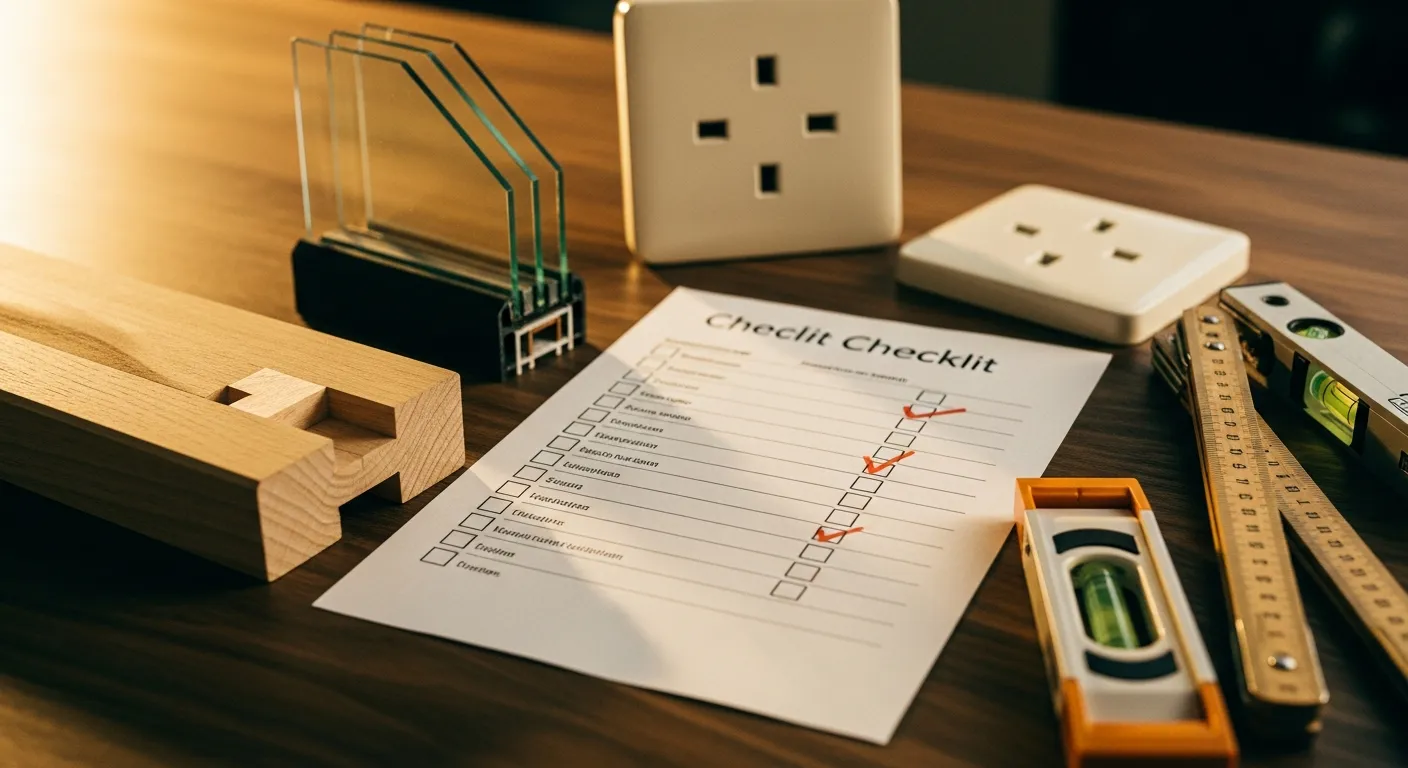
Go through your quote with this list. Tick off what's included. Anything missing is a cost you'll need to budget for separately.
1. Foundations and base
What to check:
- Is the base included in the price, or is it "by others"?
- What type of base? Concrete slab, ground screws, or timber frame?
- What thickness and specification? A proper slab should be at least 100mm concrete on compacted hardcore with a DPM (damp-proof membrane).
- Does it include excavation and levelling?
- What about removing spoil (the soil they dig out)?
If the quote says "base not included" or "client to provide a level base," you need a separate groundworks quote. Budget £80-£150/m² for a concrete slab.
2. Structural frame
What to check:
- What material? Timber frame, SIP panel, steel?
- What are the structural timber sizes? (Bigger means stronger and better insulated.)
- Is there a structural warranty? How long?
- Is the frame treated against rot and insects?
SIP panels (structural insulated panels) are generally the best option for garden rooms. They're factory-made, dimensionally accurate, quick to install, and provide excellent insulation in a slim wall build-up. Timber frame is more flexible for bespoke designs. Log cabin interlocking construction is fine for a summer house but poor for year-round use.
3. Insulation
What to check:
- What type of insulation? PIR board, mineral wool, or foam?
- What thickness in walls, roof, and floor?
- What are the U-values? (Ask for specific numbers, not just "fully insulated.")
- Is there a vapour barrier?
Target U-values for a year-round garden room: walls 0.20 W/m²K or better, roof 0.15–0.18 W/m²K, floor 0.15–0.18 W/m²K. These are not just comfort targets. If the room is large enough to need building regulations approval, Approved Document L Volume 2, Table 4.1 sets limiting values of 0.26 W/m²K for walls, 0.18 W/m²K for a flat roof (0.16 for pitched) and 0.18 W/m²K for floors, so a floor specified at 0.3 W/m²K would fail. If the supplier can't give you U-values, treat that as a red flag. Any room described as "fully insulated" with 25mm of polystyrene is not going to be comfortable in January.
4. Exterior cladding
What to check:
- What material? Western red cedar, larch, composite, render?
- Is it pre-treated or does it need ongoing maintenance?
- What's the expected maintenance schedule? Cedar needs oiling every 1-2 years. Composite needs almost nothing.
- How is it fixed? (Concealed fixings look better and reduce water ingress points.)
Cedar is the classic choice and weathers to a silver-grey if left untreated. It's beautiful but needs maintenance. Composite cladding costs more upfront but is virtually maintenance-free. Thermowood is a good middle ground.
5. Roofing
What to check:
- What type? EPDM rubber, GRP fibreglass, sedum (green roof), standing seam zinc?
- What guarantee? EPDM should come with at least 20 years. GRP: 25 years.
- Is rainwater drainage included? Guttering, downpipes, soakaway?
- What's the roof structure? Minimum fall for drainage?
- Is the roof insulated to the same standard as the walls?
EPDM is the most common choice for flat-roofed garden rooms and is reliable if installed properly. GRP costs more but is more robust. A green (sedum) roof looks fantastic but adds weight and cost (£80-£150/m² on top of the base roof).
6. Windows and doors
What to check:
- Double or triple glazed? What U-value?
- What frame material? Aluminium, timber, or uPVC?
- Are the doors bi-fold, sliding, or French? How wide is the opening?
- What security spec? Multi-point locking? Laminated glass?
- What guarantee? Frames and sealed units separately.
Aluminium frames with double glazing are the standard mid-range option. They look clean, don't warp, and need minimal maintenance. Timber frames are warmer-looking but need painting. uPVC is cheapest but can look out of place on a premium build.
If your garden room will hold expensive equipment (recording studio, home office with multiple screens), think about security. A basic aluminium door with a single lock is not going to deter a determined thief.
7. Internal lining
What to check:
- Is the interior lined? With what?
- Plasterboard and skim? Or just MDF/plywood panels?
- Is it painted or left for you to finish?
- Are there any internal partition walls?
Some suppliers deliver a room with exposed plywood interior and call it "finished." Others plasterboard, skim, and paint to a move-in standard. The difference is £1,000-£2,500 and several weekends of your time.
8. Electrics
What to check:
- Is the electrical installation included? Or just "prepared for electrics" (meaning empty conduit)?
- How many sockets, lighting circuits, and data points?
- Is the consumer unit (fuse box) in the garden room included?
- Is the armoured cable from the house included? What about the trench?
- Is Part P certification included?
This is the most commonly excluded item. In England and Wales, Part P of the building regulations requires that electrical work in a new outbuilding wired from the house is either done by a registered electrician (who can self-certify) or notified to building control. Either way, you need a certificate. Scotland and Northern Ireland run separate systems: in Scotland there is no Part P, and a detached building ancillary to a house needs a building warrant once it exceeds 8m². If the quote doesn't mention certification, the electrics aren't properly covered.
9. Heating
What to check:
- Is heating included? What type?
- Electric panel heaters, underfloor heating, or air conditioning/heat pump?
- What's the estimated running cost?
For a well-insulated 20m² garden room, a 2kW electric panel heater costs roughly £0.53/hour to run at the Ofgem price cap electricity unit rate of about 26p/kWh. An air-source heat pump split unit (like a wall-mounted air conditioner) costs more to buy (£1,500-£3,000 installed) but roughly a third as much to run. If you're using the room 8 hours a day, the heat pump pays for itself within 2-3 years.
10. Flooring
What to check:
- Is flooring included? What type?
- Is the subfloor level and ready for finishing?
- If it's "floor ready," what does that actually mean?
"Floor ready" usually means a flat surface ready for you to lay your own flooring. Some suppliers include engineered wood or laminate. Others leave you with OSB board. Ask specifically.
Red flags in garden room quotes
Watch out for these:
- No company address or registration number. A legitimate business puts their details on their quote. If it's just a mobile number and a Gmail address, proceed with caution.
- "Price subject to site survey." This means the price will change. Get the site survey done before you accept anything.
- No cancellation terms. The Consumer Contracts (Information, Cancellation and Additional Charges) Regulations 2013 give you 14 days to cancel a contract agreed at a distance or away from the supplier's premises, which covers most garden room orders placed online or during a home visit. Regulation 28(1)(b) removes that right for goods made to your specification or clearly personalised, so a supplier building a bespoke room can lawfully exclude cancellation. Get the cancellation terms in writing and ask whether the supplier is treating your room as bespoke.
- Large deposit (more than 25%). A 10-25% deposit on order is normal. 50% upfront before any work starts is not. See our guide on whether a builder should ask for 50% deposit.
- No warranty or guarantee details. You should get a structural warranty (10-25 years) and separate warranties for roof, windows, and electrics.
- Vague exclusions. "External works not included" could mean anything. Pin down exactly what's excluded and get your own prices for those items.
- No mention of building regulations. In England, a detached garden room of 15m² or less with no sleeping accommodation is exempt from building regulations. Between 15m² and 30m² it is still exempt if it is single storey, has no sleeping accommodation, and is either more than 1 metre from any boundary or built substantially of non-combustible material. Anything over 30m², or any room with sleeping accommodation, needs building regulations approval. The electrics are covered by Part P either way. A supplier who doesn't mention this either doesn't know or doesn't care.
For a broader look at quote red flags, see how to read a builder's quote and is my builder's quote too expensive.
Fixed price vs estimate
For the garden room itself, you should expect a fixed price. It's a manufactured product. The supplier knows what materials cost and how long installation takes. There's no reason to give you an estimate.
Groundwork is trickier. Ground conditions vary, and a groundworker won't commit to a fixed price until they've seen the site (or at least understood the soil type). An estimate with a "not to exceed" cap is reasonable here.
Service connections (electrics, plumbing) should be quotable once the electrician or plumber has visited and measured the cable/pipe run. Don't accept "around £2,000-£3,000" - get a written price.
For more on the difference, see our guide on fixed price vs day rate.
Comparing quotes: making them like-for-like
The only way to compare garden room quotes fairly is to normalise them. Create a simple spreadsheet with every line item from the checklist above and fill in each supplier's price (or "not included") for each item.
Once you've done that, add your own costs for everything that's excluded. Now you have a true total for each option.
You'll often find the cheapest headline quote is the most expensive all-in. And the quote that looked dear at first glance might actually be the best value because it includes foundations, electrics, and a finished interior.
If you want a second opinion on your garden room quotes, MyBuildAlly can break down each line item and flag anything that looks off. It takes two minutes and it's free.
Compare your garden room quotes →
Sources
- Checkatrade - Garden Room Costs
- Homebuilding & Renovating - What to Look for in a Garden Room
- Which? - Garden Room Buying Guide
- FMB - Choosing a Builder Checklist
Was this useful?