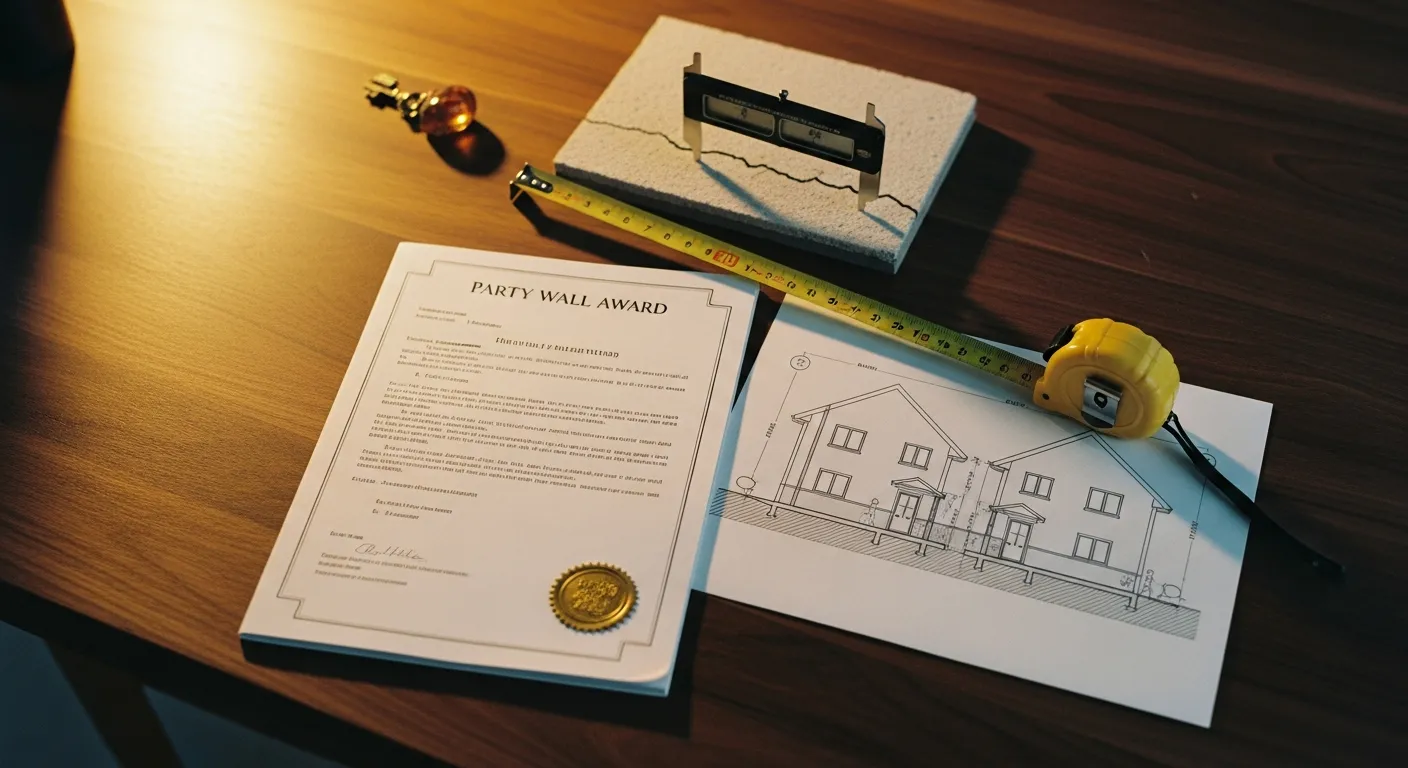
Party Wall Agreement: Costs, Process & Quote Implications
The party wall process is free if your neighbour consents and £700-£2,000+ per neighbour if surveyors are needed, and it takes 2-3 months. When you must serve notice, and how it affects your build.
You've got planning permission, a builder lined up, and a start date. Then your neighbour mentions the Party Wall Act and everything grinds to a halt for two months while surveyors get involved.
In short: If you're building on or near a shared boundary - which includes most extensions on terraced and semi-detached houses - you'll almost certainly need to serve a party wall notice. If your neighbour consents in writing, it's straightforward and free. If they don't, or they don't reply within 14 days, surveyors are needed to make an award, and it will cost £700–£2,000+ per neighbour. Either way, it takes time, and your builder's quote almost certainly doesn't include it.
Free tool: step 1 of 3
Party wall notice generator
Answer three questions to find the right notice under the Party Wall etc. Act 1996, fill in the details, and we produce the notice to serve and the acknowledgement for your neighbour to sign. It covers England and Wales only.
1. Does the work cut into, raise, underpin, repair or rebuild a wall or structure you share with a neighbour?
For example a steel beam bearing on the party wall for a loft conversion, raising the wall for another storey, underpinning it for a basement, removing a chimney breast, or inserting a damp proof course.
This is one of the most commonly overlooked costs in residential building projects. It doesn't appear in the builder's quote, it isn't part of the planning process, and many homeowners don't hear about it until they're about to start work.
What the Party Wall Act actually covers
The Party Wall etc. Act 1996 extends to England and Wales only. There is no equivalent party wall notice and award procedure in Scotland or Northern Ireland. In Scotland, rights over mutual and shared walls sit in the common law, with the Tenements (Scotland) Act 2004 governing support, shelter and maintenance in flatted property. In Northern Ireland the position is also a matter of common law and property title.
The Act covers three types of work:
1. Work directly on a party wall
A party wall is a wall shared between two properties - the wall between two terraced houses, for example. If you're cutting into, removing, or rebuilding any part of a party wall, you must serve notice.
Common examples:
- Inserting a steel beam into a shared wall (for a loft conversion or knock-through)
- Cutting a chase in a party wall for pipes or cables
- Raising or thickening a party wall
- Demolishing and rebuilding a party wall
2. Building on the boundary line
If you're building a new wall or structure on or astride the boundary between your property and your neighbour's, you need to serve notice. This covers:
- Rear extensions built up to or on the boundary
- Garden walls on the boundary line
- Any new structure that sits on the dividing line
A wall built wholly on your own land but up against the boundary still needs a notice under section 1 of the Act. The government's explanatory booklet is explicit on this (paragraph 22). The difference is that your neighbour cannot stop that wall, whereas a wall astride the boundary needs their written consent within 14 days or you must build it wholly on your own land instead.
3. Excavating near a neighbour's building
This is the one people miss. If you're digging foundations:
- Within 3 metres of a neighbouring building and going deeper than its foundations - you must serve notice
- Within 6 metres of a neighbouring building and digging below a 45-degree line drawn downwards from the bottom of their foundations - you must serve notice
Most rear extensions on terraced and semi-detached houses trigger this requirement. The foundations for your extension will almost certainly be within 3 metres of your neighbour's building.
The process: step by step
Step 1: Serve notice
You, as the building owner, must serve written notice on every adjoining owner at least two months before work starts for work on a party wall or party structure, at least one month before for a new wall built on or astride the boundary line, and at least one month before for excavation near their foundations. A surveyor can serve it on your behalf with your written authority, but the duty is yours, not your builder's.
There is no official form, but the booklet (paragraph 8) says the notice must give your name and address (naming every joint owner), the address of the building being worked on, a full description of what you propose to do, and the date you intend to start, which must not be before the notice period has run. It should be dated and say that it is a notice under the Act. Plans and sections showing the location and depth of the excavation must accompany an excavation notice. A notice is only valid for a year, so do not serve it too early. You can write and serve the notice yourself: the generator above produces one modelled on the example letters in the government's explanatory booklet.
Step 2: Wait for a response
Your neighbour has 14 days to respond. They can:
- Consent - they agree to the work in writing. No surveyors needed. Keep the consent with your papers; it does not remove your duties under the Act, such as making good any damage.
- Dissent - they don't agree. You are now in dispute and the surveyor procedure applies.
- Nothing - for a notice about an existing party structure or an excavation, if 14 days pass with no written reply the Act deems a dispute to have arisen (booklet paragraph 10). For a new wall astride the boundary, silence has a different effect: you must build the wall wholly on your own land, at your own expense (paragraph 24).
Even with consent, you cannot start before the full notice period has run unless your neighbour agrees in writing to an earlier date.
Step 3: Appoint surveyors (if there is a dispute)
If your neighbour dissents or does not reply, you are in dispute and the Act requires a party wall award - a legally binding document that sets out what work can be done, how, and when. Only surveyors appointed under the Act can make one, and only once a dispute exists; there is no template you can fill in yourselves. You cannot act as your own surveyor, and the surveyor should not be someone already engaged to supervise the building work.
Two options:
- Agreed surveyor - you and your neighbour agree on a single surveyor to act for both sides. This is cheaper (typically £700–£1,200) and faster.
- Two surveyors - each side appoints their own surveyor. Under section 10(1)(b) of the Act, those two surveyors must then select a third surveyor straight away, before they start settling the award. The two appointed surveyors agree the award between them where they can, and if they cannot, either party or either surveyor can call on the third surveyor to decide. This costs more (£1,500–£2,500+) because you pay for both.
Remember: in practice you will usually pay all reasonable surveyor costs, including your neighbour's surveyor. Section 10(13) of the Act leaves it to the surveyors making the award to determine which party pays those costs, and in the ordinary case they place them on the building owner because the work benefits you. Surveyors can apportion costs differently, for example where an adjoining owner has run up unnecessary fees. Separately, section 11(1) provides that the expenses of the works themselves are defrayed by the building owner.
Step 4: Schedule of condition
Before work starts, the surveyor will usually prepare a schedule of condition - a detailed photographic record of the neighbour's property where it adjoins yours. This documents the existing state of walls, ceilings, and floors so that if your building work causes any damage, there's a clear record of what was there before.
A schedule of condition is not always required, but it's almost always advisable. Without one, any crack or mark on your neighbour's wall becomes a potential dispute. With one, you have evidence of whether it was pre-existing.
Step 5: The party wall award
The surveyor(s) produce the award - a document that covers:
- A description of the work
- When it can be done (working hours, start dates)
- How the party wall and adjoining property must be protected
- What happens if damage occurs
- Access rights for the builder
- Insurance requirements
The award is legally binding on both parties. It is final unless a county court rescinds or modifies it on appeal, and each owner has 14 days from being served with the award to lodge that appeal (booklet paragraph 17). If either side breaches it, the other can seek an injunction or damages through the county court.
Step 6: Proceed with work
Once the award is in place (or consent has been given), you can start building. The process from serving notice to receiving an award typically takes 6–10 weeks, though it can be longer if the neighbour is difficult or the surveyors are busy.
Costs in detail
| Scenario | Typical cost |
|---|---|
| Neighbour consents (you serve notice yourself) | Free |
| Agreed single surveyor | £700–£1,200 |
| Two surveyors (straightforward case) | £1,500–£2,000 |
| Two surveyors with detailed schedule of condition | £2,000–£3,000 |
| Complex case (multiple neighbours or disputed work) | £3,000+ |
If you have neighbours on both sides (terraced house), multiply by two. A terraced homeowner with two dissenting neighbours could face £3,000–£6,000 in surveyor fees before a single brick is laid.
These costs are almost never included in a builder's quote. They're your responsibility as the building owner, not the builder's. But a good builder should warn you about them. If your quote doesn't mention party wall considerations and you live in a terraced or semi-detached house, ask the builder directly. Our guide on hidden costs in home renovations covers other commonly missed expenses.
How it affects your build timeline
The party wall process cannot happen in parallel with construction. You must serve notice and either receive consent or an award before work starts. If you start building without following the correct procedure, your neighbour can seek an injunction to stop the work.
Plan your timeline like this:
- Week 0 - serve party wall notice
- Week 2 - neighbour's 14-day response period ends
- Weeks 3–8 - surveyor appointment, schedule of condition, award preparation (if dissent)
- Week 8–10 - award issued, building work can commence
This means you should serve your party wall notice 2–3 months before your planned start date. If your builder is ready to start in January, serve notice in October or November. Don't leave it until December and then wonder why the build is delayed.
Common problems
Neighbour won't respond
If your neighbour doesn't respond in writing within 14 days to a notice about a party structure or an excavation, a dispute is deemed to have arisen. You can then appoint a surveyor on their behalf so the procedure goes ahead without their co-operation (booklet paragraph 19), but the timing is not the same in both cases. Section 10(4) lets you appoint straight away where they refuse to appoint a surveyor. Where they merely neglect to, you must first serve a request on them and then wait ten days, beginning with the day you serve it, before you may appoint on their behalf. They can't block your work by ignoring you, but appointing a day too early hands them something to argue about.
Neighbour tries to block the work
A neighbour cannot use the Party Wall Act to prevent work that's otherwise lawful. The award sets conditions on how the work is done, not whether it happens. If you have planning permission and building regulations approval, the party wall process regulates the method, not the principle.
That said, an uncooperative neighbour can slow things down. They might appoint their own surveyor (at your expense), dispute the schedule of condition, or refuse access for inspections. Patience and professionalism from your surveyor are key.
Builder starts work without a party wall notice
This is a risk. Some builders, keen to get started, will tell you the party wall notice "isn't really necessary" or that you can "sort it out as you go." Wrong. If you build without following the Act and your neighbour's property is damaged, you have no legal protection. Your neighbour can also seek an injunction to stop work mid-build, which is far more expensive and disruptive than doing it properly in the first place.
Damage to neighbour's property
If your building work causes damage - cracking, subsidence, vibration damage - the party wall award covers what happens next. Typically, the building owner (you) is responsible for making good any damage caused by the works. The schedule of condition is crucial here, because it proves what damage is new and what was pre-existing.
Party wall vs planning permission
These are separate processes. Planning permission (from the council) gives you permission to build. The party wall process (your notice, then your neighbour's written consent or a surveyors' award) governs how the work affects adjoining properties.
You can apply for planning permission and serve party wall notices at the same time. In fact, you should - running them in parallel avoids adding the party wall timeline on top of the planning timeline.
Permitted development (where you don't need planning permission) does not exempt you from the Party Wall Act. Even if your extension falls within permitted development rights, you still need to serve notice if the work affects a party wall or involves excavation near a neighbour's foundations. See our guide on planning permission for more on when you need planning approval.
What your builder should tell you
A good builder will:
- Flag party wall requirements early, ideally at the quotation stage
- Advise you to serve notice well before the planned start date
- Factor the party wall timeline into their programme
- Recommend a party wall surveyor if you need one
A builder who doesn't mention party wall obligations - especially for an extension on a terraced or semi-detached house - either doesn't know about them (concerning) or is hoping you'll sort it out yourself without delaying their start date (also concerning).
When comparing quotes, check whether party wall costs and timelines have been considered. It won't be in the quote price, but it should be mentioned in the assumptions or preliminary notes. If it's missing entirely, add £1,000–£2,000 per neighbour to your budget and 2–3 months to your timeline.
Got a quote? Check what's missing
Party wall costs are just one of several items that commonly fall outside a builder's quote. Upload your quote to MyBuildAlly and we'll flag what's included, what's missing, and where you might face unexpected costs.
Sources
- Party Wall etc. Act 1996 - the full legislation
- The Party Wall etc. Act 1996: explanatory booklet - the government's plain-English guide, with example notice letters (Open Government Licence v3.0)
- GOV.UK: Party wall guidance - government guidance
- RICS: Party walls guidance - professional standards for party wall surveyors
- Faculty of Party Wall Surveyors - find a qualified party wall surveyor
Was this useful?